My Travel and History Blog, Focussing mostly on Roman and Mediaeval Times
Life's been a bit busy this week, so here's another short post with some photos. This time you'll get some of the odd rocks one can find in the Harz, particularly the southern Harz karst landscape.

Once upon a time ... well, 250 million years ago, what is now Germany hung out around the equator, and it was a sea, the Zechstein Sea, which covered most of central Europe-to-be. Like most seas, it had tiny critters with shells swimming around, as well as coral reefs. Since the climate at the equator is hot, the water evaporated, leaving behind layers of shells, corals and other organic material which over time baked together. Then the sea would flood back in. This happened several times over until the continental drift moved the land further north. Read more »
Well, I don't think my British readers fancy any more cold water than they already got, but we have some very hot days in Germany, and the heat wave in the US seems to be still strong. Since the litte trip I did last Saturday included a waterfall (besides a cave and limestone rock formations), I'll share some photos with you.

The Lonau Fall is the only natural waterfall in the western Harz and a nice view even in summer. I've seen when the snow in the Harz mountains had just melted, and during such periods it is truly impressive. But the summer pics are interesting, too. Read more »
Some traces of the fortress built by King Håkon Magnusson and his great-grandson Håkon VI can still be seen, though much has either been changed or hides behind Renaissance and 19th century additions.
Akershus Fortress faced several more sieges in the years to come, but I'll spare you the details and more names with odd letters. The Mediaeval castle was never captured.

Right to left: Monk's Tower, Virgin's Tower (with the red roof), Renaissance palace (South Wing),
central Romerike Wing with top of Romerike Tower, Mediaeval northern wing.
The most outstanding building dating to the time of King Håkon is the so called North Wing that once housed the great banqueting hall and the king's private quarters. You can distingush it by the crow stepped gable that reminds of the layout of the Håkon's Hall in Bergen. One of the towers, the Jomfrutårnet (Virgin's Tower) also remains unaltered. The lower storeys of the Romeriksfløyen (Romerike Wing; called after an area not far from Oslo) and the Romerikstårnet (Romerike Tower) are Medieaval as well. Read more »
And other dynastic messes lol. When researching all that fun about Alv Erlingsson, King Eirik of Norway, and those Ingeborgs, I realised that Eirik was married to Scottish ladies twice, which is unusual, considering the often strained relationship between Scotland and Norway. So I took a closer look into the dynastic tangles and those marriages (dates are lifetimes).

Among others, I hunted for a connection between King Eirik II Magnusson of Norway (House Hairfair) and King Edward I of England (House Plantagenet). Ok, let's go back a bit. Edward I (1239-1307, son of Henry III ∞ Eleanor of Provence) was married in first marriage to Eleanor of Castile (1241-1290; House Burgundy), daughter of King Fernando II of Castile and Leon, and Jeanne of Ponthieu. But Fernando had been married before to Beatrice of Swabia (also called Elisabeth of Hohenstaufen, † 1235), and with her he not only had Alfonso X of Castile, his successor as king, but several more sons, among them a Felipe (1231-1274). This Felipe was married to Christina of Norway (1234-1262), sister of Magnus Lawmender King of Norway (∞ Ingeborg of Denmark), who in turn was the father of Eirik II (1268-1299) and Håkon V (1270-1319). Read more »
I've mentioned that King Håkon V Magnusson who built Vardøhus Fortress, also built Akershus in the south and made Oslo the capital of his realm (until that time it had been Nidaros, modern Trondheim). While Vardøhus retains the charme of a border fort with its timber houses and grass roofs, Akershus has developed into a large fortress with mostly stone buildings, due to its strategical importance.
Akershus Festning is situated on a little salient in the Oslofjord. Today, the town envelops the shores on both sides and the hinterland, but in the 13th century, it was a place that could be easily defended. Akershus was built of stone and bricks from the beginning, not of timber like Vardøhus, but much of the original buildings are either gone or have been changed during time (the north wing is the oldest part of the palace). Some parts of the inner defenses still date back to the late 13th / early 14th century, like the Jomfrutårnet (Virgin's Tower) and the partly reconstrcuted Knutstårnet (Knut's Tower).
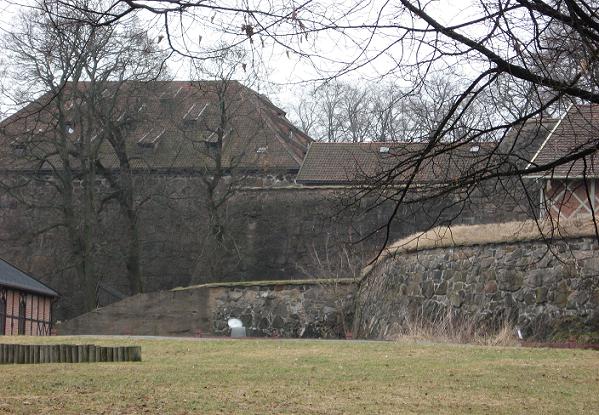
Akershus is one of the most important fortresses in Norway. It started out as fortified king's seat in ~1300, was turned into a Renaissance palace with bastions in the early 17th century, used as prison in the 19th century, and today houses the Ministry of Defence and two museums; some of the rooms in the palace are used for representation. Akershus has seen several sieges but was never taken. Read more »