My Travel and History Blog, Focussing mostly on Roman and Mediaeval Times

We don't even know who built the castle - the most likely candidates are Heinrich the Lion of Saxony, or Count Rainald of Dassel. The Dassel family held the lands of what today is called the Solling which bordered to lands held by the Welfen, so the confusion may be understandable. Possessions in such border regions often changed and the castle is mentioned in chartes only at a later time. Rainald von Dassel, Archbishop of Cologne, was the Imperial Chancellor (Reichskanzler) of Friedrich Barbarossa, one of the emperor's most trusted men until his death in the malaria epidemic during the unfortunate Italian campaign in 1167. His brother Ludolf fell in a battle in the same war. Duke Heinrich of Saxony had refused to participate in that campagin; as a result his relationship with the emperor soured which ultimately led to his downfall and exile.
The monastery in Göllingen in Thuringia is only a ruin, but what has survived the time proves to be an intriguing piece of Medieaval masonry as the octagonal tower on a square base shows. The crypt is very interesting, too.
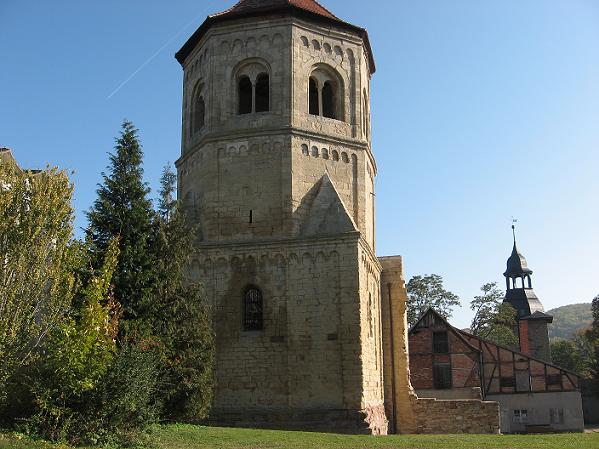
The village of Göllingen first appears in a charte of 765; there seems to have been a Carolingian crown domain at the time. The situation at the crossing of a river and the salt road from Frankenhausen likely influenced the establishment of a settlement. Read more »
The Imperial Baths (Kaiserthermen) is another of those projects that was begun when Trier became Imperial residence. Big fancy public baths had been prestige projects for quite some time, and the second - and also impressive - leisure centre, the Barbara Baths, was about 150 years old already. Still in good shape, mind you, but well, towns always tend to build newer and bigger public and governmental buildings than they really need; that hasn't changed during history.

So Maximinianus started the project. With a size of 250 x 145 metres, the baths covered the site of 4 insulae and were intended to become one of the largest leisure centres in the empire. The insulae were taken down, no matter that at least one of the buildings wasn't some run of the mill apartment block but a posh villa (with a bath of its own). No idea how the emperor convinced the owner to part with the land. Read more »
Salvete amici. Yes, it's me again, your friend Aelius Rufus. Gabriele told me to ignore the fact that I wasn't alive when the Aula Palatina, also known as Basilica of Constantine in Trier was built. You got this friend in Britannia, she said, you'll figure out something.
The Aula Palatina has survived because several important people over time thought it was of better use intact than as quarry (like so many other Roman buildings). It's today one of the largest rooms that has survived from my time. Though the roof had fallen in in the 5th century and it took some time to get a new roof up - those barbarian Franks or Merovingians or whatever they called themselves at the time probably had no idea how to construct a roof
that large.

And especially for Constance who likes to have numbers, here's the measures of the hall. The length is 71.5 metres (including the apsis), the breadth 32.6 metres. The original height can only be estimated since the original roof got lost; it's supposed to have been about 33 metres with the gable top at 40 m. The walls are 2.70 metres thick. Yeah, we built walls there. ;) Read more »
This is the first part of a series of posts about the Hanseatic League. It offers an introduction to the Hanseatic League, in German known as die Hanse (Hansa) and the first trade coperation that precedes the Hanseatic League, the Gotland Corperation.

The first and most important towns that would become the nucleus of the Hanseatic League are all coastal trade towns situated close to the Baltic Sea: Lübeck a few miles inland where the Wakenitz confluences into the Trave river, Wismar at a bay, and Stralsund dircetly at the coast opposite the island of Rügen. In former times, the towns were additionally protected by a system of channels - these can still be seen in Lübeck and Stralsund - and walls. The combination of sea harbours and landward protections was one of the features that made these towns some of the most wealthy and powerful places during the Middle Ages. Read more »
This charming litte wood carving is a detail from the choir stalls in Roskilde Cathedral in Danmark. They date to 1420 and show scenes from the Creation to the Last Judgement. This particular one is the scene of Cain slaying Abel, his interview with God ('And the Lord said unto Cain, Where is Abel thy brother? And he said, I know not: Am I my brother's keeper?') and God cursing Cain.
The weapon Cain uses is so very Scandinavian. *grin*

Yes, it's a stockfish. You gotta love how Cain not only kills his brother with a dried cod, but also drags the thing with him when he sulks off. Read more »
A cloud and snow post to go with the weather; the first rain after five weeks here, and the first autumn gales. There may even be snow later this week.

Traveling along the coast of Norway in early spring can give you some of the most beautiful light effects when the sun fights with the clouds, sometimes losing to a blue-grey twilight. Read more »
I've mentioned in my prior post that Apitz, son of the landgrave Albrecht II, got the Brandenburg as fief and obviously lived there at times between 1288 - 1305. So, who was this Apitz?
We need to go back a bit. After the Ludowing landgraves of Thuringia died out in the male line, there was a whole bunch of contenders for the heritage, leading to the Thuringian War of Succession. In the end, Heinrich III 'the Illustrious' of House Wettin (1215-1288) managed to pick the largest piece of the cake with a pretty collection of land and titles: Margrave of Meissen, Margrave of the Lausitz (Lusatia), Landgrave of Thuringia, and Count Palatine of Saxony. It also helped that Heinrich backed up Emperor Friedrich II in his struggle with the pope (yeah, that has a long traditon, no German emperor ever got along with the popes since Heinrich IV's excommunication in 1076). So Heinrich got Thuringia as fief in 1242, and he also betrothed his son Albrecht with Friedrich's daughter Margaretha - an offspring from Friedrich's third marriage to Isabella of England, a daughter of King John. They married in 1255 and had three sons.

Heinrich the Illustrious was an educated man with many interests, a poet and troubadour (Minnesänger in German) of some renown, and he didn't want to spend all his time in that dusty old office governing lands that stretched from the Werra to the Oder and from the Erzgebirge (Ore Mountains) to the Harz mountains. So he gave his sons Dietrich and Albrecht a share in the responsibility early on. Read more »
I've covered the castle ruins in the surroundings of my hometown Göttingen in several posts (and I'm busy digging up more information because I sure have more photos, lol) but there are other remains of castles as well, those that were not abandoned but inhabited constantly over time. These castles often have been changed beyond recognition, but in some cases Medieaval buildings have survived, like the keep of Adelebsen Castle and the great hall of Castle Hardeg.

The first trace of the castle can be found in a charte by a Ludwig Lord of Rosdorf who is mentioned as dominus Castri Herdegessen (1266). Though the first castle on the rocky plateau may well date back to the year 1000, and settlement of the area goes back to the Neolithicum (finds of stone axes dating to 4500 BC and a bronze axe from 1500 BC) Later, members of the Germanic tribe of the Cherusci lived there during the Augustean time. Read more »
And that's why I prefer to photograph castles and landscape. The photo below is the only decent shot I got during the eagle safari on my Hurtigruten tour; all the others were blurred and out of focus.

The seagulls who also accompanied the ship thanks to some fishy baits, were an easier target. For one, they came closer, and while they are fast and elegant birds, they still don't match those eagles in speed. Read more »
A visit to the falcon park near Bad Sachsa in the Harz marked one of the highlights of this weekend's tour. It was the last time before daylight saving changes back and darkness will start too early for longer tours. And it may have been the last day of sunshine and pretty colours before the next storms blow the leaves away.
The falcon park in the Harz (Harzfalkenhof) is a private endeavour founded in 1964. Its aim are the breeding, protection and research of birds of prey.

Olga is an Eurasian eagle owl from Siberia, and she knows that she's big, fluffy, and really cute, though like a true star, she needs some coaxing until she strikes a model pose. Read more »
St. Peter played nice this year and gave me another perfect, cold and sunny Sunday - and right at my birthday, too. So my father and I took another trip to places in Thuringia (more interesting sites can be found here) and looked for interesting things to see. The day ended with a nice dinner, but I didn't take photos of that. :)
The St.Wigbert Monastery in Göllingen was fisrt mentioned in a charte dating to 1005 as daughter house of the Abbey Hersfeld, which makes it one of the oldest monasteries in Thuringia. Not much remains of the place, unfortunately, only the westwork and the crypt. The crypt dates all the way back to about 1005 while the rest of the westwork is from the 12th century. Read more »
It's no longer warm, but the first autumn storms have given way to some sunny days, and so we packed warm jackets and went hiking again. First we found a deceivingly peaceful looking lake.

Well, it is a peaceful place today, but this was not so some 2500 to 2000 years ago. A depression in the shellbearing limestone became a lake with swampy shores, later silted up and turned into a peat bog. Peat digging as late as the 1940ies led to the development of a new lake so that the place now looks pretty much like 2000 years ago. Read more »
I've been making the best of the current Indian Summer while it lasts and used the little spare time to visit some more interesting places. One of the castles I visited together with my father gave me an abundance of photos but not so much information about its history. Brandenburg Castle in Thuringia must have been a large and well fortified place once - its remains are still impressive - but it never played a significant role in history.

inner curtain wall of the East Castle with the Hexagon Tower in the background
The castle is situated on a mountain at the foothills of the Thuringian Forest, guarding a ford across the Werra river and the road from Hersfeld to Eisenach, one of the important roads in the Middle Ages. The Brandenburg is a double castle which means it consists of two separate castles, one - the Westburg - sitting on a promontory, and the other - the Ostburg (East Castle) - on the peak itself; both are separated by a natural trench and have their own sets of curtain walls, towers and gates. Another gate with fortifications may have been at the foot of the hill, there are some worked stones lying around, and traces of an artificial trench. The other side of the hill facing the Werra river is steeper and didn't require additional fortifications. Read more »
Salvete amici, here's Aelius Rufus again. Gabriele asked me to take over today's post. That she had to drag me out of the baths in Augusta Treverorum is just a rumour, though. She caught me on my way to the baths.
Gabriele said she thought her readers were starting to miss posts about the glorious Roman civilization after all that stuff about odd rock formations, and castelli in what some of our geographers refer to as Thule. I'm really glad Tony ... oops, the noble Emperor Titus Aurelius Fulvus Boionius Arrius Antoninus Pius, never got the idea to conquer that dismal country. Darkness for three months and snow for six is not my idea of fun, and I'm used to some snow from my home in the Alpes. The Romans would mutiny if they got deployed to that Vardøhus place - they didn't even have decent baths there. Definitely worse than the Hadrian's Wall.
So, today we're going to visit the amphitheatre in Augusta Treverorum.

I mentioned in my post about the Roman Bridge that the Colonia Augusta Treverorum was founded in 17 BC by the Emperor Augustus and soon developed to a rich and prospering town. Most inhabitants were members of the tribe of the Treveri and other Gauls who imitated the Roman lifestyle gladly. Can't blame them; indoor plumbing beats going to the well every morning, especially in winter. And underfloor heating is nice, too. It didn't take long for the first mosaics and frescoes to appear, either. Those wine, pottery, and cloth merchants made a helluva money. Read more »
Life is still busy, and blogging is one of the things that got a bit of a short shift those last weeks. Meanwhile, have some pretty ammonites.

(Collection of the Department of Geology, University Göttingen)
Ammonites are an extinct subclass of marine invertebrate animals, the molluscs (cephalopoda). Ammonites were around from the Early Devonian about 400 million years ago to the Late Cretaceous when they died out together with the dinosaurs 65 million years ago. Over that time, they developed some 40,000 species from tiny 1 cm cuties to 30 cm exemplars. But there were also some really big ones that could grow to two metres. Read more »
We had a family gathering near Mannheim this weekend, in a very nice hotel with several gardens. A lot of the plants growing there are not European but Asian and American, like this combination of bamboo and a Monkey Puzzle Tree from Chile.

Its official name is Araucaria araucana, a tree that is indigenous to Chile, Argentina and south Brazil. Araucania is a member of the conifer family and can grow to 40 metres tall. The first trees were cultivated in Britain in 1850, and that's where the nickname came up, 'it would puzzle a monkey to climb that'. Since Araucaria is a very old species, it is considered a living fossil. The trees had been around when dinosaurs still walked the earth. Read more »
Life's been a bit busy this week, so here's another short post with some photos. This time you'll get some of the odd rocks one can find in the Harz, particularly the southern Harz karst landscape.

Once upon a time ... well, 250 million years ago, what is now Germany hung out around the equator, and it was a sea, the Zechstein Sea, which covered most of central Europe-to-be. Like most seas, it had tiny critters with shells swimming around, as well as coral reefs. Since the climate at the equator is hot, the water evaporated, leaving behind layers of shells, corals and other organic material which over time baked together. Then the sea would flood back in. This happened several times over until the continental drift moved the land further north. Read more »
Well, I don't think my British readers fancy any more cold water than they already got, but we have some very hot days in Germany, and the heat wave in the US seems to be still strong. Since the litte trip I did last Saturday included a waterfall (besides a cave and limestone rock formations), I'll share some photos with you.

The Lonau Fall is the only natural waterfall in the western Harz and a nice view even in summer. I've seen when the snow in the Harz mountains had just melted, and during such periods it is truly impressive. But the summer pics are interesting, too. Read more »
Some traces of the fortress built by King Håkon Magnusson and his great-grandson Håkon VI can still be seen, though much has either been changed or hides behind Renaissance and 19th century additions.
Akershus Fortress faced several more sieges in the years to come, but I'll spare you the details and more names with odd letters. The Mediaeval castle was never captured.

Right to left: Monk's Tower, Virgin's Tower (with the red roof), Renaissance palace (South Wing),
central Romerike Wing with top of Romerike Tower, Mediaeval northern wing.
The most outstanding building dating to the time of King Håkon is the so called North Wing that once housed the great banqueting hall and the king's private quarters. You can distingush it by the crow stepped gable that reminds of the layout of the Håkon's Hall in Bergen. One of the towers, the Jomfrutårnet (Virgin's Tower) also remains unaltered. The lower storeys of the Romeriksfløyen (Romerike Wing; called after an area not far from Oslo) and the Romerikstårnet (Romerike Tower) are Medieaval as well. Read more »
And other dynastic messes lol. When researching all that fun about Alv Erlingsson, King Eirik of Norway, and those Ingeborgs, I realised that Eirik was married to Scottish ladies twice, which is unusual, considering the often strained relationship between Scotland and Norway. So I took a closer look into the dynastic tangles and those marriages (dates are lifetimes).

Among others, I hunted for a connection between King Eirik II Magnusson of Norway (House Hairfair) and King Edward I of England (House Plantagenet). Ok, let's go back a bit. Edward I (1239-1307, son of Henry III ∞ Eleanor of Provence) was married in first marriage to Eleanor of Castile (1241-1290; House Burgundy), daughter of King Fernando II of Castile and Leon, and Jeanne of Ponthieu. But Fernando had been married before to Beatrice of Swabia (also called Elisabeth of Hohenstaufen, † 1235), and with her he not only had Alfonso X of Castile, his successor as king, but several more sons, among them a Felipe (1231-1274). This Felipe was married to Christina of Norway (1234-1262), sister of Magnus Lawmender King of Norway (∞ Ingeborg of Denmark), who in turn was the father of Eirik II (1268-1299) and Håkon V (1270-1319). Read more »
I've mentioned that King Håkon V Magnusson who built Vardøhus Fortress, also built Akershus in the south and made Oslo the capital of his realm (until that time it had been Nidaros, modern Trondheim). While Vardøhus retains the charme of a border fort with its timber houses and grass roofs, Akershus has developed into a large fortress with mostly stone buildings, due to its strategical importance.
Akershus Festning is situated on a little salient in the Oslofjord. Today, the town envelops the shores on both sides and the hinterland, but in the 13th century, it was a place that could be easily defended. Akershus was built of stone and bricks from the beginning, not of timber like Vardøhus, but much of the original buildings are either gone or have been changed during time (the north wing is the oldest part of the palace). Some parts of the inner defenses still date back to the late 13th / early 14th century, like the Jomfrutårnet (Virgin's Tower) and the partly reconstrcuted Knutstårnet (Knut's Tower).
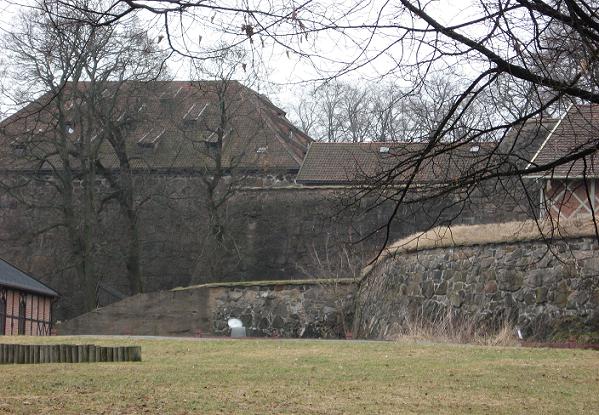
Akershus is one of the most important fortresses in Norway. It started out as fortified king's seat in ~1300, was turned into a Renaissance palace with bastions in the early 17th century, used as prison in the 19th century, and today houses the Ministry of Defence and two museums; some of the rooms in the palace are used for representation. Akershus has seen several sieges but was never taken. Read more »
I've heard there is a heat wave in parts of the US, so I'll stay in the north and post something cold. My readers in the rainy UK may think that it could be worse - at least it's not snowing, lol.
So let's go on a little tour through the world's northernmost fortress (situated at 70°22'N) in the long twilight of an Arctic spring evening. I loved those hours; you don't get colours and shades like this here.

The town Vardø is the easternmost town in Norway, located at 31°5'E, which is east of Saint Petersburg, Kiev and Istanbul. That puts Vardø (and Kirkenes) in a different timezone from Oslo, but Norway keeps one time throughout. Thus the easternmost towns are 1.20 hours ahead and at odds with daylight hours (though with the polar night and the midnight sun, that's only an issue for a few months in spring and autumn). The night before there had been dawn already at 2.30 am which did feel a bit odd, but the daylight was out of sync with Germany already in Bergen - the sun sets later in the north past equinox; I remembered that from the time I lived in Stockholm. Read more »
Here we go on our second expedition with the Fram (actually, it's the third voyage the ship made, but the more interesting one: Roald Amundsen's little trip to the South Pole. :)
The interior of the ship is very dark and cramped. They did put in some lamps but you still get a feel how it must have been like when the Fram drifted through the Polar night. The cabins were small: a bunk bed that doubled as seat, with storage room underneath, a nightstand with drawers that also served as work table, a few hooks and a bookshelf in some cabins. My cabin on the Hurtigruten tour was quite a bit larger. :)

(The grammophone and piano were the few traces of luxury.)
Roald Amundsen (born 1872) came form a family of shipowners and captains; he soon abandoned his studies of medicine in order to become an explorer. His first independent tour led him through the Northwest Passage (1903 - 1906) on a rather small yacht called Gjøa. He traveled via Baffin Bay and stayed in Gjøa Haven (Nunavut, Canada) for two winters; until he eventually managed to clear a way to Beaufort Sea and from there into the Bering Strait, thus completing the navigation of the Northwest Passage. Read more »
Let's visit the bearded seals in the Polaria in Tromsø, a mix of aquarium, museum, and research centre. Polaria was established in 1997, in order to get people acquainted with the Arctic flora and fauna, and environmental problems. It is part of the Polar Environment Centre, an institution which includes a number of research bodies, among them the Norwegian Polar Institute.

Seals are cute, and that's reason enough to post some photos. Unfortunately, they were the only ones I could catch with my camera. There's a big aquarium with a walkthrough tunnel and all, but it's impossible to get pics through the glass. Arctic waters are no sunlit coral reefs, but amazingly full of life nevertheless. Read more »