My Travel and History Blog, Focussing mostly on Roman and Medieval Times
In honour of a thread in a German forum about various typos that led to unexpected animals - in German, a mistyped end becomes a duck (Ende / Ente) and a robe can easily turn into a seal (Robbe) if you got clumsy fingers, I'll present my readers with some animals carved in wood.

This one is from the Mecklenburg Broch

There are several carvings in the Meissner Nature Park as well, like this cute owl. Close to the sculpture are signs for the various ways in the area. The third is from the Heldrastein Cliffs.

OK, I admit the title sounds more Scottish than it is, but some castles along the borders of Thuringia / Hessia / Lower Saxony have seen a fair bit of action thanks to sitting at the borders of former feudal or allodial possessions. And since I live right in the corner where the three counties meet, I've been visiting some of those places.
Today we'll have a look at the Castle of Reichenbach. The castle was built near a former - albeit shortlived - nunnery. What's left of the castle is mostly just the keep and that one has been partly rebuilt, too. But it sits at the top of a mountain above the village, like so many castles in Germany, so it made for a nice walk despite the paucity of motives.

The village of Reichenbach is first mentioned in 1098, but there is archaeological evidence for an earlier Frankish settlement. The first lord in the area who left a trace in the documents is Gozmar of Reichenbach, High Reeve of the Abbey Fulda, in 1062. Wikipedia mentions a Frankish comes (Gaugraf) Gozmar of Reichenbach in Carolingian times, but they can't even get the date right in two separate articles and I could not find any proof (1). The same goes for the castle which can be proven to date at the same time as the village, about 1050 - 1100. A Carolingian timber castle predating the stone fortress and the 5th century 'Chattian walled fort' are pure speculation at this point since no traces have been found (though archaeological research wasn't very thorough due to costs). Read more »
We got some glorious autumn days right now, and since the way to my job place goes through part of the Forest Botanical Garden, I decided to bring my camera yesterday.

There's a little pond, too, which looks lovely right now. Read more »
We followed some stations on the Romanesque Road in southern Saxony-Anhalt, and kept running into castles. Like this one we saw from the breakfast room in our hotel - what a nice view to wake up to.

The Neuenburg was founded in 1090 by Ludwig the Leaper who also built the Wartburg. The castle was extended in the 12th century and its most beautiful features date from that time, like the chapel. It also got several towers, halls, walls and gates to turn it into the big boy you can see today. Read more »
And finally some photos of the surroundings. You can't travel in the Saale-Unstrut region without catching some vineyeards - the area is famous for its wines.

Our little hotel is situated in the middle of the Ducal Vineyard (which today is owned by a farm cooperative), so we got a close look into a vineyard in autumn. Read more »
I did some hiking tours with my father to collect more photos. Our latest hangout has been the Nature Reservation Meissner and Kaufunger Wald, halfway between Göttingen and Kassel and thus an easy target for day tours.

The foothills of the Meissner mountain are another of those dolomite karst mountain areas (like the southern Harz) that developed out of the Zechstein Sea some 250 million years ago. The karst makes for picturesque formations and nice photos. Read more »
Once upon a time there were a fisherman and his wife who got a child late in life. Neringa they named their daughter, and she grew up big and strong. Indeed, so big and strong she was that the other children did not want to play with her, because she sometimes hurt them, She never wanted to hurt anyone, but she could not control her strength, and so she became a lonely child and sat at the shore for long times, watching the sea. She grew to a young maid, but still most villagers were wary of her because of her size and strength, and did not see her kindness and gentle heart.

So Neringa was a stranger in the village more than a member, and she watched people and often beheld the women cry when their husbands and sons did not return from their fishing tours. Then she saw the storms and high waves that capsized the boats and killed the men, and she decided to use her strength to help the villagers. Read more »
The title pretty much says it; summer is doing a guest visit, and as usual, really shows off. 30°C is not my favourite temperature, nor do I like the increasingly high humidity.

It was hot, too, when we visited the Curonian Spit, but water on both sides made it bearable. The beaches facing the Baltic Sea are lovely, and not so full of people except during high summer. The beaches at the German coasts are a lot more crowded. Though I still have happy childhood memories of our holidays there. Read more »
A smaller ship like our cruise ship has a few advantages, among them the fact that the ship could get closer (in)to the towns than the big monsters that have to stay in the larger outer harbours. So she sailed up the Neva to anchor directly in town. That will make for a little series of photos.

I took those photos when the ship left St.Petersburg - with an extra swing towards the first of the bridges that connects the Vasilyevsky Island with the mainland to the south. There had been a thunderstorm in the morning after a hot day before, and towards the evening, the clouds started to let up, though they still were pretty impressive. I liked the surrealistic look of the cranes against the sky. Read more »
The weather didn't play nice last week, raining on the Queen's jubilee and generally making a nuisance of itself. Though around here the trees and plants needed the water; it had been very dry. Still, it's a good reason to post some sunny photos.

The Solling-Vogler Nature Park lies to the north-west of Göttingen, stretching down to the Weser river. The other Nature/National Park I've been posting about several times, the Harz, is to the north-east. The mountains in the Solling are gentler than the highest Harz ones, but both landscapes belong to the German mittelgebirge (another word the English language snagged out of our pocket, it seems). Read more »
I'm back from my cruise which took place on a smaller ship than the usual monsters (800 passengers maximum) and therefore was a lot more fun for me. As usual, I got a truckload of photos. So here's the traditional overview post of the places I've visited.
Visby and Gotland's west coast (Sweden)
A Medieaval town that belonged to the Hanseatic League and to the Gotland Trade League before, with some well conserved town fortifications, a cathedral, nice old houses (trade made for rich merchants who in turn built pretty houses to show off), and a few ruins.

I took a bus tour along part of the west coast of Gotland so I could catch some impressions of the landscape, too. We had some interesting stops; one of them the ship setting at Gnisvärd. The flip side to guided tours are the other people in the group, but I managed to keep their appearance on photos to a minimum. Read more »
Not much is known about the chapel that lies abut 150 metres from the castle, except that is was built by Duncan MacDougall of Lorn, builder of the castle, as well.

(maybe the place of Lord John's assassination?)
Duncan must have had access to some really good masons because the stonework and the decorations are quite outstanding for the time. The guidebook even says that no other chapel on the Scottish mainland from that time (~ 1220) can rival it. Read more »
For some 150 years, Dunstaffnage Castle remained a crown possession. It appeared in the spotlight of history a few times, like in 1431, when King James I took the castle and hanged about 300 rebels who had sheltered there after the battle of Inverlochy. James had taken Alexander MacDonald of Islay, Earl of Ross prisoner and that of course, led a number of Scottish clans to rebellion. They were successful at first, but as so often, the rebellion disintegrated and Alexander only came free with King James' death in 1437.

Another sad affair took place in 1463. The keeper of Dunstaffnage at the time was John Stewart 2nd Lord of Lorn. He had a rival in Alan MacDougall, my guess is about the woman John was going to marry and who already was the mother of, or pregnant with, his son. I could not find out her name, maybe she was the 'unknown MacLaren' cited in the Peerage (10798). Alan and his men attacked John on the way to Dunstaffnage chapel close to the castle and fatally wounded him. But John managed to crawl to the altar and complete the marriage vows before he expired. You could not find a better opera scene, lol. Read more »
This is the continuation of the first post about Dunstaffnage Castle.
Revised and reposted (with additional photos), since I got hold of an interesting book (see Sources) that sheds some new light onto the matter.
Alexander Lord of Lorn, 4th chief of clan MacDougall, married Julienne Comyn, daughter of John Comyn of Badenoch, thus allying himself with the powerful Comyn and Baliol families. When John Baliol became King of the Scots in 1292, he made Alexander MacDougall - also known as Alexander of Argyll - the Sheriff of Lorn, and Alexander became a powerful representative of the Scottish king over a large territory on the west coast and the islands.
His namesake of the MacDonald line, Alexander of the Isles, threw his lot with King Edward I instead, in hope to gain the contested Lismore heritage of his wife (a sister of Alexander of Argyll - that was a marriage alliance that didn't work out). Over the next years gained in power while Alexander of Argyll's influence declined, esp, after John Baliol fell out of favour with Edward.

The big turn of events came when Robert the Bruce assassinated John 'the Red' Comyn in February 1306,, a nephew of Alexander's wife, and from that moment on it was blood feud between the MacDougall chief and Bruce. Robert Bruce crowned himself king six weeks later, and Alexander then supported King Edward I of England against Bruce, together with the Baliol-Comyn faction. Read more »

We don't even know who built the castle - the most likely candidates are Heinrich the Lion of Saxony, or Count Rainald of Dassel. The Dassel family held the lands of what today is called the Solling which bordered to lands held by the Welfen, so the confusion may be understandable. Possessions in such border regions often changed and the castle is mentioned in chartes only at a later time. Rainald von Dassel, Archbishop of Cologne, was the Imperial Chancellor (Reichskanzler) of Friedrich Barbarossa, one of the emperor's most trusted men until his death in the malaria epidemic during the unfortunate Italian campaign in 1167. His brother Ludolf fell in a battle in the same war. Duke Heinrich of Saxony had refused to participate in that campagin; as a result his relationship with the emperor soured which ultimately led to his downfall and exile.
The monastery in Göllingen in Thuringia is only a ruin, but what has survived the time proves to be an intriguing piece of Medieaval masonry as the octagonal tower on a square base shows. The crypt is very interesting, too.
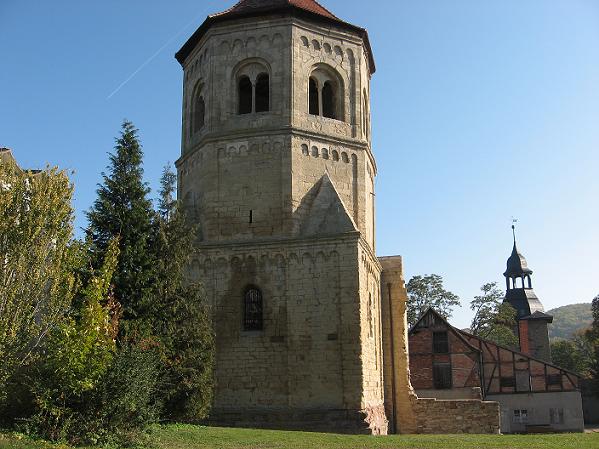
The village of Göllingen first appears in a charte of 765; there seems to have been a Carolingian crown domain at the time. The situation at the crossing of a river and the salt road from Frankenhausen likely influenced the establishment of a settlement. Read more »
The Imperial Baths (Kaiserthermen) is another of those projects that was begun when Trier became Imperial residence. Big fancy public baths had been prestige projects for quite some time, and the second - and also impressive - leisure centre, the Barbara Baths, was about 150 years old already. Still in good shape, mind you, but well, towns always tend to build newer and bigger public and governmental buildings than they really need; that hasn't changed during history.

So Maximinianus started the project. With a size of 250 x 145 metres, the baths covered the site of 4 insulae and were intended to become one of the largest leisure centres in the empire. The insulae were taken down, no matter that at least one of the buildings wasn't some run of the mill apartment block but a posh villa (with a bath of its own). No idea how the emperor convinced the owner to part with the land. Read more »
Salvete amici. Yes, it's me again, your friend Aelius Rufus. Gabriele told me to ignore the fact that I wasn't alive when the Aula Palatina, also known as Basilica of Constantine in Trier was built. You got this friend in Britannia, she said, you'll figure out something.
The Aula Palatina has survived because several important people over time thought it was of better use intact than as quarry (like so many other Roman buildings). It's today one of the largest rooms that has survived from my time. Though the roof had fallen in in the 5th century and it took some time to get a new roof up - those barbarian Franks or Merovingians or whatever they called themselves at the time probably had no idea how to construct a roof
that large.

And especially for Constance who likes to have numbers, here's the measures of the hall. The length is 71.5 metres (including the apsis), the breadth 32.6 metres. The original height can only be estimated since the original roof got lost; it's supposed to have been about 33 metres with the gable top at 40 m. The walls are 2.70 metres thick. Yeah, we built walls there. ;) Read more »
This is the first part of a series of posts about the Hanseatic League. It offers an introduction to the Hanseatic League, in German known as die Hanse (Hansa) and the first trade coperation that precedes the Hanseatic League, the Gotland Corperation.

The first and most important towns that would become the nucleus of the Hanseatic League are all coastal trade towns situated close to the Baltic Sea: Lübeck a few miles inland where the Wakenitz confluences into the Trave river, Wismar at a bay, and Stralsund dircetly at the coast opposite the island of Rügen. In former times, the towns were additionally protected by a system of channels - these can still be seen in Lübeck and Stralsund - and walls. The combination of sea harbours and landward protections was one of the features that made these towns some of the most wealthy and powerful places during the Middle Ages. Read more »
This charming litte wood carving is a detail from the choir stalls in Roskilde Cathedral in Danmark. They date to 1420 and show scenes from the Creation to the Last Judgement. This particular one is the scene of Cain slaying Abel, his interview with God ('And the Lord said unto Cain, Where is Abel thy brother? And he said, I know not: Am I my brother's keeper?') and God cursing Cain.
The weapon Cain uses is so very Scandinavian. *grin*

Yes, it's a stockfish. You gotta love how Cain not only kills his brother with a dried cod, but also drags the thing with him when he sulks off. Read more »
A cloud and snow post to go with the weather; the first rain after five weeks here, and the first autumn gales. There may even be snow later this week.

Traveling along the coast of Norway in early spring can give you some of the most beautiful light effects when the sun fights with the clouds, sometimes losing to a blue-grey twilight. Read more »
I've mentioned in my prior post that Apitz, son of the landgrave Albrecht II, got the Brandenburg as fief and obviously lived there at times between 1288 - 1305. So, who was this Apitz?
We need to go back a bit. After the Ludowing landgraves of Thuringia died out in the male line, there was a whole bunch of contenders for the heritage, leading to the Thuringian War of Succession. In the end, Heinrich III 'the Illustrious' of House Wettin (1215-1288) managed to pick the largest piece of the cake with a pretty collection of land and titles: Margrave of Meissen, Margrave of the Lausitz (Lusatia), Landgrave of Thuringia, and Count Palatine of Saxony. It also helped that Heinrich backed up Emperor Friedrich II in his struggle with the pope (yeah, that has a long traditon, no German emperor ever got along with the popes since Heinrich IV's excommunication in 1076). So Heinrich got Thuringia as fief in 1242, and he also betrothed his son Albrecht with Friedrich's daughter Margaretha - an offspring from Friedrich's third marriage to Isabella of England, a daughter of King John. They married in 1255 and had three sons.

Heinrich the Illustrious was an educated man with many interests, a poet and troubadour (Minnesänger in German) of some renown, and he didn't want to spend all his time in that dusty old office governing lands that stretched from the Werra to the Oder and from the Erzgebirge (Ore Mountains) to the Harz mountains. So he gave his sons Dietrich and Albrecht a share in the responsibility early on. Read more »
I've covered the castle ruins in the surroundings of my hometown Göttingen in several posts (and I'm busy digging up more information because I sure have more photos, lol) but there are other remains of castles as well, those that were not abandoned but inhabited constantly over time. These castles often have been changed beyond recognition, but in some cases Medieaval buildings have survived, like the keep of Adelebsen Castle and the great hall of Castle Hardeg.

The first trace of the castle can be found in a charte by a Ludwig Lord of Rosdorf who is mentioned as dominus Castri Herdegessen (1266). Though the first castle on the rocky plateau may well date back to the year 1000, and settlement of the area goes back to the Neolithicum (finds of stone axes dating to 4500 BC and a bronze axe from 1500 BC) Later, members of the Germanic tribe of the Cherusci lived there during the Augustean time. Read more »
And that's why I prefer to photograph castles and landscape. The photo below is the only decent shot I got during the eagle safari on my Hurtigruten tour; all the others were blurred and out of focus.

The seagulls who also accompanied the ship thanks to some fishy baits, were an easier target. For one, they came closer, and while they are fast and elegant birds, they still don't match those eagles in speed. Read more »
A visit to the falcon park near Bad Sachsa in the Harz marked one of the highlights of this weekend's tour. It was the last time before daylight saving changes back and darkness will start too early for longer tours. And it may have been the last day of sunshine and pretty colours before the next storms blow the leaves away.
The falcon park in the Harz (Harzfalkenhof) is a private endeavour founded in 1964. Its aim are the breeding, protection and research of birds of prey.

Olga is an Eurasian eagle owl from Siberia, and she knows that she's big, fluffy, and really cute, though like a true star, she needs some coaxing until she strikes a model pose. Read more »