My Travel and History Blog, Focussing mostly on Roman and Mediaeval Times
St.Mary's Church in Wilhelmshausen, a village in the Fulda river vallley not far from Kassel, was not exactly a chance find since had I learned about its existence when I researched the history of Castle Sichelnstein. So I put the little beauty on the list for a time we would come into the area – which happened during the tour to Castle Grebenstein.

The amount of obscure Romanesque churches that dot parts of Germany is due to the fact that they belonged to monasteries in the Middle Ages. Monasteries served as focus points of Christianisation and learning, furthered cultivation of the land, were part of the itinerant royal court – together with the palatine castles – and sometimes served as place of retirement for a dowager queen or career choice for a daughter (abbesses could hold a surprising amount of power). Read more »
This one was a chance find. My father and I returned from a longer tour, hit a diversion route which confused the GPS until I got out the good old road map and brought us back on track. We drove through several villages west of the Weser river in the fading light of an autumn evening and came across this beauty.

The chapter church St.Peter and Paul in Gehrden / Brakel near Höxter at the Weser dates back to the 12th century, though the Romanesque apse has been replaced with a larger rectangular choir in the 17th century, and the interior is Baroque, which may be the reason that it is less well known than the Weser abbeys of Bursfelde and Lippoldsberg which were built at the same time and retained their architecture unaltered. Read more »
It's not exactly a sight you'll expect when driving or hiking in the Harz area, but there it is.

This Scandinavian looking stave church is located in the outskirts of Hahnenklee, a borough of Goslar. Hahnenklee became popular as spa town in the 19th century, so that a larger church was needed for the visitors to be able to attend service; the parish church had become too small. Read more »
The Klusfelsen rock formation is a little known landmark in Goslar, usually relegated to the footnotes in travel guide books. After some initial signposts, I had to ask the locals for directions to get there. And then, passing a small path between some suburban houses, a meadow opened and on its farther edge I found this.

The Klusfelsen (Klus Rock) is a sandstone rock of about 20 metres height and 50 metres length, dating to the Lower Cretaceous 110 million years ago. The area had been a shallow sea at that time, the result of an inflow of sea water into the Norddeutsche Tiefebene . When the Harz mountains rose during the following Saxon Orogeny, those sandstone layers were pushed into a vertical position (about the geology of the northern Harz see also this post). Read more »
I came across that one a few years ago during one of the Harz tours I did with my father. The ruins of the Stapelburg – only the ringwall, bits of the curtain wall and part of the palas, the great hall, remain – are situated on a hill between Bad Harzburg and Ilsenburg on the northern foothills of the Harz. The land there is already rather flat, so the 60 metres hight hill stands out and offers a good view to Wernigerode and Halberstadt, and even the Brocken mountain on clear days.

A good place for a castle. Yet it was not easy to find much information about the Stapelburg; I could not even figure out if the preserved remains date to the first period (13th - 14th century) or the second phase of its use in the 16th century (which is more likely). The well house and a cellar have been recently restored. Read more »
Just some pretty photos today. One of the iconic motives on Rugia – besides the Königsstuhl and Kap Arkona – is the Pier of Sellin.

I went there on a late afternoon and thus got some nice photos with a play of light and shadow. It was October, and the sun was pretty low already; a lovely end to a nice day out (once the morning rains had been blown away). Read more »
2020
I had planned a spring journey to Lithuania and Latvia that fell victim to Corona, though I hope I can do it some other time. But with traveling within Germany being rather safe now, I decided to sneak in a little autumn tour and went to one of my favourite destinations for a few days – visiting Goslar and Quedlinburg in the Harz, including some hiking. I've visited both towns before, but during day trips that didn't leave me as much time – this time I got a lot of photos, so I'll be able to write virtual town tours that got some real illustrations. For now, let's have a brief look in the style of my Travel Booty posts.

The Harz mountain range is rich in silver and ore and thus has been cultivated since the Bronze Age. Mining became important in the Middle Ages, settlements developed in the valleys, cattle was sent grazing on the slopes and trees were used – and later replanted – for building, mining and firewood. The Harz today is a cultural landscape, but with parts that remain but little altered, or are allowed to reset to their natural state; those now encompass the Harz National Park. Read more »
There are several large and a number of smaller caves in the Harz mountain range, from the dripstone caves in the karst area to those in the Buntsandstein layer in the northern Harz. One of the latter became famous for serving as abode to a gang of robbers in the late 16th century. The so-called Daneil's Cave lies in the Huy, a forested ridge between Quedlinburg and Halberstadt (today Saxony-Anhalt). And of course, legends developed around a historical kernel. The cave may have been a hermit's cell in the Middle Ages, and later it was used by brigands – legendary and real.

There once lived an evil brigand chief in a cave in the Huy. His men would put up wires with little bells across the paths that announced the arrival of an unfortunate merchant, journeyman or farmer, and sometimes a maid on her way to the market in Halberstadt. The robbers would then attack the unsuspecting victims, kill them and bury their bodies in the forest, and make away with their gold and goods back to the cave. The had put their horses's shoes on backside forward and thus deceived their pursuers.Read more »
I included an overnight stop in Cheb (also known by its German name Eger) on my way to Prague, for one because the town is the site of a 12th century palatine castle – which will get its own post – and because its proximity to other interesting places like Loket Castle and Karlovy Vary. Cheb also has a pretty town centre with historical houses, so I took a little walk with my camera.

Eger, situated in the borderlands between Germany and Bohemia, has been known by both names for a long time; a charte from 1374 mentions Egra in boemica lingua Cheb (Eger, which in the Bohemian language is called Cheb). The existence of the town – or settlement at that time – dates to a charte from 1061, then named 'Egire' for the river Eger at which is situated. In Czech, the river is called Ohře; the name Cheb may derive from a word for 'river bend'. Read more »
I seldom participate in guided tours when traveling since I prefer more freedom, but sometimes it's the better option than spending too much time trying to get to a place by public transport. The visit to the Sedlec Ossuary and the town of Kutná Hora in Czechia was one of those tours.

Kutná Hora (historically also known by its German name Kuttenberg) is a town about 70 kilometres east of Prague. Some time after the Cistercians founded the abbey at Sedlec in 1142, silver and other ore was discovered in the area, and the monks brought in German miners from their mother house in Waldsassen (Upper Palatinate) who settled in Kuttenberg. The settlement is first mentioned in a charte from 1286, but existed at least some twenty years prior. Read more »
I got some more old stones for you. There are several sites in northern Germany where you may come across curious settings of rather large boulders. Their presence has been blamed on giants or the devil, and they are often known as ‘giant’s bed’, ‘devil’s oven’ and such, complete with legends how the giant or devil got tricked by the nearby villagers and was buried there.

Neither giants nor devils had anything to do with those, though. The picturesque collection of dolmen and hunebeds was the work of the Funnelbeaker people; most of them date to 3500-3000 BC. These ensembles of stone settings like dolmen, passage graves and hunebeds can be found from the Netherlands and the North German Lowlands to the Vistula in Poland, and in southern Scandiavia, mostly along the coasts. (The famous dolmen and menhir settings in Brittany belong to a different culture.) Read more »
Brochs are quite frequent in northern Scotland; the remains of some 500 can be found on Orkney, Shetland, the western isles, and Caithness on the Scottish mainland down to the Great Glen. Further south, stone brochs are almost nonexistant. But few are as well preserved and impressive as the Broch of Gurness on the Orkney Mainland and Midhowe Broch on the island of Rousay.

The first essay about the brochs of Gurness and Midhowe will deal with the historical and socio-cultural context of the brochs, while further posts will have a closer look at the buildings themselves. Illustrations are from both brochs. Read more »
I visted the site in early summer 2013, a year before Claire Beauchamp-Randall stepped through a cleft stone into pre-Culloden Scotland, and brought a trail of visitors to the hence quite place. Back then, the Clava Cairns at Balnuaran, not far from the battlefield of Culloden, were a lovely spot, especially on a sunny day. Now the inrush of visitors – not all of them respectful to the ancient monuments, alas – has led to some damage of the site.

The Clava Cairns consist of the remains of three cairns which are rather well preserved, with the walls still intact and only the domed roofs gone, and a number of standing stones. The stones are not as tall as those in the Ring of Brodgar, but they are placed in positions of astronomical importance. The cairns had been dated as Neolithic, but a survey by Prof. Richard Bradley in the 1990ies proved that there were constructed in the Bronze Age. Read more »
Kazimierz is a very different part of the historical Kraków. Less frequented by tourists, but popular with young people. Some houses have already been renovated and look as pretty as in the Old Town, but others still need some new paint or a sandblasting. It gives the place a slightly rundown, but charming atmosphere.

Originally, the part of the historical centre of Kraków today known as Kazimierz was an island in the Vistula river. There had been a Slavic shrine and a sacred pool before Poland was Christianised. Nearby was the seat of a local chief and a cattle market which later became the Bawół district. Those merged into a settlement; the first church was built on the site of the shrine in the 11th century. The town that developed on the site was independent from the Wawel and the city of Kraków (today the part known as Old Town) for several centuries. Read more »
It was Palm Sunday when I visited Kraków, an important day for Catholics in Poland, and the weather was fine to boot, so the town was rather crowded, not only with - mostly Polish - tourists, but with pretty much all inhabitants of the city and surroundings. Many women and children were carrying bouquets made of evergreen and spring flowers. The festive atmosphere was a nice addition to my visit.

Since there were services and prayers going on all day, I didn't have a chance to seen any of the churches from the inside, but I didn't mind ‒ I got plenty of church photos in my collection. There was much else to see, after all. So let me give you a virtual walk through Krakow’s Old Town, the Stare Miasto. Read more »
After the visit to the Hutewald in the Solling which is an example for a recreated and working wood pasture, let’s have a look at a former wood pasture that has been allowed to grow on its own without the influence of humans or domesticated animals for a long time now.

The Urwald Sababurg is a part of the Reinhardswald Forest (near Kassel) close to Sababurg Castle. The denomination as ‘jungle’, while popular, is misleading. It is no true primeval forest, but has been influenced by humans since the Middle Ages. But the enclave near the castle has been turned into a Nature Reserve and left to its own since 1907, so the forest had a lot of time to develop naturally. Read more »
Wood pasture was a way of using the resources of deciduous or sometimes mixed coniferous forests since settlements developed in wooded areas, and it lasted in parts until the 18th century. Forests that grew out of those old grazing sites are still around. They show some distinct features, and some have been recreated.

Among them is the Hutewald Project in the Nature Park Solling-Vogler. The area of 170 hectares is situated near Nienover (Lower Saxony) and is used for wood pasture since 2000. There had been a former Hutewald – the German word for forest pasture – before, so the old oaks made for a good basis. Now, Heck cattle (see below) and Exmoor Ponies are used to keep the undergrowth in check. Read more »
After the virtual tour of Ogrodzieniec Castle in Poland I posted in December, let's have look at the history of those fascinating ruins.

with outer wall, Footman's Tower (left), Hen's Leg, Beluard Bastion and Prison Tower
Regular readers will know that I always try to fnd out details about the history of the castles and other historical sites I've visited. It proves a bit more difficult with Czech and Polish castles, since I'm not as well acquainted with the history of the eastern central European countries as I am with Germany or the United Kingdom. But I'm busy reading up on the subject. Another problem is the lack of sources in languages I can read, especially in the case of local history (1). Read more »
I got another filming location for you. The Witcher series, a Netflix production based on the novels of the Polish author Andrzej Sapkowski and starring Henry Cavill in the lead role, will launch today. The series has been shot in Hungary and the Canary Islands, among others, but some scenes were produced in Ogrodzieniec Castle in Poland. Luckily, I visited that one during my spring journey, therefore I can give you a virtual tour of this spectacular ruin.

Ogrodzieniec is part of the so called Eagle Nest Trail, a series of castles situated on a ridge of limestone cliffs north of Kraków. Those castles were built mostly in the 14th century to protect the border to Silesia which then belonged to the Kingdom of Bohemia. Some limestone formations can be seen in immediate vicinity of the castle, which itself stands on a cluster of several large rocks on top of a hill. Read more »
Archbishopric, seat of the Teutonic Knighs, and member of the Hanseatic League - Riga's Old Town has plenty of churches, a castle, and lanes and squares with pretty old houses. I spent a day there and managed to snatch a nice collection of photos to go with a post about Riga's Mediaeval history.

Settlement at a natural harbour 15 kilometres upriver from the mouth of the Daugava river (also known as Dvina; in Old Norse as Dúna ) dates back to the 2nd century AD. The settlers were Livs, a Finnic tribe, and the Baltic Curonians. Archaeological digs have shown traces of bone and amber craftsmanship, animal husbandry and fishing. The settlement likely was a minor trade centre at that time.Read more »
Just some pretty flowers and trees today. I took the photos in the Botanical Garden in Wrocław in spring.

The Botanical Garden in Wrocław, situated on the Cathedral Island, is a lovely and quiet place. It was around lunch time when I came by the entrance and decided the garden might offer a nice spot to sit and have a sandwich. Turned out it was the right decision. Read more »
Tallinn, the capital of Estonia, had not always been known by this name. The 13th century chronicler Henry of Livonia called it Lindanisia and the surrounding country Revelia. The latter name would then be used for the town: From the Danish conquest in 1219 until the Estonian independency in 1918, Tallinn was known as Reval. Taani-linna, Danish Fortress, was the Estonian name for the castle on the hill in the town, today the Upper Town or Cathedral Hill.

There are traces of prehistoric occupation on the hill at the Gulf of Finland, and settlement of the area seems to have been continuous. Since the mid 11th century, a trading town with a timber castle on the hill and a harbour had been erected by the Estonian tribes. Read more »
I'm not only collecting new travel destinations and lots of photos, I still have an archive full of material from former tours. So here's one of the places I've visited during my Baltic Sea Cruise in 2012: Porvoo in Finland.
The old town with its 550 buildings is a treasure of old timbered houses in bright colours, and cobblestone lanes, plus a fine stone and brick church. Come and walk along with me a bit.

Porvoo (also known by its Swedish name Borgå) lies some 50 kilometres east of Helsinki. The layout of the old town dates to the Middle Ages, but Porvoo suffered from several severe fires, most of them due to wars, so most ot the houses date to the 1760ies. But the inhabitants stubbornly erected them on the same sites and pretty much to the same design several times over. Read more »
I've detailed the history of Richmond Castle in the context of the Honour of Richmond in two posts (here and here). But with some more photos and information left, there is material for a final post about the castle.
The later history of the castle is less glamorous, but Richmond is among the places that gained interest as picturesque tourist sites since J.M.W. Turner and other artists painted the ruins in the 18th and 19th century. It still looks quite picturesque today.
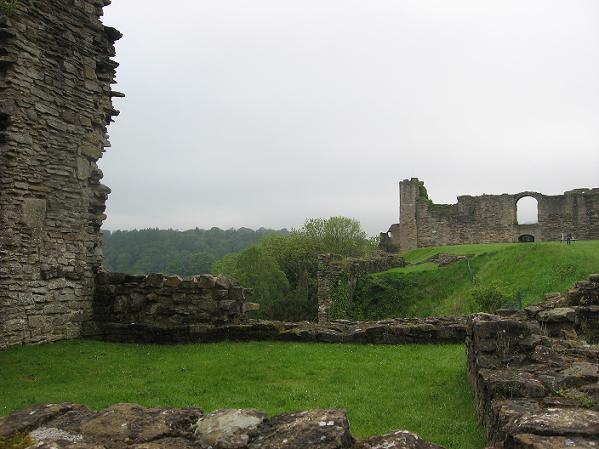
The castle was derelict in 1538. The third duke of Richmond carried out some repairs to the keep in the 1760ies. One of his successors leased the castle out to the army. They gave it to the New York Militia in 1855, who used it as their headquarters and built a barrack block against the western curtain wall. The keep was used as depot and another building set up beside the gate (that one still exists today). Read more »
Once upon a time there was an evil burgrave, Puta of Illburk, who resided in Loket Castle (1). He was a harsh man who demanded socage far beyond his rights and collected taxes without any concern about the peasants being ill or the crops having failed. One day, a widow with a wee bairn approached him. She had lost her husband to disease and was shaking with a fever herself, clutching the little underfed boy to her breast. But the burgrave who stood on a parapet outside his hall watching the crowd that had come with her, would not listen to her pleas and tears. "Pay me the tax your late husband is due, or I will throw you into the dungeon."
When the poor woman realised that no tears and pleas would move the burgrave, she cursed him. "A heart of stone you have, and may God turn you to stone for it."

At that moment, despite the weather being fair and the sky blue, a lightning struck the parapet and a bright light soared skyward. The crowd fell to their knees in fear and covered their eyes against the light. When they dared to look up again, a wall in the burgrave's hall had disappeared, and a large black stone lay inside the room. Read more »
I only took a brief walk through the centre of Karlovy Vary (Czechia). The town has a lot of pretty, and even splendid, buildings of the Neo-Classicist, Art Déco and Art Nouveau styles that have been lovingly restored. Nevertheless, the overcast sky and lack of green (except for some willows in the park) early in the year made it look a bit grey. I'm sure Karlovy Vary will be lovely when the sun sparkles in the water, the trees are green, and the façades of the houses shine in their bright colours. You'll have to deal with the less colourful photos, I'm afraid.

Karlovy Vary is situated at the confluence of the river Ohře and the warm water river Teplá; site of 13 main springs and about 300 smaller ones. The healing properties of the waters have long been known; traces of settlements in the area date to the Bronze Age. The first mention of the place in the Middle Ages is the Breve testatum, a charte dating to 1325, signed by King John 'the not yet Blind' of Bohemia, which mentions hunting grounds at the 'horké lázně u Lokte' (= the hot springs near Loket). Read more »
When I was researching the Teutonic Knights and the forging of the union between Władysław Jagiełło of Poland and Vytautas of Lithuania (see this post), I came across a paragraph mentioning that one of the participants in the siege of Vilnius in 1390 was Henry Bolingbroke, the future King Henry IV of England, who had joined the Teutonic Knights with a number of household knights and archers. That intrigued me and I hunted down more information about Henry's adventures in Lithuania. I'm sure my British readers will be interested in that probably little known piece of history.
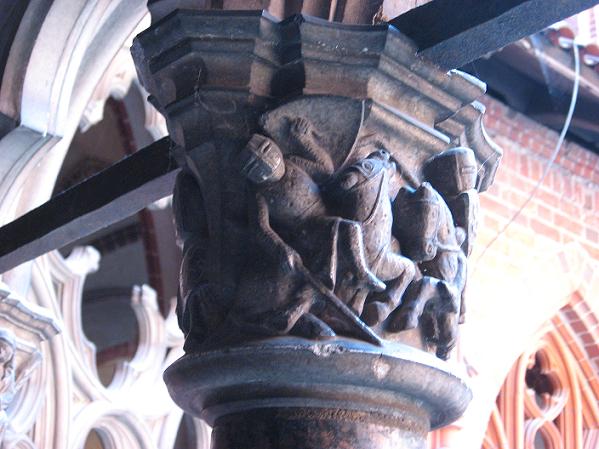
A short biography of King Henry IV will suffice here (1). Henry IV, also known as Henry Bolingbroke after his place of birth, and Henry of Derby (he held the honorary title Earl of Derby since 1374), was born on April 15, 1367. His father was John of Gaunt, a younger son of King Edward III; his mother was Blanche, heiress of Lancaster (and in turn descended from Henry III; 2). In 1380, Henry married Mary de Bohun, daughter of Humphrey de Bohun, 7th Earl of Hereford. Read more »
Sedlec is today a suburb of the Czech town Kutná Hora, about an hour's drive from Prague. The place has become popular with tourists due to a somewhat morbid and scary attraction: the Ossuary of Sedlec. The town of Kutná Hora (Kuttenberg) is a UNESCO site and worth a visit as well. But in this post, let's get down to the bones. :-)

Literally, in fact. The ossuary is located in the basement of the All Saints' Chapel in the cemetary of Sedlec. So, how did some 40,000 skeletons end up in this place, and part of those as decorations to boot? Read more »