9 Aug 2008
A Most Unusual Castle - The Regenstein
Wales may have the biggest castles, but we have the coolest. In particular the Regenstein is a very unusual construction. Situated on a 100 metres high sandstone cliff, it overlooks the plains northeast of the Harz mountains all the way to Quedlinburg and Halberstadt, and makes use of the natural caves in the rock. Most of them have been enlarged, and new ones have been added; for example one that was used as chapel in the 12th and 13th centuries and shows traces of an artificial cross grain vault ceiling hewn into the rock.

View towards the Regenstein with the keep and some of the caves
Archaeological traces show that the place has been used for several thousand years, probably as gathering spot for religious ceremonies. The Harz is full of those; a plateau on the Rosstrappe is another one - obviously such exposed cliffs have been regarded as places of power. The natural caves on the Regenstein (the name derives from rein - clear, white) may have been used as shelter of a hill fort.

Regenstein Castle, Keep
The first use as Mediaeval castle dates to the early 11th century, the time of the first Salian Emperor, Konrad II. A keep was built and fortifications added to the natural defenses. The Regenstein is not mentioned in Heinrich IV's wars against the Saxon nobles and may have escaped destruction. Later it came into the possession of the Harzgaugrafen (Harz Counts of the Mark) and was one of the castle triad of Regenstein, Blankenburg (today a Renaissance/Baroque palace) and Heimburg (only a few stones left). The most important of those was Lothar of Süpplingenburg whom we have met as founder of Königslutter Cathedral; the grandfather of Duke Henry the Lion.

Keep seen from the guard tower
When Lothar became Emperor in 1125, the Harz Mark County fell to vassals, and in 1169 one of them, another Konrad, appears as first Count of Regenstein. His brother held the Blankenburg. During his time the castle was enlarged and better fortified, a process that went on until about 1300. Since later times have used most of the stones (a good deal went into the Blankenburg Renaissance palace), what remains today is the ruins of the keep and some traces of the curtain walls and gates; most of the houses over the caves have disappeared.

Entrance to the north gate seen from inner bailey
In 1670, troops of the Prince Elector of Brandenburg occupied the Regenstein during a quarrel about feudal rights to the land, and developed the abandoned Medieaval castle into a mountain fortress with garrison buildings, bastions, stables and magazines etc. that would eventually encompass an area much larger than the old castle. Later the Regenstein came to Prussia but lost its strategical importance and was dismantled in 1758. Which in a way is lucky because the 'modern' buildings over the caves were deconstructed, thus giving the fortress back some of its look as Medieaval castle.
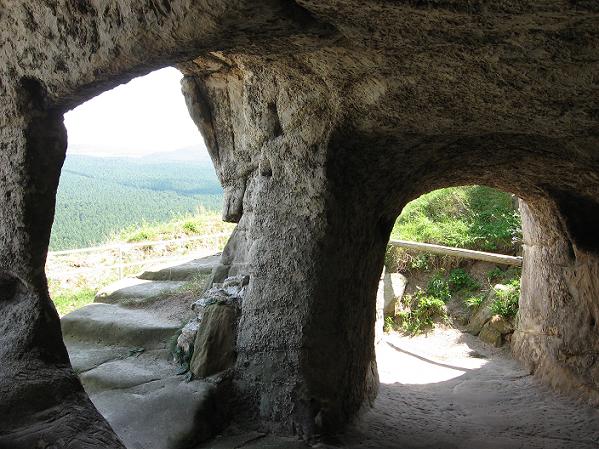
Guard house at the north gate Guard tower, based on a natural sandstone formation
(I call it that, because the platform on top provides a fine view in all directions)
The Counts of Regenstein were partisans and probably vassals (the feudal rights are not entirely clear*) of Heinrich the Lion during his quarrels with the Emperor Friedrich Barbarossa. Finally in 1180, the majority of the princes of the realm declared Heinrich, the most powerful rival among them, an outlaw. The emperor Friedrich Barbarossa distributed Heinrich's lands among some of the princes and then invaded Heinrich's Saxon possessions with an army to bring the rebel to task. Most of his allies abandoned Heinrich, and in 1181 he had to surrender at the diet of Erfurt and was condemned to exile.
* The Bishops of Halberstadt also claimed the overlordship.

One of the cliff promontories, seen from the curtain wall
The Count of Regenstein, either the aforementioned Konrad or his son, delivered the castle to Friedrich Barbarossa without resistance**, and was soon thereafter granted back the fief. In the following decades the family expanded the castle into a 100x175 square metres fortress with eight towers and about 200 metres curtain wall in addition to the natural cliffs. The St.Nicholas chapel dates from that time as well.
**An online source says the castle was destroyed, but I'm prone to believe the official guidebook, particularly since the fief seems to have been returned shortly after the surrender.
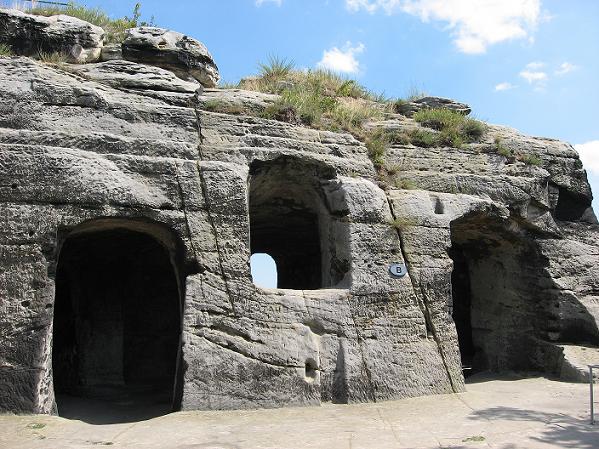
St.Nicholas Chapel, seen from the outside
Wales may have the biggest castles, but we have the coolest. In particular the Regenstein is a very unusual construction. Situated on a 100 metres high sandstone cliff, it overlooks the plains northeast of the Harz mountains all the way to Quedlinburg and Halberstadt, and makes use of the natural caves in the rock. Most of them have been enlarged, and new ones have been added; for example one that was used as chapel in the 12th and 13th centuries and shows traces of an artificial cross grain vault ceiling hewn into the rock.

Archaeological traces show that the place has been used for several thousand years, probably as gathering spot for religious ceremonies. The Harz is full of those; a plateau on the Rosstrappe is another one - obviously such exposed cliffs have been regarded as places of power. The natural caves on the Regenstein (the name derives from rein - clear, white) may have been used as shelter of a hill fort.

The first use as Mediaeval castle dates to the early 11th century, the time of the first Salian Emperor, Konrad II. A keep was built and fortifications added to the natural defenses. The Regenstein is not mentioned in Heinrich IV's wars against the Saxon nobles and may have escaped destruction. Later it came into the possession of the Harzgaugrafen (Harz Counts of the Mark) and was one of the castle triad of Regenstein, Blankenburg (today a Renaissance/Baroque palace) and Heimburg (only a few stones left). The most important of those was Lothar of Süpplingenburg whom we have met as founder of Königslutter Cathedral; the grandfather of Duke Henry the Lion.

When Lothar became Emperor in 1125, the Harz Mark County fell to vassals, and in 1169 one of them, another Konrad, appears as first Count of Regenstein. His brother held the Blankenburg. During his time the castle was enlarged and better fortified, a process that went on until about 1300. Since later times have used most of the stones (a good deal went into the Blankenburg Renaissance palace), what remains today is the ruins of the keep and some traces of the curtain walls and gates; most of the houses over the caves have disappeared.

In 1670, troops of the Prince Elector of Brandenburg occupied the Regenstein during a quarrel about feudal rights to the land, and developed the abandoned Medieaval castle into a mountain fortress with garrison buildings, bastions, stables and magazines etc. that would eventually encompass an area much larger than the old castle. Later the Regenstein came to Prussia but lost its strategical importance and was dismantled in 1758. Which in a way is lucky because the 'modern' buildings over the caves were deconstructed, thus giving the fortress back some of its look as Medieaval castle.

Since 1988 the place has undergone conservation and some restoration to preserve the ruins of the Medieaval castle and remains of the Baroque fortress, and specifically the intriguing mix of rock structures and architectural additions. It was fun to explore the place, a veritable labyrinth of stairs, caves, walkways and slopes.
Since the early 11th century, the Regenstein and its fellow triad castles Blankenburg and Heimburg (see this post) served to protect the ways to the palatine castles and towns of Quedlinburg, Goslar and Magdeburg, but also the ways to the iron and silver mines of the Harz.

(I call it that, because the platform on top provides a fine view in all directions)
The Counts of Regenstein were partisans and probably vassals (the feudal rights are not entirely clear*) of Heinrich the Lion during his quarrels with the Emperor Friedrich Barbarossa. Finally in 1180, the majority of the princes of the realm declared Heinrich, the most powerful rival among them, an outlaw. The emperor Friedrich Barbarossa distributed Heinrich's lands among some of the princes and then invaded Heinrich's Saxon possessions with an army to bring the rebel to task. Most of his allies abandoned Heinrich, and in 1181 he had to surrender at the diet of Erfurt and was condemned to exile.
* The Bishops of Halberstadt also claimed the overlordship.

The Count of Regenstein, either the aforementioned Konrad or his son, delivered the castle to Friedrich Barbarossa without resistance**, and was soon thereafter granted back the fief. In the following decades the family expanded the castle into a 100x175 square metres fortress with eight towers and about 200 metres curtain wall in addition to the natural cliffs. The St.Nicholas chapel dates from that time as well.
**An online source says the castle was destroyed, but I'm prone to believe the official guidebook, particularly since the fief seems to have been returned shortly after the surrender.

Comments:
<< Home
What a great place! I love caves as well as castles so Regenstein would be a dream day out for me!
Thanks for the history too - I tend to forget that other countries have history sometimes lol!
By the way - Arminius gets about a bit, doesn't he ;-)
Thanks for the history too - I tend to forget that other countries have history sometimes lol!
By the way - Arminius gets about a bit, doesn't he ;-)

Pembroke Castle should be fun for you then; it's got a nice, big cave.
Actually, it's not that far from the Weser to the Harz, but it's easier to stay put somewhere a few days instead of spending a lot of time driving. Perticularly behind slow trucks. ;)
And the land was all Cheruscian territory.
Actually, it's not that far from the Weser to the Harz, but it's easier to stay put somewhere a few days instead of spending a lot of time driving. Perticularly behind slow trucks. ;)
And the land was all Cheruscian territory.
Impressive structure. Thanks for sharing your photos. I always enjoy looking at them.
Steven
http://steventill.com
Steven
http://steventill.com
Thank you, Steven.
I like sharing my pictures, it's a lot more fun than just collecting them in albums as I did pre-blog times.
I like sharing my pictures, it's a lot more fun than just collecting them in albums as I did pre-blog times.
Good pictures and narrative. The defenses should always reinforce the natural terrain – this is fantasic! With cave's natural temperature control probally the most confortable castle in Germany
Could it be that a plot bunny will sneak out from behind a rock and inspire a snippet someday?
Could it be that a plot bunny will sneak out from behind a rock and inspire a snippet someday?
Could it be that a plot bunny will sneak out from behind a rock and inspire a snippet someday?
Hmm, I think that could happen. ;)
Hmm, I think that could happen. ;)
Wonderful photos, Gabriele, and equally wonderful narrative.
Drop by my blog for a special comment for you.
Drop by my blog for a special comment for you.
Oooh, what a great place! I'm sure there must be lots of plotbunnies there, waiting to jump out on you. ;)
Post a Comment
<< Home