I've mentioned that King Håkon V Magnusson who built Vardøhus Fortress, also built Akershus in the south and made Oslo the capital of his realm (until that time it had been Nidaros, modern Trondheim). While Vardøhus retains the charme of a border fort with its timber houses and grass roofs, Akershus has developed into a large fortress with mostly stone buildings, due to its strategical importance.
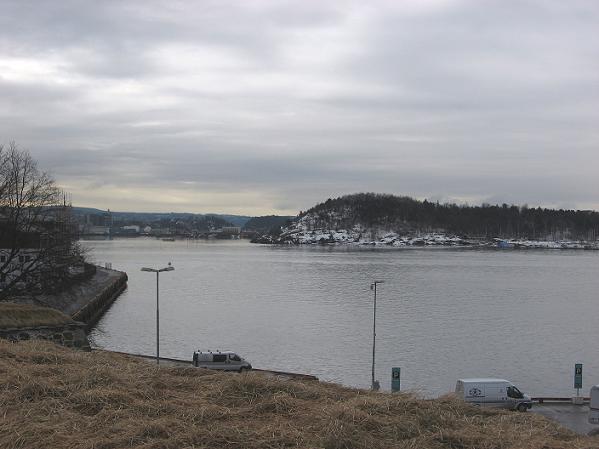
Akershus Festning is situated on a little salient in the Oslofjord. Today, the town envelops the shores on both sides and the hinterland, but in the 13th century, it was a place that could be easily defended. Akershus was built of stone and bricks from the beginning, not of timber like Vardøhus, but much of the original buildings are either gone or have been changed during time (the north wing is the oldest part of the palace). Some parts of the inner defenses still date back to the late 13th / early 14th century, like the Jomfrutårnet (Virgin's Tower) and the partly reconstrcuted Knutstårnet (Knut's Tower).
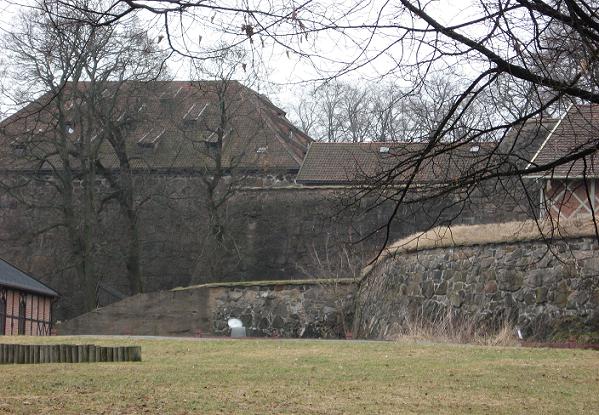
Akershus is one of the most important fortresses in Norway. It started out as fortified king's seat in ~1300, was turned into a Renaissance palace with bastions in the early 17th century, used as prison in the 19th century, and today houses the Ministry of Defence and two museums; some of the rooms in the palace are used for representation. Akershus has seen several sieges but was never taken.
I could start with King Håkon V building Akershus some time between 1299 and 1304, but I'll start a bit earlier and say that it was all Alv Erlingsson's fault. *grin* Well, it was not his fault that the old king's seat in Oslo couldn't withstand a siege, but he brought the point home. Plus, his story is interesting and so I'll tell it to you.
Alv Erlingsson was member of the powerful Tønsberg family and second cousin of King Magnus VI Lawmender (who in turn was son of Håkon IV, the one who lost the Hebrides to Scotland at the battle of Largs in 1263; Alv's father had fought in that battle, too). Alv was governor of Borgarsyssel (today county of Østfold at the Oslofjord) and jarl of Sarpsborg (comes de Saresburg, as he styled himself in documents). When King Magnus died in 1280, he left his sons Eirik and Håkon as minors, and a guardianship board was established. Alv was not an official member of that board, but nevertheless wielded great influence because of his position as governor of an important province and because the dowager Queen Ingeborg held him in high esteem.

(The main building is the Renaissance palace; the older north wing can be seeen to the left)
In 1284, the problems between Norway and the Hanseatic League reached a new peak, with the League basically blockading Norway. Alv wasn't going to play that game and personally led some privateers, sinking a bunch of Hanseatic ships and gaining renown as 'mighty pirate'. A year later, the Danish king Erik V 'Klipping' (Erik the Coin Clipper) joined the side of the Hanseatic League. Erik was a cousin of the dowager Queen Ingeborg, and there was still the issue of an unpaid dowry between her and the rest of her family. So Alv had a double reason to add good ol' viking-ing to the privateering, and started to harry the coasts of Denmark.
But in the end King Eirik Magnusson of Norway made peace with the Hanseatic League - sinking ships doesn't really help with the economy in the long run. He had to pay a fine of 6000 mark silver, a huge sum at the time, and a sum he didn't really have. Plus there was still war going on with Denmark. A number of nobles, centered around Eirik's younger brother Duke Håkon (the later King Håkon V), started an opposition against Alv Erlingsson whom they held responsible for the mess. Though for the time being Alv remained in power.
He went on an embassy to King Edward I of England where he - successfully - tried to loan 2000 mark silver and hire mercenaries for the war with Denmark. I wonder a bit why Edward would be willing to help Alv and/or the King of Norway, but maybe Kathryn can shed a light on that. Meanwhile back home, the Danish King Erik had solved his little civil war that had prevented him from participating in the peace negotiatons between the King of Norway and the Hanseatic League. He now made his own peace with King Eirik Magnusson of Norway.
Akershus is first mentioned in a charte dating to 1300, and thus it's assumed the fortress was built shortly before that date. Maybe Håkon V had it started already while he still was duke.
It didn't take long for the place to see its first siege. Ok, this is getting complicated again; kings should not produce three sons, that only leads to trouble. But the King of Sweden, another guy called Magnus, did, and the two younger brothers promptly didn't get along with the eldest. So Erik and Valdemar fled to Norway while the oldest, Birger, found an ally in his brother-in-law King Erik VI of Denmark - not the Coin Clipper but his son. King Håkon gave Erik, who was Duke of Södermanland already, the lands of Kungahälla (the place is today in Sweden) and promised him marriage to his daughter, named Ingeborg like so many girls of the time, once she came of age.
In 1306, Erik and Valdemar snatched their brother Birger during a feast in Sweden (later know as the Håtuna Games) and threw him into the dungeon in Nyköping. But alliances shifted and things turned against Erik and Valdemar. In 1308, King Håkon was at the side of King Birger of Sweden who had been released from captivity, claimed Kungahälla to be returned to him and refused to marry Erik to Ingeborg. From what I could find out, it seems that Erik had played the game of shifting alliances as well, and made peace with King Erik of Denmark behind Håkon's back. But now it was Erik of Denmark and Håkon of Norway against Erik of Södermanland and Valdemar, with Birger watching from the stands.
Erik laid siege to Akershus at some point during the war, but his troops were defeated by a Norwegian army. Though overall Erik was able to ride out the storm without too many losses, and in 1310, there was peace again. What consisted as Sweden at the time was more or less divided between the three brothers.
Despite the war, despite never having returned Kungahälla, breaking almost all promises to Håkon and for some time having been betrothed to another woman, Håkon agreed to the marriage between his daughter (who was 11 at the time) and Erik in 1312. Makes you wonder about politics.

It was a double marriage: Erik married Håkon's daughter, while his brother Valdemar married the daughter of the late King Eirik, Håkon's brother, another Ingeborg. Sorry, I didn't name the lot. ;) To make it a bit easier, one was named Ingeborg Håkonardottir and the other Ingeborg Eiriksdottir.
But there was not to be a Happily Ever After. A few years later, in 1317, their brother Birger, de jure King of Sweden, invited Erik and Valdemar to a Christmas banquet in Nyköping. There he had them put in chains and thrown into the same dungeon he'd been in, where they starved to death. Revenge best served cold and all.
But Birger had misestimated the political situation and the lack of support. The two Ingeborgs came swooping down on him with the followers of their husbands and chased him out of Sweden; his son got killed. Birger found an exile with Erik of Denmark, and Magnus, the son of Erik of Södermanland and Ingeborg Håkonardottir, was installed as King of Sweden.
Magnus' son Håkon VI later would spend a lot of time in Akershus during the years 1360 - 1370 and have the fortress expanded.

with the Jomfrutårnet in the background left
and the 13th century great hall (crow stepped gable) to the right
So when Alv returned with a large group of mercenaries, they were no longer needed. In 1287, Queen Ingeborg died and Alv lost his most important support at court. The problems with the young Duke Håkon developed into a military conflict. Alv refused to hand over the 2000 mark silver (he probably needed the money to pay the mercenaries he also kept), conquered the king's seat in Oslo, burned the town, took the garrison commander Hallkjell prisoner and later killed him. For that he was declared an outlaw. After Alv lost a battle against Håkon where most of his mercenaries were killed, he fled to Sweden and further to Riga.
In Riga, he went back to his Viking life, setting up a new base, obviously a mix of pirate and highway robber activities. The grand master of the Teutonic Knights complained about the 'harmful wolves led by the Count of Tønsberg'. Though Alv Erlingsson seems to have tried to make peace with King Eirik; there's a letter to King Edward I of England, dating to 1290, asking him to act as arbiter between Alv and Eirik.
Alv obviously was on his way to England when he got captured at the Danish coast. The local sheriff had him tortured and executed at Helsingborg. The interesting point is that Norway and Denmark were at war again at the time - looks neither king cared much about Alv's fate. Thus died the man who would later be refered to as 'the last Viking'.

Håkon became king after his brother's death in 1299. The previous events had shown him that Trondheim was too far north, and that a capital further south would be more useful, with all those troubles going on with Denmark and Sweden. Moreover, it needed to be well fortified. He also tried to curb the power of the great old families - Håkon didn't want another Alv Erlingsson.
The next part can be foundhere.
It wasn't good to be the king in 13th-century Denmark. Ingeborg of Denmark, who became Queen of Norway, was a daughter of the Danish King Erik IV. Erik IV was beheaded by men in the service of his brother Abel. King Abel was killed by a wheelwright in a dispute over taxes, and he was succeeded by his brother Christopher. When Christopher died unexpectedly after drinking Communion wine(!) he was succeeded by his son Erik V who was therefore Ingeborg's cousin as you stated. You can be sure that Erik V did not die a natural death either.
Anyway, Ingeborg's guardians did not want her to marry Magnus, son of Norwegian King Haakon, so they sent the 17-year-old girl off to a convent, from which she was rescued by the Norwegians to become their queen. It was after this that Alv Erlingsson's career took many interesting turns. Tore Skeie has written a biography of Alv but as far as I know it's available only in Norwegian which I cannot read.

 : August 01, 2011
Thank you, Paul.
After the dowager Queen Ingeborg died, Alv lost support at court and soon fell foul of Håkon; I don't think he'd have served as ambassador then.
But the connection between King Edward I and Alv is interesting insofar as Norway had much closer connections with Scotland. King Eirik II was married to Scottish ladies twice, first Margaret daughter of King Alexander (with whom he had the daughter Margaret who was later going to be betrothed to Edward II), and then Isobel Bruce, sister of Robert the Bruce.
The daughter Ingeborg Eiriksdottir who would marry Valdemar Duke of Finland (borther of King Birger of Sweden) came from that marriage, and if she had Bruce blood it's no surprise she led her late husband's men against Birger, lol.
I need to sort out that geneaological mess. Intermarrying and naming all kids the same doesn't really help. ;)
Could Edward I have been hoping to get Norway on his side and reduce its ties to Scotland? If Norway owed him a favour, he may have thought they would be less likely to intervene in Scotland. Even if he wasn't yet thinking of doing to Scotland the same as he had to Wales (was the embassy after or before King Alexander III was killed?), could he have been trying to reduce the chance of Norway and Scotland allying against England? Or maybe he was trying to undermine Denmark by supporting their enemy Norway, thereby reducing the chance of Denmark being a threat to England?
Edward I had a friendly relationship with Magnus VI, exchanging falcons with him. When Magnus VI fell ill in 1280, he wrote to Edward I asking him to uphold his wishes regarding the appointment of Eirik II as king and his brother Haakon as duke, and charged him with providing counsel and aid to the two boys (about 12 and 10 at the time). Shortly afterwards, he died, and the throne passed to Eirik in minority. During the minority Alv Erlingsson played a prominent but informal role, and became a favourite of the queen mother, Ingeborg of Denmark.
In 1284, Edward I and Eirik II, who was by now in his majority, and also was married to Edward's niece and the father of her daughter, confirmed a treaty of mutual cooperation that had existed between their fathers: a ratification initiated by Eirik. Only a month beforehand, the Scottish nobility had undertaken to accept Eirik's daughter Margaret as their queen if Alexander III should die without producing further children (his son Alexander had died in January 1284). The treaty was activated throughout 1285, when Edward supported the Norwegian position in their trading dispute with the Hanseatic League.
In 1286, when Eirik sent Alv Erlingsson to Edward as an envoy, it was probably to seek his assistance in Eirik's developing conflict with Denmark over access to his mother's disputed Danish inheritance. War with Denmark began officially in 1287, but Edward had already given orders in 1286 that his regent should give safe conducts to any English knights moved by Alv's story of the murder of Ingeborg's father (therefore Eirik's grandfather), Erik IV of Denmark, by his brothers and their associates, who might want to accompany him to avenge the death, which had occurred some 36 years earlier.
Short version: Norwegian kings had been seeking alliances with Henry III & Edward I for decades in tandem with their Scottish links. It was only really the fall out of the Great Cause, and the Franco-Scottish alliance that put a dampener on their connections.
<< Home