My Travel and History Blog, Focussing mostly on Roman and Mediaeval Times
Life is still busy, and blogging is one of the things that got a bit of a short shift those last weeks. Meanwhile, have some pretty ammonites.

(Collection of the Department of Geology, University Göttingen)
Ammonites are an extinct subclass of marine invertebrate animals, the molluscs (cephalopoda). Ammonites were around from the Early Devonian about 400 million years ago to the Late Cretaceous when they died out together with the dinosaurs 65 million years ago. Over that time, they developed some 40,000 species from tiny 1 cm cuties to 30 cm exemplars. But there were also some really big ones that could grow to two metres. Read more »
We had a family gathering near Mannheim this weekend, in a very nice hotel with several gardens. A lot of the plants growing there are not European but Asian and American, like this combination of bamboo and a Monkey Puzzle Tree from Chile.

Its official name is Araucaria araucana, a tree that is indigenous to Chile, Argentina and south Brazil. Araucania is a member of the conifer family and can grow to 40 metres tall. The first trees were cultivated in Britain in 1850, and that's where the nickname came up, 'it would puzzle a monkey to climb that'. Since Araucaria is a very old species, it is considered a living fossil. The trees had been around when dinosaurs still walked the earth. Read more »
Life's been a bit busy this week, so here's another short post with some photos. This time you'll get some of the odd rocks one can find in the Harz, particularly the southern Harz karst landscape.

Once upon a time ... well, 250 million years ago, what is now Germany hung out around the equator, and it was a sea, the Zechstein Sea, which covered most of central Europe-to-be. Like most seas, it had tiny critters with shells swimming around, as well as coral reefs. Since the climate at the equator is hot, the water evaporated, leaving behind layers of shells, corals and other organic material which over time baked together. Then the sea would flood back in. This happened several times over until the continental drift moved the land further north. Read more »
Well, I don't think my British readers fancy any more cold water than they already got, but we have some very hot days in Germany, and the heat wave in the US seems to be still strong. Since the litte trip I did last Saturday included a waterfall (besides a cave and limestone rock formations), I'll share some photos with you.

The Lonau Fall is the only natural waterfall in the western Harz and a nice view even in summer. I've seen when the snow in the Harz mountains had just melted, and during such periods it is truly impressive. But the summer pics are interesting, too. Read more »
Some traces of the fortress built by King Håkon Magnusson and his great-grandson Håkon VI can still be seen, though much has either been changed or hides behind Renaissance and 19th century additions.
Akershus Fortress faced several more sieges in the years to come, but I'll spare you the details and more names with odd letters. The Mediaeval castle was never captured.

Right to left: Monk's Tower, Virgin's Tower (with the red roof), Renaissance palace (South Wing),
central Romerike Wing with top of Romerike Tower, Mediaeval northern wing.
The most outstanding building dating to the time of King Håkon is the so called North Wing that once housed the great banqueting hall and the king's private quarters. You can distingush it by the crow stepped gable that reminds of the layout of the Håkon's Hall in Bergen. One of the towers, the Jomfrutårnet (Virgin's Tower) also remains unaltered. The lower storeys of the Romeriksfløyen (Romerike Wing; called after an area not far from Oslo) and the Romerikstårnet (Romerike Tower) are Medieaval as well. Read more »
And other dynastic messes lol. When researching all that fun about Alv Erlingsson, King Eirik of Norway, and those Ingeborgs, I realised that Eirik was married to Scottish ladies twice, which is unusual, considering the often strained relationship between Scotland and Norway. So I took a closer look into the dynastic tangles and those marriages (dates are lifetimes).

Among others, I hunted for a connection between King Eirik II Magnusson of Norway (House Hairfair) and King Edward I of England (House Plantagenet). Ok, let's go back a bit. Edward I (1239-1307, son of Henry III ∞ Eleanor of Provence) was married in first marriage to Eleanor of Castile (1241-1290; House Burgundy), daughter of King Fernando II of Castile and Leon, and Jeanne of Ponthieu. But Fernando had been married before to Beatrice of Swabia (also called Elisabeth of Hohenstaufen, † 1235), and with her he not only had Alfonso X of Castile, his successor as king, but several more sons, among them a Felipe (1231-1274). This Felipe was married to Christina of Norway (1234-1262), sister of Magnus Lawmender King of Norway (∞ Ingeborg of Denmark), who in turn was the father of Eirik II (1268-1299) and Håkon V (1270-1319). Read more »
I've mentioned that King Håkon V Magnusson who built Vardøhus Fortress, also built Akershus in the south and made Oslo the capital of his realm (until that time it had been Nidaros, modern Trondheim). While Vardøhus retains the charme of a border fort with its timber houses and grass roofs, Akershus has developed into a large fortress with mostly stone buildings, due to its strategical importance.
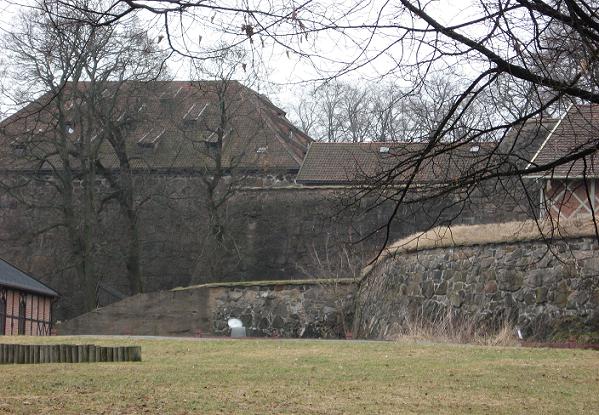
Akershus Festning is situated on a little salient in the Oslofjord. Today, the town envelops the shores on both sides and the hinterland, but in the 13th century, it was a place that could be easily defended. Akershus was built of stone and bricks from the beginning, not of timber like Vardøhus, but much of the original buildings are either gone or have been changed during time (the north wing is the oldest part of the palace). Some parts of the inner defenses still date back to the late 13th / early 14th century, like the Jomfrutårnet (Virgin's Tower) and the partly reconstrcuted Knutstårnet (Knut's Tower).
Akershus is one of the most important fortresses in Norway. It started out as fortified king's seat in ~1300, was turned into a Renaissance palace with bastions in the early 17th century, used as prison in the 19th century, and today houses the Ministry of Defence and two museums; some of the rooms in the palace are used for representation. Akershus has seen several sieges but was never taken. Read more »
I've heard there is a heat wave in parts of the US, so I'll stay in the north and post something cold. My readers in the rainy UK may think that it could be worse - at least it's not snowing, lol.
So let's go on a little tour through the world's northernmost fortress (situated at 70°22'N) in the long twilight of an Arctic spring evening. I loved those hours; you don't get colours and shades like this here.

The town Vardø is the easternmost town in Norway, located at 31°5'E, which is east of Saint Petersburg, Kiev and Istanbul. That puts Vardø (and Kirkenes) in a different timezone from Oslo, but Norway keeps one time throughout. Thus the easternmost towns are 1.20 hours ahead and at odds with daylight hours (though with the polar night and the midnight sun, that's only an issue for a few months in spring and autumn). The night before there had been dawn already at 2.30 am which did feel a bit odd, but the daylight was out of sync with Germany already in Bergen - the sun sets later in the north past equinox; I remembered that from the time I lived in Stockholm. Read more »
Here we go on our second expedition with the Fram (actually, it's the third voyage the ship made, but the more interesting one: Roald Amundsen's little trip to the South Pole. :)
The interior of the ship is very dark and cramped. They did put in some lamps but you still get a feel how it must have been like when the Fram drifted through the Polar night. The cabins were small: a bunk bed that doubled as seat, with storage room underneath, a nightstand with drawers that also served as work table, a few hooks and a bookshelf in some cabins. My cabin on the Hurtigruten tour was quite a bit larger. :)

(The grammophone and piano were the few traces of luxury.)
Roald Amundsen (born 1872) came form a family of shipowners and captains; he soon abandoned his studies of medicine in order to become an explorer. His first independent tour led him through the Northwest Passage (1903 - 1906) on a rather small yacht called Gjøa. He traveled via Baffin Bay and stayed in Gjøa Haven (Nunavut, Canada) for two winters; until he eventually managed to clear a way to Beaufort Sea and from there into the Bering Strait, thus completing the navigation of the Northwest Passage. Read more »
Let's visit the bearded seals in the Polaria in Tromsø, a mix of aquarium, museum, and research centre. Polaria was established in 1997, in order to get people acquainted with the Arctic flora and fauna, and environmental problems. It is part of the Polar Environment Centre, an institution which includes a number of research bodies, among them the Norwegian Polar Institute.

Seals are cute, and that's reason enough to post some photos. Unfortunately, they were the only ones I could catch with my camera. There's a big aquarium with a walkthrough tunnel and all, but it's impossible to get pics through the glass. Arctic waters are no sunlit coral reefs, but amazingly full of life nevertheless. Read more »
Since gladiatorial fights, play performances, and the occasional public execution were so popular with the Romans, it's not that difficult to find the remains of amphitheatres. After the earth and timber one of Birten that may date as far back as Augustean times, we'll visit another one attached to a legionary fort, the stone and timber amphitheatre of Caerleon, dating to AD 90. In a lose series of blogposts, we'll move on to the grand 2nd and 3rd century stone amphitheatres of Trier and Chester, and finally visit the partly reconstructed one of Xanten, as well as the remains of the stage theatre in Mainz.

The amphitheatre of Caerleon is one of the prettiest today because the arena and the remains of the earthen support walls are overgrown with grass and make for a nice green oasis even on an overcast and dreary day. Read more »
The first legionary fort on the Fürstenberg hill near Xanten, known as Castra Vetera I, goes back to at least 12 BC when Drusus started his campaigns into Germania. Digs during the first third of the 20th century have shown a number of at least five forts that were built partly over each other, so that most traces of the older ones have been obscured. Moreover, the first forts had been constructed in half-timbered style with earth or timber/earth walls. Aerial surveys in the last years have rendered more traces of those. But the best-researched is the fort from Nero's time that later got destroyed during the Batavian rebellion in AD 70.

After the war, the fort was rebuilt nearby as Vetera II, in a space now under the waters of the shifting Rhine. The various version of Vetera I lie under agricultural fields these days. Read more »
And now for something completely different that's not Roman or Mediaeval. After visiting the Viking Ship Museum and a stave church in Oslo, I had some time left and decided to take a jump to the late 19th / early 20th century and look at the Fram; Fridtjof Nansen's ship for polar expeditions. The ship is located inside a hall today, so I couldn't take a shot of the complete vessel; you'll get her in bits and pieces.
That's what the Fram 1 looked like. Fram means 'Forward'.

In the late 19th century, the poles were some of the few white spots left on the world map. One of the Arctic explorers trying to tackle those white spots was the Norwegian Fridtjof Nansen. He liked cold, ice and snow, it seems, because he'd already done fun things like crossing Greenland on ski. Visiting the North Pole was another voyage no one had done before, and so he put it on his To Do List (which also included finishing his PhD in Zoology and participating in ski jumping competitions). Read more »
Edward's conquest of Wales should get its own post because he's to blame for some of those big castles I visited, but the list of Posts To Write gets ever longer.
Despite the Treaty of Montgomery, Llywelyn ap Gruffydd continued to face troubles with his Welsh neighbours (esp. the princes of Powys and Deheubarth) who didn't like being the vassals of another Welsh prince; the English Marcher lords who kept trying to nibble bits off Wales; and his brother Dafydd who, like any good Welsh brother, tried to kill Llywelyn and, when the plot failed, ran off to the king of England.

When Edward I ascended to the throne and summoned Llywelyn to renew his oath of fealty, Llywelyn replied that Edward should first address his grievances about Marcher lords and hiding brothers. From Edward's point, Llywelyn's refusal to swear fealty was, of course, treason. Moreover, Llywelyn was planning to marry Eleanor de Montfort, a daughter of that rebellious baron. Read more »
I'll jump ahead a bit and leave Llywelyn the Great of House Aberffraw to another post. He is most closely connected with Dolwyddelan Castle, but I did some research on Criccieth first and that's in my notes already. I really have to clean out those and turn them into posts.
Criccieth Castle is situated on a rocky promontory overlooking Tremadog Bay. I visited it on a sunny evening and got some nice pics for you.

It is first mentioned in Brut y Tywysogyon, a Welsh chronicle. Gruffydd ap Llywelyn was kept prisoner there by his half-brother Dafydd. They both were sons of Llywelyn the Great, but Gruffydd was born on the wrong side of the blankets, while Dafydd was the son of Llywelyn and his wife Joan, an illegitimate daughter or King John of England. Now, according to Welsh inheritance laws, it was perfectly fine for an illegitimate son to be treated the same way as legitimate offspring, and thus Gruffydd, who was the older of the two, could have become the main heir. But Llywelyn wanted to introduce the Anglonorman laws that only allowed for legitimate children to inherit (he got thumbs up from the Pope, too). Thus Dafydd got the lion share which didn't sit well with Gruffydd. He visited his brother with some friends, but Dafydd obviously had more friends, and imprisoned his troublesome half-brother in Criccieth Castle in 1239. Read more »
The last post about the Ebersburg will deal with the architecture. Thankfully, there is a group of people dedicated to researching the castle and preventing further decline: They've put up a very informative website from which I took the details about the assumed layout of the castle before the better part of the stones, especially of the outer works, disappeared in mud and shrubs. Those brave guys and girls dug a lot of them out of their hiding places during the last years.

The castle encompasses a walled-in forework, and an outer and inner bailey, the latter consisting of two parts. The German words Unterburg and Oberburg would better translate as 'lower' and 'upper' bailey, since the Ebersburg is one of those German hilltop castles that are built on several levels (while the Wartburg fe. is situated on a sufficiently large promontory for the outer and inner bailey to be on the same level, others like the Plesse are built over two or three levels). Read more »
One more picture post before we go back to the regularly scheduled posts about castles, cathedrals and Romans. It's just that I have so many photos that I could put up pic spam every week. :)
These are from the dog sled tour I took near Kirkenes. Because I'm sure you'll like some cuddly Huskies.

This blog should come with sound. All those huskies (and some other dogs among them) made a lot of noise, barking and yipping like mad. But they were very friendly dogs. Read more »
I wanted to do the Hurtigruten tour for years, and in the winter season it's half the price for a voyage that leads along the Norwegian coast from Bergen all the way up to Kirkenes at the Russian border, crossing the Arctic Circle and circling the North Cape, and back again. The Hurtigruten started out as post service with some bunks for passengers in 1893, and has over time morphed into a mix of cruise, ferry service and freight transport. It's still an unusual cruise with no captain's dinner and entertainment on board (the landscape is entertainment enough), and with a lot more stops that a normal cruise. There's time to visit some of the towns along the way, and guided tours to fun places like a reindeer farm.

My journey took me first to Copenhagen and Roskilde, then by ferry to Oslo, and next by train to Bergen where the Hurtigruten starts. I left a day early at Trondheim on the way back to get more time for that town; and took the train to Oslo. Read more »
I had promised a post about the finds in the Isis Temple in Mainz which are displayed in the room protecting the excavated foundations, so here we go.
Oil lamps must have played more or less the same role in the temples as votive candles in Christian churches. Some 300 have been found in the Isis temple, all with traces of soot that proves they were used. Most of them were found lying on top of places of burnt offerings where they obviously had been deposed after the ritual was finished. But oil lamps also served to illuminate the temple.

34 curse tablets were found in the temple. The one below reads: Whatever Prima Aemilia, lover of Narcissus, will attempt and will do, wrong shall it go for her. She shall never let anything blossom; she shall be out of her mind, and all she does shall be a lie. Whatever happens to her shall be wrong. This shall be the fate of Prima [lover] of Narcissus by this tablet [...] never bloom.
Read more »
I was doing some research on the landgraves of Thuringia to go with the Ebersburg photos, and that gave me the idea to revisit their main seat, the Wartburg, which is in driving distance. And I want to show you that we not only have kaput castles in Germany but some intact ones as well.

The buidling to the left is the 12th century palas, followed by the 19th century keep;
the half timbered part is from the 15th century on older foundations
We'd been there shortly after the Wall fell, and the place was stuffed to the brim with tourists who got the same idea. The castle had been preserved during GDR times because it played such an important role in German history. Well, there were fewer tourists this time since it's not yet holiday season, but there already were international; groups from the US, Mexico, and France. A few Germans, too, but we were outnumbered. Read more »
The Ebersburg was built by Hermann I Landgrave of Thuringia between 1181-1190. The family of the Ludowings had risen from minor nobles to power and political eminence within a few generations, and the Ebersburg is only one of several castles they built on their expanding territory. The castle was once much larger than the remains make it seem today; there is a lot buried in the ground, or has completely fallen into decay. But the keep is still impressive.

The Ebersburg is situated in the south-eastern Harz foothills near Nordhausen; the northernmost fortification within the realm of the landgraves of Thuringia. The castle held a garrison but was also sufficiently large and representative to host the landgrave himself on occasion. Members of the high nobility, like the king himself, did a lot of traveling to personally see to matters (like exercising high justice) in their lands. Read more »
This post will give a short overview over the Ludowing landgraves of Thuringia and the role they played in history. We'll meet again with some people we've met before like Heinrich IV, Friedrich Barbarossa and some of his sons, plus Heinrich the Lion and Otto IV. The photos show castles built by, or connected with, the landgraves of Thuringia.

The founder of the family is Ludwig the Bearded († 1080) who bought land near Gotha in Thuringia where he set up some villages after he had the forests cleared. He soon obtained the right to build a castle (almost no remains of the Schauenburg are left, though) and married a rich heiress, that way getting lands in the southern Harz foothills. His successors continued that politics and married into the surrounding nobiliy, gaining more land by dowries. Read more »
Fredelsloh is a village not far from Göttingen. There had been an important chapter in the Middle Ages, belonging to the famous Weser abbeys I have mentioned several times. Fredelsloh isn't situated directly at the river like the other abbeys and chapters but it belongs in the same historical context.
Like Lippoldsberg Abbey, Fredelsloh was founded by an archbishop of Mainz, Adalbert I, in 1132. The abbey lies in the north-western outskirts of the fomer archdiocese and was intended as chapter following the Augustine rules. Fredelsloh gained importance very fast thanks to donations and privileges from popes, emperors and great feudal lords. Soon (I could not find an exact date) a ladies' chapter was added and some 150 people would meet during the liturgy of hours.

The counts of Dassel acted as reeves of the abbey (until 1322 when the family died out in the male line). During the feud between Welfen and Staufen, Fredelsloh managed to play both parties and get the best out of the situation. The provost Bertram was liege of the archbishop of Mainz who sided with the Welfen, while one of the chapter members, Johannes of Dassel, supported the Staufen. I'd have liked to sit in at the chapter meetings during the years of the fallout between Friedrich Barbarossa and Heinrich the Lion. I can imagine they were quite lively. Read more »
I asked Aelius Rufus to give us a tour of the Roman Bridge in Trier. Hallo Aelius.
Salvete, Gabriele and dear readers. You're some friend, making me dig out those dusty old history books so I can fill your readers in on the two bridges that were there before the one they built in my time.
Well, let's get started. Augusta Treverorum, what is now called Trier, is situated on the right side of the Moselle though today its spreads to the other shore as well, Gabriele tells me. The river widens into a valley here, framed by hills which are mostly wood covered, sprinkled with the occasional vineyeard - not enough of them for my taste - or grazing ground. But already the Roman town encroached up the hills looming behind it; the arena is situated on one of them, for example.

(The photos were taken during a Moselle river cruise.)
Trier was founded in 17 BC, and the first bridge spanning the Moselle dates to that time. The deified Augustus had just made the last of his enemies fall upon their swords or snakes and won the civil war. He now could concentrate on the neglected provinces. He sent his friend Marcus Vipsanius Agrippa to kick some German marauders out of Gaul (what is the matter with those ancestors of yours?) and bring the infrastructure up to Roman standards. You know, us soldiers want nice roads to march on, not tree roots, swamps and undergrowth. Read more »
The helmet below is considerably older than those mentioned in the previous post, predating even the Montefortino. It's an Etruscan design from 500-450 BC called Vetulonic or Negau helmet. These helmets are made of bronze, with a comb-shaped ridge across the skull and a protruding rim with a groove right above the rim. They were no longer worn in battle since about 300 BC though. The term 'Negau helmet' goes back to a depot find of 26 such helmets in Negau (today Ženjak in Slovenia) that was discovered in 1811. The proposed time of the helmets' burial is 55-50 BC, some 35 years before the territory was conquered by the Romans.

(Exhibition Imperium in Haltern 2010; loan from the Kunsthistorisches Museum Vienna)
The 23 remaining helmets can be found in museums all over the world. Several of them have inscriptions on the rim. Now, inscriptions aren't that rare; we got a number of examples from Roman helmets, mostly owner names, numbers of the legion and cohort to classify a helmet as army issue, unspectacular things like that.