My Travel and History Blog, Focussing mostly on Roman and Mediaeval Times
19 May 2019
Decorative Bones - The Sedlec Ossuary (Czechia)
Sedlec is today a suburb of the Czech town Kutná Hora, about an hour's drive from Prague. The place has become popular with tourists due to a somewhat morbid and scary attraction: the Ossuary of Sedlec. The town of Kutná Hora (Kuttenberg) is a UNESCO site and worth a visit as well. But in this post, let's get down to the bones. :-)

Bone decorations in the Sedlec Ossuary
Literally, in fact. The ossuary is located in the basement of the All Saints' Chapel in the cemetary of Sedlec. So, how did some 40,000 skeletons end up in this place, and part of those as decorations to boot? Read more »
Sedlec is today a suburb of the Czech town Kutná Hora, about an hour's drive from Prague. The place has become popular with tourists due to a somewhat morbid and scary attraction: the Ossuary of Sedlec. The town of Kutná Hora (Kuttenberg) is a UNESCO site and worth a visit as well. But in this post, let's get down to the bones. :-)
Literally, in fact. The ossuary is located in the basement of the All Saints' Chapel in the cemetary of Sedlec. So, how did some 40,000 skeletons end up in this place, and part of those as decorations to boot? Read more »
4 May 2019
From Political Movement to Bronze Figures - The Wrocław Dwarfs
Well, some of the Wrocław Dwarfs - impossible to find all of the 163 official dwarfs (krasnale) spread over the town, plus the 150+ additional inofficial ones. The tourist office offers a map to help you hunt down the wee chaps, but I thought that's pretty much like seeking Easter eggs with a GPS; therefore I just kept my eyes open in hope to notice some of the dwarfs. Let me show you the guys I found.

Welcome to Wrocław
Some are cheerful, others cheeky, and a few even look grim. But this wee chap is surely of the welcoming sort. Read more »
Well, some of the Wrocław Dwarfs - impossible to find all of the 163 official dwarfs (krasnale) spread over the town, plus the 150+ additional inofficial ones. The tourist office offers a map to help you hunt down the wee chaps, but I thought that's pretty much like seeking Easter eggs with a GPS; therefore I just kept my eyes open in hope to notice some of the dwarfs. Let me show you the guys I found.
Some are cheerful, others cheeky, and a few even look grim. But this wee chap is surely of the welcoming sort. Read more »
22 Apr 2019
Kraków and Wrocław - My Spring Journey 2019, Part 2
The second post of my Travel Return Booty will present the places I visited in Poland.

Kraków, Cloth Hall and belfry (left)
It was Palm Sunday in Kraków, an important day for Catholics in Poland, and the weather was fine to boot, so the town was rather crowded, not only with - mostly Polish - tourists, but with pretty much all inhabitants of the city and surroundings. The women and some children were carrying bouquets made of evergreen and spring flowers. It was a pretty sight. Read more »
The second post of my Travel Return Booty will present the places I visited in Poland.
It was Palm Sunday in Kraków, an important day for Catholics in Poland, and the weather was fine to boot, so the town was rather crowded, not only with - mostly Polish - tourists, but with pretty much all inhabitants of the city and surroundings. The women and some children were carrying bouquets made of evergreen and spring flowers. It was a pretty sight. Read more »
21 Apr 2019
Prague and More - My Spring Journey 2019, Part 1
I'm back from my tour through the Czech Republic and Poland, and I did indeed manage to visit some other places, besides the major towns. Here is part one of the customary overview posts.

Prague seen from the Hradčany
Prague was of course the highlight. The town is beautiful, but also pretty stuffed with tourists already in April. I wouldn't want to travel there in summer; you'd probably have to ride a Nimbus 2000 to get any photos without peoples' heads in the foreground, and the queues in front of the Hradčany ticket office will wind down halfway into the Lesser Town. Read more »
I'm back from my tour through the Czech Republic and Poland, and I did indeed manage to visit some other places, besides the major towns. Here is part one of the customary overview posts.
Prague was of course the highlight. The town is beautiful, but also pretty stuffed with tourists already in April. I wouldn't want to travel there in summer; you'd probably have to ride a Nimbus 2000 to get any photos without peoples' heads in the foreground, and the queues in front of the Hradčany ticket office will wind down halfway into the Lesser Town. Read more »
23 Mar 2019
Lithuanian History: Troublesome Cousins - Jogaila Algirdaitis and Vytautas Kęstutaitis
I mentioned the union of Poland and Lithuania under Władysław Jagiełło of Poland, formerly Jogaila of Lithuania, only briefly in my post about the history of Gdańsk. Of course, the process, and the years leading up to it, did not go as smoothly as such a brief mention may suggest. When I read up on the details, I got interested in this little piece of history, not the least because the crusades against the still pagan Lithuanians involved some noblemen from England, among them the future Henry IV. I'm preparing a post about his adventures, so this essay serves to present the historical background.

Map (copyright: Wikipedia Commons)
The map above shows the countries in north-eastern Europe in the 14th century. The borders are not exactly the same as today, but it gives a good overview: Livonia and Courland cover what are basically present day Latvia and Estonia, Baltic lands then held by the Teutonic Knights. Poland today encompasses Prussia - except for the Kaliningrad Oblast - and Silesia (the latter was part of Bohemia in the 14th century), as well as part of Pomerania. The other part of Pomerania is now the German county of Vorpommern. Contested Samogitia today is Lithuanian. To the east, Lithuania's borders stretched far into what is now Belarus and Ukraine; at its largest expanse, towns like Kiev and Smolensk belonged to the grand duchy, while Lviv/Lemberg, part of former Halych-Volhynia, was Polish. Read more »
I mentioned the union of Poland and Lithuania under Władysław Jagiełło of Poland, formerly Jogaila of Lithuania, only briefly in my post about the history of Gdańsk. Of course, the process, and the years leading up to it, did not go as smoothly as such a brief mention may suggest. When I read up on the details, I got interested in this little piece of history, not the least because the crusades against the still pagan Lithuanians involved some noblemen from England, among them the future Henry IV. I'm preparing a post about his adventures, so this essay serves to present the historical background.
The map above shows the countries in north-eastern Europe in the 14th century. The borders are not exactly the same as today, but it gives a good overview: Livonia and Courland cover what are basically present day Latvia and Estonia, Baltic lands then held by the Teutonic Knights. Poland today encompasses Prussia - except for the Kaliningrad Oblast - and Silesia (the latter was part of Bohemia in the 14th century), as well as part of Pomerania. The other part of Pomerania is now the German county of Vorpommern. Contested Samogitia today is Lithuanian. To the east, Lithuania's borders stretched far into what is now Belarus and Ukraine; at its largest expanse, towns like Kiev and Smolensk belonged to the grand duchy, while Lviv/Lemberg, part of former Halych-Volhynia, was Polish. Read more »
25 Feb 2019
A Virtual Tour through Medieval and Renaissance Gdańsk / Danzig
After the history lesson below, let's now have a little walk through Gdańsk / Danzig. Most of the famous landmarks are situated not in the Old Town, but in the - much older - Rechtstadt (Town of the Law), the part of Danzig which held town rights since 1224.
Much of Gdańsk had been destroyed during WW2, but was restored in the years after the war, with its various town gates, beautiful late Gothic gabled houses and decorated Renaissance buildings that once had been the homes of wealthy merchants and burghers, a lot of whom were of German origins. A considerable number of Germans lived in Danzig and Pomeralia (later known as East Prussia) since the early 12th century and remained there until the end of WW2.

Crane Gate
One of the iconic buildings is the Crane Gate. A timber gate with an integrated crane function had been built in 1367, but it was destroyed by a fire in 1442. A new and larger brick gate in Gothic style replaced it immediately afterwards. The wealthier burghers of Danzig collected money to its construction, and they successfully faced off the protests of the Teutonic Knights who felt their nearby castle to be threatened. Read more »
After the history lesson below, let's now have a little walk through Gdańsk / Danzig. Most of the famous landmarks are situated not in the Old Town, but in the - much older - Rechtstadt (Town of the Law), the part of Danzig which held town rights since 1224.
Much of Gdańsk had been destroyed during WW2, but was restored in the years after the war, with its various town gates, beautiful late Gothic gabled houses and decorated Renaissance buildings that once had been the homes of wealthy merchants and burghers, a lot of whom were of German origins. A considerable number of Germans lived in Danzig and Pomeralia (later known as East Prussia) since the early 12th century and remained there until the end of WW2.
One of the iconic buildings is the Crane Gate. A timber gate with an integrated crane function had been built in 1367, but it was destroyed by a fire in 1442. A new and larger brick gate in Gothic style replaced it immediately afterwards. The wealthier burghers of Danzig collected money to its construction, and they successfully faced off the protests of the Teutonic Knights who felt their nearby castle to be threatened. Read more »
23 Feb 2019
Between Polish Kings and Teutonic Knights - A History of Medieval Gdańsk / Danzig
I only spent a few hours in Gdańsk (Danzig in German; also used in English books about the historical Gdańsk), sufficient for a walk through the historical part of the town with its interesting and important buildings, but not enough time to visit the interior of the Crane and the Town Hall. But I got plenty of photos to illustrate a few posts.

Danzig, Town Hall of the 'Town of the Law'
'Town of the Law' (Rechtstadt) refers to the part of Danzig that got town rights in 1224; not to be confused with the - much younger - Old Town. Read more »
I only spent a few hours in Gdańsk (Danzig in German; also used in English books about the historical Gdańsk), sufficient for a walk through the historical part of the town with its interesting and important buildings, but not enough time to visit the interior of the Crane and the Town Hall. But I got plenty of photos to illustrate a few posts.
'Town of the Law' (Rechtstadt) refers to the part of Danzig that got town rights in 1224; not to be confused with the - much younger - Old Town. Read more »
3 Feb 2019
History of Rugia: Prince Wilhelm Malte of Putbus
I've already mentioned Prince Wilhelm Malte I of Putbus (1783 - 1854) in my prior post. He was the scion of the Slavic noble family of Putbus (the lords of Putbus trace their lineage to the 12th century) whose members had intermarried with the Swedish nobility since Rugia belonged to Sweden in the aftermath of the Thirty Years War (1648). His father was the Swedish Marshal of Court Malte Friedrich of Putbus. His mother was Sophie Wilhelmine von der Schulenburg, a German noble family who - going back to the 13th century - would rise to important positions under the kings of Prussia. Malte's grandfather Moritz Ulrich of Putbus already renovated the family palace and built a hunting lodge in the forests of the Granitz; his grandson would expand on those and found the town of Putbus around the palace.

The Neo-Gothic hunting lodge Granitz
Malte, whose father died when he was three years old, studied at the universities of Greifswald (which is not far from Rugia) and Göttingen. In July 1800, he joined the Stockholm Life Hussars, two years later he was created chamberlain, and in May 1807, he was elevated to the rank of Prince by King Gustav IV Adolf of Sweden. Read more »
I've already mentioned Prince Wilhelm Malte I of Putbus (1783 - 1854) in my prior post. He was the scion of the Slavic noble family of Putbus (the lords of Putbus trace their lineage to the 12th century) whose members had intermarried with the Swedish nobility since Rugia belonged to Sweden in the aftermath of the Thirty Years War (1648). His father was the Swedish Marshal of Court Malte Friedrich of Putbus. His mother was Sophie Wilhelmine von der Schulenburg, a German noble family who - going back to the 13th century - would rise to important positions under the kings of Prussia. Malte's grandfather Moritz Ulrich of Putbus already renovated the family palace and built a hunting lodge in the forests of the Granitz; his grandson would expand on those and found the town of Putbus around the palace.
Malte, whose father died when he was three years old, studied at the universities of Greifswald (which is not far from Rugia) and Göttingen. In July 1800, he joined the Stockholm Life Hussars, two years later he was created chamberlain, and in May 1807, he was elevated to the rank of Prince by King Gustav IV Adolf of Sweden. Read more »
30 Dec 2018
Impressions from Rugia - The Seaside Resort Binz
Binz is the prettiest of the seaside resort towns at the beaches of Rugia. It started out as fishing and farming village in the Middle Ages (its first mention on a tax collection chart dates to 1318). 'Byntze' belonged to the Principality of Rugia which later became part of the Duchy of Pomerania. After the Thirty Years war, the island came to Sweden until 1815, when it was integrated into the Prussian province of Pomerania.

The beach at Binz
In the early 19th century, Rugia was governed by Wilhelm Malte Prince of Putbus (1783-1854), first in service of the Swedish government and later as Prussian governor-general and president of the regional council. He achieved a lot of building work on the island (more about him in the next post). Read more »
Binz is the prettiest of the seaside resort towns at the beaches of Rugia. It started out as fishing and farming village in the Middle Ages (its first mention on a tax collection chart dates to 1318). 'Byntze' belonged to the Principality of Rugia which later became part of the Duchy of Pomerania. After the Thirty Years war, the island came to Sweden until 1815, when it was integrated into the Prussian province of Pomerania.
In the early 19th century, Rugia was governed by Wilhelm Malte Prince of Putbus (1783-1854), first in service of the Swedish government and later as Prussian governor-general and president of the regional council. He achieved a lot of building work on the island (more about him in the next post). Read more »
28 Oct 2018
The Flint Fields at Mukran / Rugia
The formation of the island of Rugia began about 70 million years ago during the Cretaceous period. The area was a shallow sea in which the accumulation of exoskeletons of dead microorganisms over several million years developed a 400 metres thick layer of very fine limestone. In between the chalk, layers of flint formed. Flint is a sedimentary cryptocristalline form of quartz. Its mode of formation is still discussed; the most widely accepted hypothesis is that gelationous material, like the spicules of siliceous sponges, filled cavities in the sediment (holes bored by molluscs, for example) and later became silicified.

Coastal line of the 'Schmale Heide' spit
We have seen examples of the chalk cliffs of Rugia in this post. Those are the result of the earth movements during the last three Ice Ages when glaciers from Scandinavia pushed across the area of what today is the Baltic Sea. Those glaciers moved large amounts of debris which accumulated in moraines at their fringes. The pressure upon the ground, in this case the chalk, was so great that it bulged in the places not covered by ice, especially during the last Ice Age. Those bulges would become the core islets of Rugia (see map linked in the post). Read more »
The formation of the island of Rugia began about 70 million years ago during the Cretaceous period. The area was a shallow sea in which the accumulation of exoskeletons of dead microorganisms over several million years developed a 400 metres thick layer of very fine limestone. In between the chalk, layers of flint formed. Flint is a sedimentary cryptocristalline form of quartz. Its mode of formation is still discussed; the most widely accepted hypothesis is that gelationous material, like the spicules of siliceous sponges, filled cavities in the sediment (holes bored by molluscs, for example) and later became silicified.
We have seen examples of the chalk cliffs of Rugia in this post. Those are the result of the earth movements during the last three Ice Ages when glaciers from Scandinavia pushed across the area of what today is the Baltic Sea. Those glaciers moved large amounts of debris which accumulated in moraines at their fringes. The pressure upon the ground, in this case the chalk, was so great that it bulged in the places not covered by ice, especially during the last Ice Age. Those bulges would become the core islets of Rugia (see map linked in the post). Read more »
7 Oct 2018
Impressions from Rugia - Jasmund and Königsstuhl, Kap Arkona
The island of Rugia (Rügen in German) is a fine place for hiking and I did a good deal of that. Of course, I also visited the best known sites Königsstuhl (King's Chair) and Kap Arkona, the latter on a very stormy day. There are still tourists around this time of the year, but not as many as in summer.

Chalk cliffs on the Jasmund peninisula, seen from the water
When you look at the shape of Rugia (see map) you'll notice that the mainland has 'caught' two other islands which are connected by small spits. The eastern peninsula is the Jasmund with its beech forests and chalk cliffs, the northern one is Wittow, a wind blasted land with few trees, but good ground for agriculture. The inland waters which are still connected with the sea are called Bodden, the largest is the Great Bodden of Jasmund. The spits are the 'Schmale Heide' in the south and the 'Schaabe' in the north, both with wonderful sand beaches. Read more »
The island of Rugia (Rügen in German) is a fine place for hiking and I did a good deal of that. Of course, I also visited the best known sites Königsstuhl (King's Chair) and Kap Arkona, the latter on a very stormy day. There are still tourists around this time of the year, but not as many as in summer.
When you look at the shape of Rugia (see map) you'll notice that the mainland has 'caught' two other islands which are connected by small spits. The eastern peninsula is the Jasmund with its beech forests and chalk cliffs, the northern one is Wittow, a wind blasted land with few trees, but good ground for agriculture. The inland waters which are still connected with the sea are called Bodden, the largest is the Great Bodden of Jasmund. The spits are the 'Schmale Heide' in the south and the 'Schaabe' in the north, both with wonderful sand beaches. Read more »
9 Sept 2018
Hiking in the Harz - Bode Canyon and Rosstrappe Cliff
The Harz has some beautiful and even spectacular landscapes, from tree-covered mountains and semi-Alpine meadows to charming little valleys with sparkling rivers, from windswept peaks and cliffs to canyons with waterfalls and rivers whose brown waters gush over boulders in vivid currents, from caves and abandoned mines to natural lakes and reservoirs lying in silent beauty. Most of the Harz been declared a natural preserve for a reason.

View from the Rosstrappe Cliff into the Bode canyon
I've been hiking there a lot - often together with my father - but only posted a small part of my photos so far. So there will be a series of Harz posts, among others, in the next months. Read more »
The Harz has some beautiful and even spectacular landscapes, from tree-covered mountains and semi-Alpine meadows to charming little valleys with sparkling rivers, from windswept peaks and cliffs to canyons with waterfalls and rivers whose brown waters gush over boulders in vivid currents, from caves and abandoned mines to natural lakes and reservoirs lying in silent beauty. Most of the Harz been declared a natural preserve for a reason.
I've been hiking there a lot - often together with my father - but only posted a small part of my photos so far. So there will be a series of Harz posts, among others, in the next months. Read more »
3 Sept 2018
Drinking Water for Central Germany - The Rappbode Reservoir in the Harz
During one of our Harz tours we crossed the dam of the Rappbode reservoir and stopped, so that I could take a few photos. But there are no legends about princesses in caves this time, and the lake is sadly lacking in monsters as well; it's too modern for that.
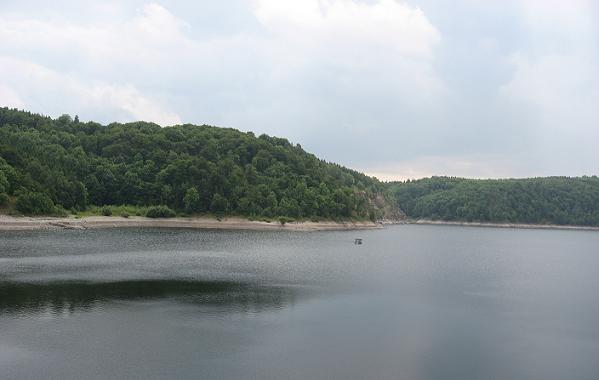
Rappbode Reservoir
The Rappbode reservoir had been built 1952-1959 as one of the prestige projects of the GDR. It is part of a system of six reservoirs, retention bassins and forebay bassins regulating the Bode estuary (the Warme Bode, Kalte Bode and Rappbode rivers) between the towns of Rübeland and Wendefurth. The catchment area of the Rappbode Reservoir is 269 square kilometres, that of the Wendefurth retention bassion 309 square kilometres; the whole system has a catchment area of 3,000 square kilometres (1,200 square miles). Read more »
During one of our Harz tours we crossed the dam of the Rappbode reservoir and stopped, so that I could take a few photos. But there are no legends about princesses in caves this time, and the lake is sadly lacking in monsters as well; it's too modern for that.
The Rappbode reservoir had been built 1952-1959 as one of the prestige projects of the GDR. It is part of a system of six reservoirs, retention bassins and forebay bassins regulating the Bode estuary (the Warme Bode, Kalte Bode and Rappbode rivers) between the towns of Rübeland and Wendefurth. The catchment area of the Rappbode Reservoir is 269 square kilometres, that of the Wendefurth retention bassion 309 square kilometres; the whole system has a catchment area of 3,000 square kilometres (1,200 square miles). Read more »
12 Aug 2018
Hiking in the Harz - Ilse Valley and Ilse's Rock
The Ilsestein - Ilse's Rock - is more than a granite promontory in the Harz mountains; it is the home of a fairy queen, a secret crystal cave full of wonders. But it is a long time since she last has been seen and invited a visitor to her hidden realm. Too many tourists around on a sunny day for her to bathe in the river, I suspect.

The Ilsestein (Ilse's Rock) hidden in the foliage
Beautiful Princess Ilse was the daughter of the Harz King and very much in love with the young knight of Westenburg, who lived in a castle on the other end of what then was still a single large plateau. But her father looked ill upon their love and smote a cleft into the plateau, forever separating both castles by a deep crevice. Princess Ilse was encased in the rock which she only can leave on certain nights to bathe in the river which bears her name. Read more »
The Ilsestein - Ilse's Rock - is more than a granite promontory in the Harz mountains; it is the home of a fairy queen, a secret crystal cave full of wonders. But it is a long time since she last has been seen and invited a visitor to her hidden realm. Too many tourists around on a sunny day for her to bathe in the river, I suspect.
Beautiful Princess Ilse was the daughter of the Harz King and very much in love with the young knight of Westenburg, who lived in a castle on the other end of what then was still a single large plateau. But her father looked ill upon their love and smote a cleft into the plateau, forever separating both castles by a deep crevice. Princess Ilse was encased in the rock which she only can leave on certain nights to bathe in the river which bears her name. Read more »
22 Jul 2018
"Palaces adorn its every shore" - The Villa Urbana in Longuich at the Moselle
Where the blueish stream expands, behold the multitude
Of villae, proudly gabled, leaning against the rocks,
And as the river wanders in a meand'ring course,
Palaces alternately adorn its every shore. (1)
Decimus Magnus Ausonius, Mosella, lines 283-286; translation by me.

The villa urbana in Longuich, east wing
One of those palaces (praetoria) praised in the poem is the Roman villa near Longuich at the Moselle. The reconstructed east wing shows only a part of the entire villa as Ausonius would have beheld it, but it is still a pretty example of Roman country estate architecture. The villa is situated on a terrace halfway up the vineyard hills framing the Moselle, with a fine view over the valley and river. Read more »
Where the blueish stream expands, behold the multitude
Of villae, proudly gabled, leaning against the rocks,
And as the river wanders in a meand'ring course,
Palaces alternately adorn its every shore. (1)
Decimus Magnus Ausonius, Mosella, lines 283-286; translation by me.
One of those palaces (praetoria) praised in the poem is the Roman villa near Longuich at the Moselle. The reconstructed east wing shows only a part of the entire villa as Ausonius would have beheld it, but it is still a pretty example of Roman country estate architecture. The villa is situated on a terrace halfway up the vineyard hills framing the Moselle, with a fine view over the valley and river. Read more »
24 Jun 2018
The Earldom of Richmond and the Duchy of Brittany - The History of Richmond, Part 2
The Earldom of Richmond and the Duchy of Brittany were still connected during the rule of Henry III, which led to problems because the duke of Brittany owed allegiance to the king of France, while the Honour of Richmond was a fief held from the king of England. Since the two kings were at cahoots most of the time, the position of the duke of Brittany / earl of Richmond was often precarious. Moreover, the lands belonging to the Honour of Richmond had sometimes been split and given to several nobles (1).

Another shot of the keep
In 1223, the Honour was split between the Earl of Chester and Duke Peter de Dreux of Brittany, acting as regent for his son John (2). Peter forfeited his part for joining the King Louis VIII of France in an attack of the English Poitou and Gascony. But Peter would have prefered Brittany to be independent of the French king, and Henry III needed his support in the war, so the Honour - obviously the complete one - was restored to Peter but a year later. When Louis died, Peter led a rebellion against his son Louis XI and his mother Blanche of Castile, but the revolt eventually failed, and he had to make his peace with the king of France. That, of course, led to the second forfeiture of the earldom of Richmond on 1234. Read more »
The Earldom of Richmond and the Duchy of Brittany were still connected during the rule of Henry III, which led to problems because the duke of Brittany owed allegiance to the king of France, while the Honour of Richmond was a fief held from the king of England. Since the two kings were at cahoots most of the time, the position of the duke of Brittany / earl of Richmond was often precarious. Moreover, the lands belonging to the Honour of Richmond had sometimes been split and given to several nobles (1).
In 1223, the Honour was split between the Earl of Chester and Duke Peter de Dreux of Brittany, acting as regent for his son John (2). Peter forfeited his part for joining the King Louis VIII of France in an attack of the English Poitou and Gascony. But Peter would have prefered Brittany to be independent of the French king, and Henry III needed his support in the war, so the Honour - obviously the complete one - was restored to Peter but a year later. When Louis died, Peter led a rebellion against his son Louis XI and his mother Blanche of Castile, but the revolt eventually failed, and he had to make his peace with the king of France. That, of course, led to the second forfeiture of the earldom of Richmond on 1234. Read more »
10 Jun 2018
Gibraltar of the North - A Virtual Tour through Luxembourg City
The historical centre of Luxemburg lies on a rocky plateau that is surrounded on three sides by the rivers Alzette and Pétrusse which have carved out a forty metres deep valley. A settlement at the Alzette, known as Grund, dates to the 11th century. Today, the town has spread along the rivers and to the hills on the other side of the valley, which in turn is spanned by a number of bridges. That particular situation, together with the fortifications that have been built on and into the rocks during several centuries, earned Luxembourg the nickname 'Gibraltar of the North'. The town is part of the UNESCO Cultural Heritage since 1994.

Luxembourg - a city on different levels
Sightseeing in Luxembourg City means a lot of walking uphill and downhill, either on stairs or steep lanes. There are also two elevators which lead from the valley quarters Grund and Pfaffenthal to the Upper City. The payoff are an abundance of great vistas, esp. when the weather is playing nice - sunny with some interesting cloud formations - like I did when I visited the town. Read more »
The historical centre of Luxemburg lies on a rocky plateau that is surrounded on three sides by the rivers Alzette and Pétrusse which have carved out a forty metres deep valley. A settlement at the Alzette, known as Grund, dates to the 11th century. Today, the town has spread along the rivers and to the hills on the other side of the valley, which in turn is spanned by a number of bridges. That particular situation, together with the fortifications that have been built on and into the rocks during several centuries, earned Luxembourg the nickname 'Gibraltar of the North'. The town is part of the UNESCO Cultural Heritage since 1994.
Sightseeing in Luxembourg City means a lot of walking uphill and downhill, either on stairs or steep lanes. There are also two elevators which lead from the valley quarters Grund and Pfaffenthal to the Upper City. The payoff are an abundance of great vistas, esp. when the weather is playing nice - sunny with some interesting cloud formations - like I did when I visited the town. Read more »
3 Jun 2018
Urban Wildlife
Here's a little picture post to tide you over while I'm sorting through all those Luxembourg photos to prepare a city tour post.

Curious hedgehog
I caught that wee chap on the meadow behind our appartment building. He was busy nosing through the grass in search of tasty morsels, and for a brief moment looked up to check what was about. Then he went back to food hunting.

Acrobatic squirrel
I met with the acrobatic squirrel climbing a wall in an artificial ruin in the Park at the Ilm in Weimar. Red squirrels are still common in Germany, and this was a particularly pretty specimen in all its bushy-tailed glory.
Here's a little picture post to tide you over while I'm sorting through all those Luxembourg photos to prepare a city tour post.
I caught that wee chap on the meadow behind our appartment building. He was busy nosing through the grass in search of tasty morsels, and for a brief moment looked up to check what was about. Then he went back to food hunting.
I met with the acrobatic squirrel climbing a wall in an artificial ruin in the Park at the Ilm in Weimar. Red squirrels are still common in Germany, and this was a particularly pretty specimen in all its bushy-tailed glory.
21 May 2018
Pretty Houses and a Famous Minster – A Virtual Tour through Strasbourg
Strasbourg is a pretty town and even prettier in sunshine. But since I visited the place on a sunny Sunday in late April, there were more tourists than in Bruges. It was almost impossible to get photos without people standing in front of the vistas.
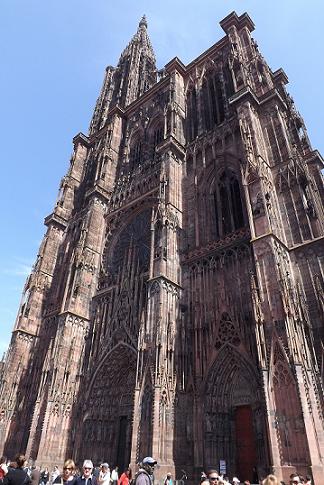
Strasbourg is best known for the famous Minster (Cathedral of Our Lady). Its construction began in the 12th century, but it would take until 1439 to finish the building - and only the north tower was erected to its intended height of 142 metres. At that time, the Minster of Strasbourg was the tallest building in the known world, surpassing the pyramids of Gizeh.
6 May 2018
What I Visited – Castles in the Eifel and Luxembourg
As promised, here is the introductory post about the castles and fortifications I visited. As usual, longer posts will follow sometime.
I decided for the Manderscheid Castles in the Eifel instead of one of the castles directly at the Moselle, because they offer some spectacular ruins and are less tourist infected than fe. Castle Eltz.

Castle Lower Manderscheid (Niedermanderscheid) seen from the upper castle
The double castle of Manderscheid in the Eifel is an impressive structure, particularly the castle of Lower Manderscheid (Niedermanderscheid). It was the only day of my journey that started with rain, but fortunately, the sun came out later and enabled me to enjoy the hiking tour of both castles. On a wet day, the Eiffel slate is rather slippery. Read more »
As promised, here is the introductory post about the castles and fortifications I visited. As usual, longer posts will follow sometime.
I decided for the Manderscheid Castles in the Eifel instead of one of the castles directly at the Moselle, because they offer some spectacular ruins and are less tourist infected than fe. Castle Eltz.
The double castle of Manderscheid in the Eifel is an impressive structure, particularly the castle of Lower Manderscheid (Niedermanderscheid). It was the only day of my journey that started with rain, but fortunately, the sun came out later and enabled me to enjoy the hiking tour of both castles. On a wet day, the Eiffel slate is rather slippery. Read more »
What I Visited - Romans at the Moselle
I'm back with another bunch of photos, so here is one of the usual introductory posts. There are a lot or Roman remains, particularly villae, around Trier and along the Moselle. The land is now mostly part of Germany, but in Roman times it belonged to the province of Gallia Belgica and was strongly influenced by Roman civilization.

The Porta Nigra at night
I said in the post below that I wanted to revisit the Porta Nigra because I didn't take enough photos of it during my first visit. Well, there is no shortage of photos now. *grin* Read more »
I'm back with another bunch of photos, so here is one of the usual introductory posts. There are a lot or Roman remains, particularly villae, around Trier and along the Moselle. The land is now mostly part of Germany, but in Roman times it belonged to the province of Gallia Belgica and was strongly influenced by Roman civilization.
I said in the post below that I wanted to revisit the Porta Nigra because I didn't take enough photos of it during my first visit. Well, there is no shortage of photos now. *grin* Read more »
8 Apr 2018
Normans, Angevins and Britons - The History of the Honour of Richmond, Part 1
Richmond Castle, situated on a cliff above the river Swale in northern Yorkshire, is one of the finest examples of Norman architecture since it has not been altered in later centuries and displays the largest remains of 11th century architecture in England. It was part of the Honour of Richmond, a vast accumulation of lands which encompassed possessions in several counties in England. No wonder its history turned out to be rather convoluted. The castle itself played but a small role in comparison, but the photos serve as a nice illustration to the history posts.

Richmond Castle, the keep
William's conquest of nothern England did not go smoothly. Rebellions flared up in 1069/70, supported by Edgar Ætheling, last surviving member of House Wessex, who had found shelter with King Malcolm III Canmore of Scotland, Edwin and Morcar of Mercia, Gospatric of Northumbria - whom William had installed as earl - and his cousin Waltheof of Northumbria. They made a pact with King Sveyn Estridson of Denmark, so there was a significant threat to William's rule. Read more »
Richmond Castle, situated on a cliff above the river Swale in northern Yorkshire, is one of the finest examples of Norman architecture since it has not been altered in later centuries and displays the largest remains of 11th century architecture in England. It was part of the Honour of Richmond, a vast accumulation of lands which encompassed possessions in several counties in England. No wonder its history turned out to be rather convoluted. The castle itself played but a small role in comparison, but the photos serve as a nice illustration to the history posts.
William's conquest of nothern England did not go smoothly. Rebellions flared up in 1069/70, supported by Edgar Ætheling, last surviving member of House Wessex, who had found shelter with King Malcolm III Canmore of Scotland, Edwin and Morcar of Mercia, Gospatric of Northumbria - whom William had installed as earl - and his cousin Waltheof of Northumbria. They made a pact with King Sveyn Estridson of Denmark, so there was a significant threat to William's rule. Read more »
30 Mar 2018
Winter Night on Hardangervidda - From Oslo to Bergen by Train
I took the afternoon train from Oslo to Bergen, well aware that the last part of the journey would take place in darkness. But as it turned out, there was sleat later changing into rain once we passed the Hardangervidda, so I didn't miss much since the scenery would have been veiled by rain and fog anway.
The first part of the ride offered a mostly overcast sky and the long period of twilight typical for late March in the north. I managed to get some photos out of the moving train - a journey into winter indeed. Snow was piling up high on the Hardanger Plateau.

Lake Krøderen
Like the Dovre Railway, the Bergenbanan (Bergen Railway) was built in bits and pieces. The part from Bergen to Voss dates to 1883. There also was a railway from Oslo to Drammen since 1866. The whole single track line connecting those parts was finished in 1909. It covers a distance of almost 500 kilometes (310 miles), with some 180 tunnels and 300 bridges; the ride takes about seven hours. Read more »
I took the afternoon train from Oslo to Bergen, well aware that the last part of the journey would take place in darkness. But as it turned out, there was sleat later changing into rain once we passed the Hardangervidda, so I didn't miss much since the scenery would have been veiled by rain and fog anway.
The first part of the ride offered a mostly overcast sky and the long period of twilight typical for late March in the north. I managed to get some photos out of the moving train - a journey into winter indeed. Snow was piling up high on the Hardanger Plateau.
Like the Dovre Railway, the Bergenbanan (Bergen Railway) was built in bits and pieces. The part from Bergen to Voss dates to 1883. There also was a railway from Oslo to Drammen since 1866. The whole single track line connecting those parts was finished in 1909. It covers a distance of almost 500 kilometes (310 miles), with some 180 tunnels and 300 bridges; the ride takes about seven hours. Read more »
11 Mar 2018
A Trace of Spring in Dovrefjell - From Trondheim to Oslo by Train
I took the train from Trondheim to Oslo mid-April 2011 after the Hurtigruten voyage and managed to take some photos out of the moving train. The usual caveat for pictures taken out of a train or bus applies: there might be some reflections from the windows and slight blurs.

Kongsvoll Mountains.
I traveled the Dovre Railway in the 'wrong' direction. When it was built, the first stage covered the way from Oslo to Eidsvoll and was the first railway in Norway (1854). The line was then built in bits and parts. The stretch between Søren and Trondheim dates to 1864, followed the connections between Eidsvoll - Hamar - Lillehammer etc., while the last part from Dombås to Søren - the original Dovre Railway which today gives the name to the entire route - was finished in 1921. Read more »
I took the train from Trondheim to Oslo mid-April 2011 after the Hurtigruten voyage and managed to take some photos out of the moving train. The usual caveat for pictures taken out of a train or bus applies: there might be some reflections from the windows and slight blurs.
I traveled the Dovre Railway in the 'wrong' direction. When it was built, the first stage covered the way from Oslo to Eidsvoll and was the first railway in Norway (1854). The line was then built in bits and parts. The stretch between Søren and Trondheim dates to 1864, followed the connections between Eidsvoll - Hamar - Lillehammer etc., while the last part from Dombås to Søren - the original Dovre Railway which today gives the name to the entire route - was finished in 1921. Read more »
3 Mar 2018
The Architecture of Scarborough Castle
After the tour through the earlier and later history of Scarborough Castle, let's have a closer look at some of the architectural features.

The barbican seen from the viewing platform;
the double D-shaped outer gate is to the left, the first bridge to the right
Since the castle is situated on a headland with steep cliffs (about 90 metres / 300 feet high) on three sides, there was only the landward side which needed additional protection. A double ditch was cut and curtain walls put up; the remains of the present ones date mostly from the 12th and early 13th centuries. The entrance was defended by a gatehouse with a double D-shaped tower on the land side, as well as two drawbridges (which today have been rebuilt in stone) and a walled-in walkway. There likely had been a portcullis, too. Read more »
After the tour through the earlier and later history of Scarborough Castle, let's have a closer look at some of the architectural features.
the double D-shaped outer gate is to the left, the first bridge to the right
Since the castle is situated on a headland with steep cliffs (about 90 metres / 300 feet high) on three sides, there was only the landward side which needed additional protection. A double ditch was cut and curtain walls put up; the remains of the present ones date mostly from the 12th and early 13th centuries. The entrance was defended by a gatehouse with a double D-shaped tower on the land side, as well as two drawbridges (which today have been rebuilt in stone) and a walled-in walkway. There likely had been a portcullis, too. Read more »