My Travel and History Blog, Focussing mostly on Roman and Mediaeval Times
The second introductory post of my journey to Lübeck and Schleswig: The open air museum in Haithabu near Schleswig - on the peninsula that separates the Baltic Sea from the North Sea - has been on my list for some years. Because Vikings. *grin* Actually, the site is of historical interest beyond some reconstruced houses and shiny finds. King Heinrich the Fowler conquered the town, then in Danish possession, in 934, and his sons kept having trouble with the Danes in the years to come not least because of the importance of Haithabu.

Haithabu, also known as Hedeby in ancient sources, was a major trade settlement from the 8th to the 11th century. A new settlement evolved on the other side of the river Schlei (the present day town of Schleswig) after the place was abandonend, therefore the remains of Haithabu have never been built over. Excavations take place since the early 20th century and recently some houses have been reconstructed as open air museum. Read more »
I finally found time to sort through my photos and write the obligatory introduction posts to my latest little journey to the Hanseatic towns of Lübeck and Wismar, and visiting some Vikings in the open air museum of Haithabu near Schleswig.

The Holstentor IS sagging a bit due to a soft underground; that's not the fault of the photo. It is a fine example of representative brick architecture and shows that the merchants and town council had the money to build in grand style. Read more »
I'll be away on the little trip to the Baltic Sea I mentioned in the post below until the beginning of May. But I'll leave you with some photos of fairy tale castles that have been connected to the stories collected and retold by the Grimm Brothers. The Grimm Brothers lived, studied and worked first in Kassel, later in Göttingen, and part of the oral traditon that was included in their fairy tale collection came from the area around these towns. So it is no surprise that some castles became connected with those tales. The local tourist management is grateful for that. *grin*

The Trendelburg, situated on a promontory in the Reinhardswald Forest in the western Weser uplands, is said to have been the home of Rapunzel or the Maiden in the Tower. The 38 metres high keep would indeed make a prison for a fair princess. Though today there is a door ar ground level so you don't have to climb a hairy ladder. Read more »
The church in the small village of Wiebrechtshausen near Northeim is another of those pretty Romansque churches you can find in off road corners in Germany. It is one of the sites where I got a bunch of photos but not much information to go with them, in this case likely due to the fact that Wiebrechtshausen never played a significant role in the great historical events.

The most important event connected with the nunnery is the burial of Duke Otto of Braunschweig-Göttingen († 1394), first outside the church because he had been excommunicated. After his wife managed to get the ban lifted in 1400, a chapel connected to the church was erected over his tomb. The connection with House Hannover also helped in getting funds for repairs in later times, so the church is in a good condition today. Read more »
We've seen that Chepstow Castle was still considered a fitting accomodation during the Tudor times, albeit with some added comfort. It also continued to be of strategially importance in controlling the crossing of the Severn.
While changes in Tudor times involved the living quarters, later alterations served to adapt the fortifications to modern warfare, like those made to the battlements in order to accomodate cannons.

Chepstow was still in possession of the earls of Worcester at the outbreak of the Civil War in 1642. At the time it was held by Henry Somerset, the fifth earl (later created 1st Marquess of Worcester) who had converted to Catholicism and declared for King Charles. Henry supported the king - not at least thanks to his enormous wealth by rising regiments and such - while holding a low profile himself, but when King Charles escaped the battle of Naseby and sought shelter in Raglan, another Worcester castle and the earl's main seat, Henry Somerset got actively involved in the war. Read more »
There are a few notes about historical events and persons connected with Chepstow Castle in the guidebook, so I've tried to find additional information to connect those local events with the larger historical picture. But this post still remains a collection of historical vignettes instead of an in-depth essay; most of it is just too far outside my areas of research (and book collections).

Edward II gave Chepstow Castle to his half-brother Thomas of Brotherton in 1312. Thomas left the actual management of the pace to a constabler who disappeared for an unknown destination two years later, taking the money chest with him. Read more »
Chepstow Castle is one of the first generation Norman castles in Wales, built in the wake of William the Conqueror's conquest of England and what parts of Wales and Scotland he could snatch. The Welsh didn't like being snatched, though, and thus William had to erect a number of castles in the borderlands, the Marches, as defense as well as base for further conquests.
Throughout the Middle Ages, Chepstow was the administrative centre of the Marcher lordship of Striguil. During those years, the castle had been expanded and altered, but the first keep, the Great Hall, still stands.

King William gave the task of organising the border defenses to William FitzOsbern lord of Breteuil, his childhood, friend, later his steward and his chief military strategist. FitzOsbern also led men of his own at the conquest. Read more »
Castle Plesse was founded some time before 1100 and in use until 1660. During those centuries, the castle underwent several changes to adapt it to the changing ways of warfare (like the addition of musket balistrarias). Most of these were done by the Lords of Plesse. Since often several members of the family shared in the inheritance of the castle and lived there together, we have some inventary lists of buildings and goods that allow to reconstruct the former look of the castle. Even more interesting are some pencil and ink sketches done by Landgrave Moritz of Hesse-Kassel in 1624 (see below). The architecture of the Plesse is thus well documented. Today mostly ruins are left except for the keep, the - partly reconstructed - great hall, and the so-called Little Tower. There are also substantial remains of the chapel and porter's house, and the curtain walls.

Castle Plesse sits on a 300 metres high promontory overlooking the Leine valley and the main north-south running Heerstrasse (military road), a connection that has been in use basically since the Roman campaigns under Drusus in BC 11. Today the Highway 7 still follows the same route.Read more »
I've mentioned in this post, that Bernhard of Höckelheim replaced Robert as Lord Commander of Castle Plesse in about 1150. At that time he must have held the castle as fief from the counts of Winzenburg - first from Hermann and after his death in 1152 from Hermann's nephew Otto (the son of his brother Heinrich of Assel). When Otto died without surviving offspring in 1170, the fief fell back to the bishop of Paderborn. It was then granted directly to Bernhard and his brother Gottschalk of Höckelheim. They are called 'edelfrei' which means they were of free men of noble birth and not ministeriales (1) and carried the title comes de Plesse (2) since 1183. Today they are known as Edelherrn von Plesse - Noble Lords of Plesse.

The Höckelheim family was probably around longer, but documentary evidence can only be traced to the father of Bernhard and Gottschalk, Helmold von Höckelheim (1079-1144). His descendants moved their main seat to Castle Plesse from which they took the name, but the family retained the Höckelheim possessions (some 20 miles south of the Plesse) where they founded a monastery in 1247. Read more »
This is only a brief introduction to the history and the historical buildings of Paderborn. There's much to see, and most of the churches and other buildings presented in this post deserve their own posts in the future. But for now, come with me on a short trip through a town rich in history and architecture. Sorry the weather wasn't playing more nicely; sunny photos would have been more pretty.

Paderborn was founded by Charlemagne in 776, during the first years of his long war to conquer the - then pagan - Saxons. He built a palatine seat and a church, both surrounded by a wall since those Saxons were not exactly a peace loving lot at the time. He also held several diets in Paderborn. The town and the bishop's see that was established in 806 would play an important role for centuries to come. The bishops were elevated to princes of the realm in 1217; Paderborn is an archespiscopal see until today (my regular readers will have come across the bishops of Paderborn a few times already). Read more »
I know I've been a bad blogger and not updated for weeks. Well, I blame a nasty cold, lots of work at the money job, a nice journey (yay) and more job work. But I've finally found time to sort my latest photo booty and share some of them with you.
Our four day tour this time led us westward, to Paderborn (which will be covered in its own post) and the the area of Lippe / Egge Mountains / Teutoburg Forest. A land equally rich in history as the Harz, with its share of castles and churches.

The Archaeological Open Air Museum in Oerlinghausen is a fun place and we spent a nice bit of time there. They got everything from a tent of the reindeer hunters to a 7th century Saxon long house. Since it was late into the season already, there were no performances of old crafts, but also almost no tourists. Read more »
The weather on our Paderborn and Surroundings tour was unfortunately not very cooperative; overcast sky at best, often with mist, drizzle or downright rain. So you'll get some autumn photos that'll make you want to sit inside with a nice hot tea.
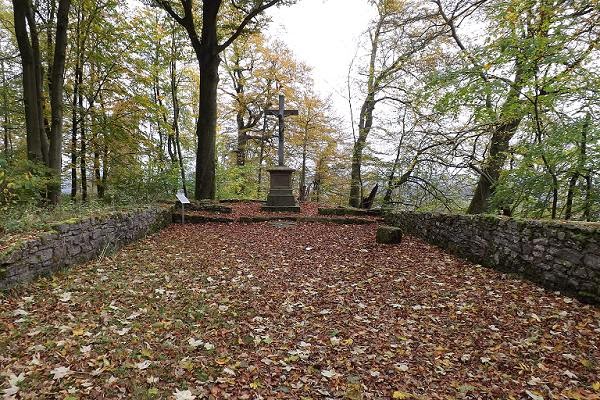
Not much remains of the Iburg today, but there was a Saxon hillfort already in the 8th century, which Charlemagne conquered. He had a chapel built there and gifted the place to the bishop of Paderborn. In 1189, bishop Bernhard II built a castle around the chapel (which he expanded), using some of the old wall and trench structures. The castle was destroyed by Otto of Braunschweig in 1444. Read more »
Castle Plesse near my hometown Göttingen is a fine example of a typical Mediaeval hilltop castle. Though pretty large for the area and extended over time, The Plesse as it is called, is not as formidable as the Norman castles in Wales, or the Wartburg in Thuringia, but it's also less tourist infected. The manor of the lord has been reconstructed and holds a restaurant, but it's closed on Mondays, so I chose a Monday to visit the place.

The rise of the mountain castles falls into a period of internal struggles and changes in Germany. Kings, nobility and high ranking churchmen got into conflicts with each other in the 11th century, which finally led to a stronger position for the latter two, and a weakened king. Castles were not only built for defense, but were status symbols as well. Originally, only the king had the right to build castles; he then gave them to the nobles as fiefs or sometimes allodial possessions, but now whoever had the power and the means built castles. Soon Mediaeval German lords couldn't see a hill without wanting to get a castle up there. *grin* No wonder I have six of them within half an hours driving distance. Read more »
The castle today known as Heldenburg was first mentioned in chartes in the early 14th century as castrum soltho der helden which means 'the castle at the place near saltworks on a slope' (1). Salt had been extracted in the area since the 13th century and maybe earlier, so the castle likely dates back to the 13th century and served to protect the saltworks. Its founders were either the Welfen dukes or the counts of Dassel, one of the leading families of the area who also may have built Grubenhagen Castle.
The history of the castle is more easily to trace from the time it came into possession of Heinrich Mirabilis (2) Duke of Braunschweig. He was a great-grandson of Heinrich the Lion and Matilda of England, daughter of Henry II. In for a bit more geneaology? *grin*

When Heinrich the Lion was banned in 1182, he lost his titles and all his lands. Upon his second return from exile in 1189, he regained the possessions inherited from his mother, Gertrud of Süpplingenburg, the only daughter of Emperor Lothar - which was a considerable chunk of lands in northern Germany - but not the lands of his father Heinrich the Proud in Bavaria. The status of the Welfen family was a bit of a limbo. They had lost their titles as Dukes of Saxony and Bavaria (3) but on the other hand they were more than mere local nobility, because they could still marry into royal families and stand as candidates for the kingship. Read more »
Continuation of this post, with some random photos.
The arrival in England of the Empress Matilda, claimant to the English throne, who was supported by her illegitimate half-brother Robert of Gloucester, in September 1139, changed the political map. Ranulf of Chester, David’s rival for Carlisle, joined her party.
At first, David watched from the sidelines, consolidating his position in Northumberland and Cumbria by a net of feudal and marital relationships between himself, his son Henry, William fitz Duncan, and various nobles, among them Eustace fitz John and the Umfravilles who became members of Henry's close entourage. Robert Bruce of Annandale resumed his feudal relationship with David after the treaty of Durham, and Bernard de Balliol swore an oath as well. Hugh de Morville had always been faithful to the king.
The castles at Newcastle and Bamburgh were again brought under David’s control, and he attained dominion over all of England north-west of the River Ribble and Pennines. He held the north-east as far south as the River Tyne, the border of the core territory of the bishopric of Durham. David also rebuilt the fortress of Carlisle which replaced Roxburgh as his favoured residence.
Salvete carissimi lectori, it's Aelius Rufus again. Gabriele told me I should tell you a bit about the Limes fort in Aalen since that's from my time.
Gabriele has also added two maps about the Limes to her post with Roman maps so our dear readers won't get lost in the German forests.

The German Limes, or as it's usually called, Upper German-Raetian Limes (Obergermanisch-Rätischer Limes) has a few things in common with Hadrian's Wall where my friend Gaius Fannius lives. Read more »
Hi, it's me, Aelius Rufus. Gabriele has taken an old post of me and added some of those little pictures and more information, so I have to retell a few things. I got to see the cavalry fort at Aalen which dates to the time of Antoninus Pius, and she thought it would be fun to compare the soldiers' barracks of the standard Hadrian's Wall / Limes forts to the cavalry ones.

That's the place where my friend Gaius Fannius commands a unit of the 5th cohort of Gaul auxiliary, sometimes visited by the mysterious, time traveling Merlinus. Well, he's a centurion and gets some more space to his own. Read more »
Yesterday, I promised someone on Twitter that I would post some photos of historical guns and rifles I took in the museum in Coburg Fortress. So here we go.

The history of Coburg Fortress (Veste Coburg) goes back to the 11th century, but I'll leave that for another post. It is one of the castles that has never fallen into ruins, but was altered significantly over time. Albeit some old features still remain, like the Romanesque lower part of the Blue Tower or the Gothic High House, the most striking parts today are the fortifications from the 16th century. Read more »
34°C this afternoon. That's just mad.
And so I looked for some photos with nice, cool water. :-)

Sunshine and pretty green grass is a bonus. I would have loved to walk barefoot, but there were too many sheep droppings. Read more »
The Limes, the frontier between the Roman Empire and Germania, runs south of Nuremberg and thus I was able to visit some Roman places. And Regensburg is on the Roman side anyway. Aelius Rufus was quite happy, though I had difficulties getting him out of the baths in Weissenburg. *grin*

Aalen was a fort for an ala milliaria, a double cavalry unit. What remains today are the foundations of the principia, the main administrative building in the centre of the fort. One can only try to imagine how large the entire fort had been; part of it is now covered by a cemetary. Read more »
All towns I visited (actually, Nuremberg is a city) date back to at least the Middle Ages and are rich in history, which means rich in old buildings other than the churches and castles. Here are a few.

on a islet in the river Regnitz
There was some quarrel about the location of the town hall; old town (the part around the cathedral) or new town (which now is old, too), so an islet in the river was expanded by heavy oak posts rammed into the ground, and the town hall was built right on the boundary. Read more »
I have mentioned that one of the reasons the Krukenburg fortifications were built was to protect the monastery of Helmarshausen - Helmareteshus - in the valley beneath the castle. Of this monastery not much is left; only the foundations of the church (that have been marked so one can see the layout of the building), and the eastern wing of the adjacent monastery buildings that today houses a youth hostel. Stones from the church, which fell into decay in the 17th century, have been used to build a large barn in 1749.

The monastery was founded by count Ekkehard of Reinhausen and his wife; one source says because they had lost their young son and heir. The foundation was confirmed by Emperor Otto III and Pope Sylvester II in 997. The counts of Reinhausen (today a village near Göttingen) were a branch of the Esicon (sometimes also named Asicon) family which also was the ancestor of the more famous Billung family. Read more »
I know I've been neglecting this blog lately. So here's a post about Krukenburg Castle, with a few detours beyond the local history to the larger events involving the politics in which the Krukenburg only played a marginal role.

The Krukenburg sits on an 80 metres high spur above the village and former monastery of Helmarshausen, near Karlshafen where the Diemel river confluences into the Weser. The place is a ruin nowadays, but a pretty one – esp. in sunshine – and of somewhat unusual layout. I’ve been there several times, and the last time - in 2010 - I got the digital camera so I could share some photos. Read more »
With the conflict between Henry’s daughter and appointed heir, Matilda, and his nephew Stephen who also claimed the throne, things got really interesting in Northumbria.
Among other adventures, Alnwick Castle and its lord Eustace fitz John will come back into focus again. Ivo de Vescy, who had received the castle in 1095, erected the first Norman stone fortifications. His daughter married Eustace fitz John who was given the right to the castle and title. Eustace fitz John made a career under Henry I (I have mentioned him as one of the ‘colleagues’ of David already before he became king of Scots). The marriage to the rich heiress Beatrix de Vescy (before 1130) gave Eustace Alnwick and other lands in Northumbria, another marriage lands in Malton in Yorkshire, and he evolved as one of the key players during the reorganisation of the Northumbrian society under Norman control. Eustace also was one of the justiciars of the North and Keeper of Bamburgh Castle. Read more »
The book I was waiting for has finally arrived, but since I meawhile had prepared a post about one of the many German castles I’ve visited and never got around to posting about, I’ll give you some info and photos about Castle Polle first. Because castles are always fun. :-)
Unfortunately, there's not much research material so I have to rely on online information and a few tables set up in the castle which I photographed.

Castle Polle is one of the castles in possession of the Counts of Everstein about whom I blogged when I had visited one of their other castles. Other than the Kugelsburg which was held by a chatellain, Polle was frequently inhabited by the family. The castle lies only a few miles south of the main seat at Everstein Castle on the other side of the river (of which almost no traces remain). It occupies a strategically important position on a rocky hill with three steep sides at a bend of the Weser with a good view over the river. It guarded the crossing, and the counts of Everstein also had the right to take a toll from the ships travelling the Weser. No wonder the possession of the castle would not remain uncontested. Read more »
Here are some landscape photos to tide you over the wait for the next post about Scottish history.

I took all the photos out of the bus, so there may be slight reflections from the window - I got a front seat - and some blurs. I deleted the worst offenders, but the pics are not up to my usual quality. Still, they're pretty enough to share. Read more »
The death of both King Malcolm III and his designated heir Edward at Alnwick in November 1093, as well as Margaret who might have been able to keep the remaining family together, soon thereafter, led to the usual succession quarrels. Malcolm’s brother Donald Bán came out of the woodwork (or wherever he had spent the last twenty or so years) and claimed the throne. Since primogeniture was not yet established in Scotland, he had a valid right to it, and he got the backing of those Scots who didn’t like the strong English element at Malcolm’s court.
The remaining sons of Malcolm and Margaret were forced to flee to England, to William Rufus. One can only imagine what they thought about having to seek shelter with the man who indirectly was to blame for their father’s and brother’s death. Moreover, while William took them in generously enough, he already was backing a Scottish king-to-be against the anti-English Donald Bán: Duncan, Malcolm's eldest son with Ingibjorg. William Rufus had fred Duncan from his status as hostage when he came to power in 1087, but Duncan, thoroughly Normanized, prefered to stay at William’s court. Duncan also cemented his position in Northumbria by marrying the granddaughter of Earl Gospatric, Octreda. Since they already had children in 1094, the marriage must have taken place earlier - an attempt of William to already groom Duncan as successor to the Scottish throne when his problems with Malcolm III increased? Read more »
Hi, just a photo post today. I'm doing Nano again, plus I had a special qualifications course for work that left me pretty braindead in the afternoons. We'll be back to Alnwick Castle in December.

There are several ways to cross from the mainland to Orkney; the best known is the car ferry from Scrabster to Stromnes. But I took the bus from Inverness which connects to the person ferry from John O'Groats to Burwick (and another bus to Kirkwall). It's a nice way to see a lot of landscape. Read more »