The Lost Fort
My Travel and History Blog, Focussing mostly on Roman and Mediaeval Times
A Summer Afternoon in Germany
The weather is fine these days albeit a bit on the hot side (at least for me who thinks anything above 25°C is what hell must be like). So my father and I decided to take a little tour down to the Weser, one of our favourite areas. We found a few things on the way.
-- A pink palace:
 Welfenschloss, Hann.-Münden
This pretty building is the Welfenschloss in Hannoversch-Münden, built by Duke Erich II of Calenberg-Göttingen in 1560 in the style of the so called Weser Renaissance. It was a residental palace used for living, but also provided rooms for the administration of the area. In later generations its importance as ducal seat decreased, and in 1849 the south wing burned down. Today it houses the town library, a museum, and the tax office. Read more »
Mull - From Craignure to Fionnphort
I managed to take some photos from the bus though it was tricky. The best chances were when the bus had to stop to let a car pass on the single track road. The bus tour takes about an hour and goes through some of the most scenic parts of Mull.
 Glen More
In the morning, the weather was pretty bad - typical Scottish, people say, though my experiences included a lot of sunshine both times I went to Scotland. There are eagles in Glen More, but they must have kept elevenses; we didn't see any. That's a Swiss bus in front of us. Read more »
Dunstaffnage Castle - An Ancient MacDougall Stronghold
Dunstaffnage Castle stands on a rock promontory where Loch Etive meets the Firth of Lorn, thus guarding the entrance into central Scotland via Loch Etive and the Pass of Brander. The promontory also shelters Dunstaffnage Bay from the westerly winds and provides a good harbour.
The castle looks forbidding from the outside, but it's actually a nice place to visit on a sunny summer afternoon. And because someone is bound to ask - yes, there was a plotbunny hiding in the entrance archway. :)
 Dunstaffnage Castle
The rock foundation and castle walls rise to 15 metres and more, with the entrance several metres above ground. In former times, the way between the outer staircase and the gates was additionally protected by a drawbridge. Definitely not an easy place to get into back in the Middle Ages. Today you only need to pay your fee in the house outside the castle, ascend the stairs and cross a solid wooden bridge, without danger of someone shooting arrows at you from the - now completely ruined - corner tower. Read more »
West Highland Line Impressions
This one can probably called a pic spam post, lol. Just some photos I took on the train from Glasgow to Oban. I'm very busy writing right now and too lazy to do a long post.
 A train of the West Highland Line
The West Highland railway line is considered one of the most scenic in the world. It goes from Glasgow to Fort William and Mallaig, with a side line branching off to Oban at Crianlarich. Read more »
Edinburgh Views
My first afternoon in Edinburgh was a sunny one - the clouds never got in the way but added nicely to a more interesting sky in the pictures.
 Firth of Forth, seen from the castle
Ten years ago I visited Edinburgh Castle on a cold, misty morning which lent it a menacing air. But I had the place more or less to myself. This time I visited on a sunny afternoon which makes the castle look more accomodating. The flip side were lots of tourists walking through my photos. Read more »
Staffa
The tour from Fionnphort / Mull to Staffa took place during some of the few hours of rain I had on my trip. The other one had been Inchcolm where I bought a rain cape in the gift shop (Historical Scotland knows why they sell those, lol), and it proved useful in the open boat to Staffa as well.
Staffa is a small island (200x600 metres) in the Inner Hebrides, famous for its unusual hexagonal basalt columns. It became a tourist attraction in the late 18th century after Sir Joseph Banks waxed poetic about its natural beauty that rivalled the temples in Greece.
 Approaching Staffa
Staffa has severall caves (the photo above shows Boat Cave), the most famous is Fingal's Cave, named after James MacPherson's Ossianic hero Finn mac Cumhail in the 18th century. Its older name was An Uamh Binn - cave of melodies, because of the echos in the cave. Fingal's Cave is a sea cave (formed by the waves of the sea), 10 m wide and 70 m long, the walls consisting of the hexagonal basalt columns for which Staffa is known. Read more »
Passing by Dunollie and Kilchurn Castles
When traveling around, you not only see lots of landscape (far more than you can ever photograph out of moving vehicles) but also a few interesting buildings. I managed to catch two castles on my journey which I didn't really visit, but of which I got some nice pictures nevertheless.
Dunollie Castle
The one that looks like some Maya ruins in the rainforest is Dunollie Castle near Oban which I caught from the sun deck of the Mull ferry.
Read more »
Crossing to Mull
I took the ferry from Oban to Craignure / Mull twice. The first pics were taken on a sunny early afternoon with a stiff breeze going on. There were some drama queen clouds, but they never did any harm.
 KerreraRead more »
My Scotland Tour 2009
Here's the the usual introductory post with pictures of places I've visited.
 Edinburgh Castle
I started with Edinburgh. I had visited town and castle back in 1998, but this time the weather was much nicer. Edinburgh is also a good starting point to explore some places in the surroundings. Read more »
Spring Impressions from Göttingen
Because it's raining I wanted to share some pictures of a sunny evening. Follow me on a walk through the Old Botanical Garden (Alter Botanischer Garten) in Göttingen.

The garden lies directly outside the Mediaeval town walls and has a size of 5 hectares. There are a new botanical garden and a forestry garden outside the modern town, but the old garden possesses more charm; and it provides a shortcut from the centre to the Archaeological Institute. Read more »
The Palatine Seat and Monastery of Pöhlde
Or what is left of them, which is not much. Pöhlde is a sleepy village today, especially on a warm Easter sunday afternoon, but it once played an important role in history as one ofthe palatine seats of the German emperors. Today only a few foundations of those old buildings are left, and a 17th century church with some pretty Renaissance wood paintings showing Biblical themes. The interior has been renovated last year to protect the wood from water damage.
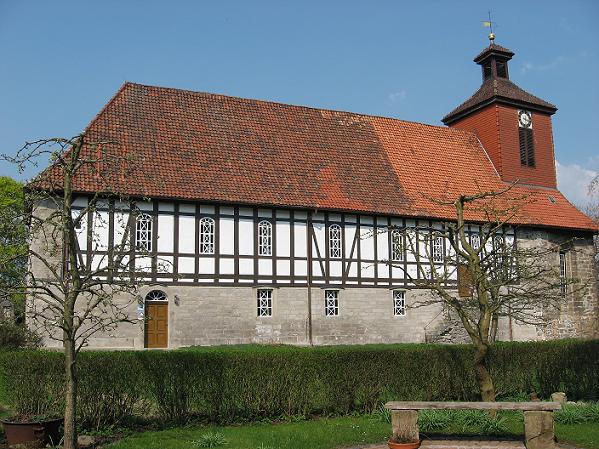 Pöhlde Church, seen from the west
Pöhlde is first mentioned as Polithi in a charte dating from 927 in which Heinrich I 'the Fowler' (919-936) gave the palatine seat, at that time more or less a country estate, to his wife Mathilde. She lived there as widow and gifted parts of the land to the Church to have a monastery built. Her son Otto I granted the monastery of Pöhlde a number of priviledges; and it developed into an important and rich one with territorial possessions and tithing rights spreading as far Frisia. The palatine seat at Pöhlde became the so called Weihnachtspfalz of the Ottonian emperors, the place where family and court would meet during Christmas. Read more »
Spring at the Rhume Springs
The Rhume river, a tributary of the Leine that flows through Göttingen, has an unusual source: a karstic spring south of the Harz mountains. The rock there is gypsum karst, and the water that seeps into the ground from the Harz rivers Sieber and Oder flows under the ground until it comes to light again in the funnel shaped well of the Rhume.

Colour tracking done in 1930 showed the connections between the Harz rivers and the Rhume. The karstic stone is rich in hollow spaces where water can find its way, and the Harz rivers bring with them a lot of rain that leads to the high output of the Rhume well. Read more »
More Anglo-German Marriage Connections and Geneaology Fun
When the German king Heinrich the Fowler looked for a suitable bride for his son Otto (912-979), he contacted King Æthelstan of Wessex who sent two of his-half sisters on a visit. Otto, the future Duke of Saxony and King of East Francia, would make a fitting brother-in-law for the king of Wessex, and both Æthelstan and Otto shared an enemy in the Danes who had that habit of making unannounced visits to the coasts of England and northern Germany. For the young House of the Liudolfings on the other hand, a daughter of Edward the Elder and granddaughter of Alfred the Great would support their claim to the kingship. After all, the West Francian Carolingians still presented some competition.

Otto decided for Editha (Eadgytha) who was said to have been of royal bearing and sweet disposition (1). The marriage took place in 930 and Editha got the income from the bishopric of Magdeburg as morning gift. Her tomb was discovered in the cathedral of Magdeburg in November 2008. Read more »
An Unfortunate Emperor
Here is the first of the posts about Otto IV in honour of the 800 year anniversary of his coronation as Holy German Emperor.
Some pictures of the Harzburg where Otto died in 1218 will illustrate this post. The Harzburg is a hilltop castle, one of the few that could have competed with the Norman whoppers once. Today not much is left, but a few featuers have been reconstruced to give an impression of its former splendour.

Harzburg, outer curtain wall
The castle had been built by Heinrich IV,
was destroyed during his wars with the Saxon nobles and rebuilt in the 12th century when it was an Imperial possession. Later it fell to the Welfen family. Read more »
The Ffwrwm
No, not an unknown prehistoric lizard or some mythological wyrm, but a garden in Caerleon. The name derives from the Latin forum, and with its craft shops, art gallery and restaurant the ffwrwm resembles an odd miniature forum cozily cuddled between the walls of an 18th century town garden. I found it by chance when looking for a place to have a lunch snack.
 The Ffwrwm Garden in Caerleon, with one of Harrison's carved thrones to the left
The garden is a charming mix of shrubs and trees - most of the old and gnarled - antique statues, and modern art showing scenes from the Arthurian myths that are connected with Caerleon. The wood carvings, inspired by the Mabinogion, were done by Ed Harrison. There is also a metal statue depicting the final battle between Arthur and Mordred. Read more »
Hazy Welsh Views, With Castles
Few of the photos I took of the Welsh landscape are not veiled by the hazy atmosphere, but judging from the picutures in my guidebook that problem is a persistant one. Does something like a clear Welsh sky actually exist?
 Mountains at Dolwyddelan Castle
Of all the castles I visited, Dolwyddelan was the one with the most spectacular location, and the one offering the best climb. A bit like those German hilltop castles, just with fewer tourists and more sheep. The view of the Conwy Vale is breathtaking. Read more »
Outside the Saalburg Fortress
Here's another quick picture post, showing the vicus outside the Saalburg. Almost all Roman frontier forts attracted a settlement at their threshold where the inofficial families of the soldiers, craftsmen and traders lived. Some of those villages developed from the local huts into a more sophisticated place with stone-built forum, baths and temples.
 The main gate seen from the outside
Contrary to the fortress, the vicus has not been reconstructed except for the mithraeum, but the foundations that appeared during excavations in the 19th century have been preserved. Read more »
Pembroke Pictures
I've had a busy week and the next one doesn't look any better; right now I don't even get as much writing done as I want, thanks to the complicated mess that is business administration studies. So it will only be a photo post today. I chose a collection of another southern Welsh castle: the famous Pembroke.
 Pembroke Castle in the evening sun
There will be a post with more information later, but for now let's enjoy what my Travel in Wales guidebook calls a 'big, whopping caste.' The castle and the main road more or less make the town of Pembroke. The disadvantage is that the station is at one end of the road and the castle (and my hotel) at the other. Dragging luggage made that road appear very long. Read more »
The Caledonians Are Coming!
Today the view from the remains of a fortress tower or mile castle along the Hadrian's Wall shows a peaceful scenery.
 View from the ruins of a mile castle near Birdoswald
Back when the towers still stood proud, a Roman sentinel on guard service may have seen something else. Read more »
Roman Weapons
Since I came back from my visit to the Saalburg fortress in 2007 with a lot of photos; I got some more for you. How about a few sharp and pointy toys for the big boys?

Roman swords of the gladius type, with metal (to the left below) and bone (upper rows left) sheath mountings, and sword strap buckles (to the right). Read more »
Roman Pottery
I'm not a specialist in Roman pottery, but I've seen enough of it to get an image what a Roman table may have looked like. I've also eaten from the replica of Roman tableware in restaurants that serve Roman dishes. Which make for some interesting taste experiences, but that's another topic. (And no, stuffed dormouse was not on the menu, lol.)
The terra sigillata style Roman pottery was a mass product; shards of it can be found pretty much everywhere the Romans stayed for longer than an hour, and trade spread it even outside the spheres of Roman influence.
 Some terra sigillata (Saalburg Museum)
What struck me as an interesting variation when I visited the museum in the Saalburg Fortress was another shelf with larger pots which were decorated with faces. I filed them under the Odd Things Roman category and pretty much forgot about them. Until I today came across a post in Adrian Murdoch's Bread and Circuses blog, linking to an obituary of Jill Braithwaite, an archaeologist specialising in those face pots. Read more »
Winter Wonderland - Views from my Balcony
This post is a collection of several winter posts with photos taken from my balcony, because I love me some snow (and hoarfrost).
 Hoarfrost on the famous tree in front of my balcony
The temperatures demonstrated how far they can get down when they really want. The record was -24°C on the night to Tuesday. And I seem to be the only one to like such temperatures, lol. Read more »
Autumn at the Werra / Weser
Autumn is my favourite season, and it has truly arrived here. Not only with the flame coloured leaves and melancholical mists, but also with storms and rain, and the first hoarfrosts.
The Werra, linguistically the same as the Weser (the Roman Visurgis), is another of those typical German rivers surrounded by mountains and fertile plains where the valley widens. It runs through Thuringia and northern Hessia, the ancient land of the Chatti. Like most German rivers, its main direction is south to north to either the Baltic or the North Sea (the Werra / Weser runs into the North Sea).
 Werra river in the autumn sun
It is an area rich in history as well, all the way back to the Roman camp in Hedemünden close to where the Werra confluences with the Fulda and is then called Weser. Read more »
Chapter Church Quedlinburg
The old town of Quedlinburg is dominated by the Chapter Church St. Servatius (also refered to as Quedlinburg Cathedral) on the Castle Hill. There's no exterior shot except the one on the post about the town because of the scaffolding, but I got some nice interior ones.
 Main nave, view to the choir
The hill had been the site of a palatine castle and a chapel when Mathilde, widow of Heinrich I, commissioned the building of a chapter church to replace the smaller chapel where her husband lay entombed. It took from 997 to 1021 for the church to be finished, and after a fire part of it had to be rebuilt. The present church was consecrated in 1129, in presence of King Lothar of Süpplingenburg, the later Emperor and founder of
Königslutter Cathedral.
Read more »
Aberystwyth Impressions
Aberystwyth was a flyby visit on my way from Pembroke to Caernarfon, though should I ever come to Wales again, I'd like to spend more time there than two hours. It's a lively place because of the many students, but less hectic than Bangor with its connection to the train line to Manchester. An onlinke acquaintacne, James, gave me a qick tour to the promenade and the castle remains.
 View to the Pier at low tide
The pier had once been 900 feet long, but only about 300 remain today after the sea reclaimed parts of it. The sea tends to do that; Ceredigion Bay is also the location of the legendary Cantre'r Gwaelod, one of the sunken cities that line the coasts - its legends are related to Kêr Ys in Brittany. Read more »
The Lost Fort is a travel and history blog based on my journeys in Germany and Europe (esp. Northern Europe). It includes virtual town and castle tours with a focus on history, essays on Roman and Mediaeval history, hiking tours, and photography.
This blog is non-commercial.
All texts and photos (if no other copyright is noted) are copyright of Gabriele Campbell. The use of my texts and photos for AI-training is not allowed.
GDPR Privacy Policy
Kommentare sind auch in deutscher Sprache willkommen.


- Name: Gabriele Campbell
- Location: Goettingen, Germany
I'm a blogger from Göttingen, Germany, with a MA in Literature and History, interested in everything Roman and Mediaeval, avid reader and sometimes writer, opera enthusiast, traveller with a liking for foreign languages and odd rocks, photographer, and tea aficionado. And an old-fashioned blogger who refuses to get an Instagram account.
View my complete profile
The overview links will lead to the respective section in the sidebar.
Travels: Historical Places
Germany
• Towns
• Castles
• Abbeys and Churches
• Romans Remains
• Neolithicum and Bronze Age
• Museums
• Local Tours
England
Scotland
Wales
Denmark
Faroe Islands
Finland
Iceland
Norway
Sweden
Estonia
Latvia
Lithuania
Czechia
Poland
Belgium
France
Luxembourg
Netherlands
Cross Border Tours / City Trips
Landscapes and Geology
Germany
Great Britain
Nordic Countries
The Baltics and Central Europe
Historical Essays
Essays about Medieval History
Germany
Great Britain
Scandinavia
Lithuania / Poland / Bohemia
Flanders / Luxembourg / Netherlands
Roman History
Neolithicum to Iron Age
Post-Medieval History
Historical Places
Germany
Towns
Bad Sooden-Allendorf
Historical Town and Graduation Tower
Bruchteiche Reservoir
Binz
A Seaside Resort
Braunschweig
History Tidbits
Lion Benches in the Castle Square
The Quadriga
Bremerhaven
The Zoo by the Sea
Erfurt
Medieval Erfurt
Goslar
Chapel in the Klus Rock
Lübeck
St. Mary's Church
Magdeburg
Church of Our Lady: Beginnings
Church of Our Lady: Bishop Adalbert II
Church of Our Lady: Reformation
Mainz
The Temple of Isis and Mater Magna
Paderborn
Early History
Quedlinburg
Early History
The Chapter Church
Speyer
The Cathedral
Jewish Ritual Bath
Stralsund
The Harbour
The Old Town
Tangermünde
History
Treffurt
Medieval Lanes and Old Houses
Trier
The Roman Amphitheatre
The Aula Palatina
The Imperial Baths
The Porta Nigra
Weimar
Sites of the Weimar Classicism
The Park at the Ilm
Wismar
The Old Harbour
Xanten
Roman and Medieval Xanten
The Gothic House
Castles
Adelebsen
The Keep
Altenstein (Werra)
A Border Castle
Bramburg
Weser River Reivers
Brandenburg (Thuringia)
The Beginnings
Albrecht II of Thuringia
Coburg Fortress
History
Architecture
Ebersburg
The Marshals of Ebersburg
Architecture
Grebenstein
History
Grubenhagen
History of the Keep
Hanstein
First Impressions and Early History
Hardeg Castle
The Great Hall
Hardenberg
History
Heldenburg (Salzderhelden)
A Welfen Seat
Hohnstein (Harz)
The Counts of Hohnstein
Between Welfen and Staufen
14th-15th Century
Krukenburg
Built to Protect a Chapel
Kugelsburg
The Counts of Everstein
Later Times
Plesse
The Counts of Winzenburg
The Lords of Plesse
Architecture
Polle Castle
An Everstein Stronghold
Regenstein
History
Reichenbach (Hessia)
History
Scharzfels
History
Architecture
Sababurg
Photo Impressions
Scharfenstein
From Castle to Convention Centre
Sichelnstein
History
Stapelburg
A Little Known Ruin in the Harz
Stauffenburg (Harz)
A Secret Mistress
Trendelburg
Photo Impressions
Wartburg
A Virtual Tour
Weidelsburg
History
Architecture
Revisiting the Weidelsburg
Abbeys and Churches
Bursfelde
Early History of the Abbey
Fredelsloh
A Romanesque Basilica
Gehrden
A Romanesque Church
Göllingen
The Byzantine Crypt
Hahnenklee
The Stave Church
Heiligenstadt
Churches St.Martin and St.Mary
Helmarshausen
Remains of the Monastery
Lippoldsberg
Early History of the Abbey
Interior of the Church
Lorsch
The Carolingian Gate Hall
Pöhlde
Remains of the Monastery
Scharzfeld (Harz)
The Cave Church
Vernawahlshausen
Medieval Murals
Walkenried
The Monastery - Introduction
Wiebrechtshausen
Romanesque Church and a Ducal Burial
Wilhelmshausen (Kassel)
The Romanesque Church
Roman Remains
Augusta Treverorum / Trier
The Amphitheatre
The Aula Palatina
The Imperial Baths
The Porta Nigra
The Roman Bridge
Colonia Ulpia Traiana / Xanten
Roman Xanten
The Amphitheatre in Birten
Haltern am See
Romans in Haltern
Playmobil Romans, LWL Museum Haltern
Varus Statue in Haltern am See
Limes Fort Aalen
The Barracks
Limes Fort Osterburken
The Discovery
The Cohort castellum
The Annex Fort
The Garrisons
Limes Fort Saalburg
A Reconstructed Limes Fort
Main Gate and Walls
The vicus
Shrine of the Standards
Military Sites
Hedemünden
Kalefeld-Harzhorn
Kalkriese
Romans at the Moselle
Romans at the Moselle
The Villa Urbana in Longuich
Romans at the Rhine
Boppard - Roman Baudobriga
The Villa in Wachenheim
Neolithicum and Bronze Age
Neolithic Burials
Neolithic Burials in the Everstorf Forest and Rugia
The Necropolis of Oldendorf
Bronze Age
Bronze and Iron Age Remains at the Werra
Museums / Reconstructed Sites
Palatine Seat Tilleda
The Defenses
Viking Settlement Haithabu
The Nydam Ship
Open Air Museums
European Bread Museum Ebergötzen
Open Air Museum Oerlinghausen
Post-Mediaeval Exhibits
Historical Guns, Coburg Fortress
Vintage Car Museum, Wolfsburg
Local Tours
German Baltic Sea Coast, Part 1 / Part 2
Bavarian Towns
Harz Tours
At Saale and Unstrut
Summer Tours 2016
Thuringian Castles
England
Northumbria Tour
Towns
Chester
Roman and Medieval Chester
Hexham
The Abbey - Introduction
The Old Gaol
York
Clifford Tower
Guild Hall
Monk Bar Gate with Richard III Museum
Museum Gardens: St. Mary and Roman Tower
Houses in the Old Town
Tour on the Ouse River
York Minster: Architecture
Castles
Carlisle
History
Richmond
Conquest to King John
Henry III to the Tudors
Architecture
Scarborough
Romans to the Tudors
Civil War to the Present
Architecture
Roman Remains
Eboracum / York
Roman Bath in the Fortress
The Hadrian's Wall
Introduction
Hadrian's Wall: Birdoswald
The Dark Age Timber Halls
Hadrian's Wall: Segedunum
Museum and Viewing Tower
The Baths
Other Roman Sites
The Mithraeum at Brocolita
The Signal Station at Scarborough
Scotland
Scotland Tour
Towns
Edinburgh
Views from the Castle
Stirling
The Wallace Monument
Castles
Doune
A Virtual Tour
The Early Stewart Kings
Royal Dower House
Duart Castle
Guarding the Sound of Mull
Dunstaffnage
An Ancient MacDougall Stronghold
The Wars of Independence
The Campbells Are Coming
Dunstaffnage Chapel
Stirling
Robert the Bruce
Abbeys and Churches
Inchcolm
Arriving at Inchcolm Abbey
Neolithicum and Bronze Age
Neolithic Orkney
Ring of Brodgar
Skara Brae
Brochs and Cairns
Clava Cairns
The Brochs of Gurness and Midhowe - Introduction
Picts and Dalriatans
Dunadd Hill Fort
Staffa
Wales
Towns
Aberystwyth
Castle and Coast
Caerleon
The Ffwrwm
The Roman Amphitheatre
The Baths in the Legionary Fort
Conwy
The Smallest House in Great Britain
Castles
Beaumaris
History
Architecture
Caernarfon
Master James of St.George
The Castle Kitchens
Cardiff
From Romans to Victorians
Chepstow
Beginnings unto Bigod
Edward II to the Tudors
Civil War
Conwy
History
Architecture
Criccieth
Llywelyn's Buildings
King Edward's Buildings
Manorbier
The Pleasantest Spot in Wales
Pembroke
Photo Impressions
Roman Remains
Isca Silurum / Caerleon
The Amphitheatre
The Baths in the Legionary Fort
Denmark
Denmark Tour Part 1 / Part 2
Castles
Egeskov Castle
The Gardens
Faroe Islands
Some Information about the Faroes
Finland
Towns
Porvoo
Medieval Porvoo
Iceland
Iceland Cruise
Norway
Hurtigruten Tour
Castles and Fortresses
Akershus Fortress in Oslo
History
Architecture
Vardøhus Fortress
History
Museums
The Fram Museum in Oslo
Sweden
Neolithicum and Bronze Age
Gotland
Gnisvärd Ship Setting
Museums
The Vasa Museum in Stockholm
Raising the Vasa Wreck
Estonia
Towns
Tallinn
The History of Medieval Tallinn
Latvia
Towns
Riga
The History of Medieval Riga
Lithuania
Towns
Lithuania Tour Part 1 / Part 2
Vilnius
Photo Impressions
Czechia
Czechia Tour
Towns
Cheb / Eger
The Old Town
Karlovy Vary / Karlsbad
Brief History of the Town
Kutná Hora
The Sedlec Ossuary
Medieval Town and St.Barbara's Church
Poland
Poland Tour
Towns
Gdańsk / Danzig
History of Medieval Gdańsk
Medieval and Renaissance Gdańsk
Kraków
The Old Town
Jewish Kraków - Kazimierz and the Ghetto
Wrocław / Breslau
The Botanical Garden
The Wrocław Dwarfs
Castles
Ogrodzieniec Castle
A Virtual Tour
First Castle to the Boner Family
Belgium
Towns
Antwerp
The Old Town
Bruges
Medieval Bruges
Ghent
Medieval Ghent
Tongeren
Tour of the Historical Town
France
Strasbourg
A Tour of the Town
Luxembourg
Luxembourg City
A Tour of the Town
Netherlands
River Cruise through the Netherlands
Parks and Palaces
Keukenhof Park
Cross Border Tours / City Trips
Baltic Sea and Baltic Countries
Baltic Sea Cruise
Baltics and Finland, Part 1
Baltics and Finland, Part 2
St. Petersburg
Impressions from the Neva River
Landscapes and Geology
Germany
Baltic Sea Coast
Flensburg Firth
Impressions from Rugia
Rugia: Flint Fields
Rugia: Jasmund Peninsula and Kap Arkona
Rugia: The Pier of Sellin
A Tour on the Wakenitz River
Lüneburg Heath
Hiking in the Lüneburg Heath
Harz National Park
A Collection of Tours
Arboretum Bad Grund / Hübichenstein
Bode Valley and Rosstrappe Cliff
Daneil's Cave
Devil's Wall
Ilse Valley and Ilse's Rock
Klus Rock
Lonau Falls
Oderteich Reservoir
Rappbode Reservoir
Rhume Springs
Southern Harz Karst
National Park Hainich
Oberderdorla and Hainich National Park
Nature Park Meissner-Kaufunger Wald
Blue Dome near Eschwege
Hiking in the Meissner Mountains
Hessian Switzerland
Rossbach Heath
Salt Springs at the Werra
Nature Park Reinhardswald
Old Forest at the Sababurg
Nature Park Solling-Vogler
The Forest Pasture Project
Hannover Cliffs
Raised Bog Mecklenbruch
Parks
Botanical Garden in Göttingen
Hardenberg Castle Gardens
Winter at the Kiesteiche Park, Göttingen
Rivers and Lakes
Autumn at Werra/Weser
The Danube in Spring
Edersee Reservoir
A Rainy Rhine Cruise
Vineyards at Saale/Unstrut
Weser River Ferry
Weser Skywalk
Wildlife
Zoo am Meer Bremerhaven
Harz Falcon Park
Ozeaneum Stralsund: Baltic Sea Life
Ozeaneum Stralsund: North Sea Life
Red squirrels
Fossils and Rocks
Fossilized Ammonites
Great Britain
The East Coast
By Ferry to Newcastle
Impressions from the East Coast
Scottish Sea Shores
Crossing to Mull
Mull: Craignure to Fionnphort
Dunollie and Kilchurn
Highlands: Inverness to John o'Groats
Pentland Firth
Staffa
Summer in Oban
Scotland by Train
West Highland Railway
Wales
Some pretty Views
Wildlife
Sea Gulls
Nordic Countries
Faroe Islands
Faroe Impressions
Iceland
Iceland Impressions
Norway: Coasts and Fjords
Fjords of South-Western Norway
Hurtigruten: A Voyage into Winter
Hurtigruten: Light and Shadows
Lysefjord: Geology
Norway by Train
From Oslo to Bergen
From Trondheim to Oslo
Wildlife
Bearded Seals
Dog Sledding With Huskies
Eagles and Gulls in the Trollfjord
The Baltics and Central Europe
Baltic Countries
Beaches on the Curonian Spit
Geology of the Curonian Spit
Photo Parade 2023 (Lithuania)
Photo Parade 2024 (Latvia/Estonia)
Czechia
The Loket Meteorite
Poland
The Botanical Garden in Wrocław
Historical Essays
Essays about Medieval History
Medieval Arts and Technologies
Medieval Art
Choir Screen in the Cathedral of Mainz
The Gospels of Heinrich the Lion
Hunting Frieze in Königslutter Cathedral
The Viking Treasure of Hiddensee
Craftmanship
Goldsmithery
Medical Instruments
Historical Ships
The Nydam Ship
The Vasa
Warfare
Trebuchets
Northern Crusades
The Wendish Crusades
German Expansion East of the Elbe in the 10th and 11th Centuries
Crusades in Poland and the Baltic States
The Conquest of Danzig
German Sword Brothers and the Danish Duchy of Estonia
Teutonic Knights and the Bishops of Riga
The Siege of Vilnius 1390
The Hanseatic League
History of the Hanseatic League
Introduction and Beginnings
Hanseatic Architecture
Examples of Brick Architecture
Hall Houses (Dielenhäuser)
Goods and Trade
Stockfish Trade
Germany
List of Medieval German Emperors
Anglo-German Marriage Connections
Kings and Emperors
The Salian Dynasty
King Heinrich IV
House Luxembourg
King Sigismund of Luxembourg
Princes, Dukes, and Lords
House Welfen
Emperor Otto IV
Heinrich the Lion's Ancestors
The Dukes of Braunschweig-Grubenhagen
Otto I of Braunschweig-Göttingen
House Wittelsbach
Jacoba of Bavaria-Holland
The Landgraves of Thuringia
The Ludowing Landgraves of Thuringia
Albrecht II and Friedrich I of Thuringia
Counts and Lords
The Marshals of Ebersburg
The Counts of Everstein
The Counts of Hohnstein
The Lords of Plesse
The Counts of Reichenbach
The Counts of Winzenburg
Feuds and Rebellions
Royal Troubles
Otto IV and Bishop Adalbert II of Magdeburg
Local Feuds
The Lüneburg Succession War
The Thuringian Succession War
The Star Wars
Great Britain
Kings of England
House Plantagenet
Richard Lionheart in Speyer
House Lancaster
King Henry IV's Lithuanian Crusade
Dukes of Brittany
Uneasy Relationships
Normans, Britons, Angevins
The Earls of Richmond
Kings of Scots
House Dunkeld
Malcolm III and Northumbria
Fight for the Throne: Malcolm III to David I
King David and the Civil War, 1
King David and the Civil War, 2
Houses Bruce and Stewart
The Early Stewart Kings
Welsh Princes
The Princes of Gwynedd
The Rise of House Aberffraw
Conflicts and Rebellions
The Scottish Wars of Independence
Alexander of Argyll
The Fight for Stirling Castle
The Welsh Rebellions
Llywellyn ap Gruffudd to Owain Glyn Dŵr
Scandinavia
Kings of Denmark
House Knýtlinga
Harald Bluetooth's Flight to Pomerania
Kings of Norway
Foreign Relations
King Eirik's Scottish Marriages
King Håkon V's Swedish Politics
Beginnings of the Kalmar Union
Feuds and Rebellions
Alv Erlingsson of Tønsberg
Lithuania / Poland / Bohemia
The Polish-Lithuanian Union
The Jagiełłonian Kings
Władysław Jagiełło and the Beginning of the Union
Royal Dynasties of Bohemia
Bohemian Kings of House Luxembourg
King Sigismund and the Hussite Wars
Flanders / Luxembourg / Netherlands
Lower Countries versus Burgundy
The Counts of Hainaut/Holland-Zeeland
Philip 'the Good' and Jacoba of Holland's Heritage
Roman History
Roman Forts and Fortifications
The German Limes
The Cavalry Fort Aalen
Limes Fort Osterburken
Limes Fort Saalburg
The Hadrian's Wall
Introduction
The Fort at Segedunum / Wallsend
Border Life
Exercise Halls
Mile Castles and Watch Towers
Soldiers' Living Quarters
Cavalry Barracks
Campaigns and Battles
Maps
The Romans in Germania
The Pre-Varus Invasion in Germania
Roman Camp Hedemünden
New Finds in 2008
The Battle of the Teutoburg Forest
Museum Park at Kalkriese
The Battle at the Harzhorn
Introduction
The Batavian Rebellion
A Short Introduction
Roman Militaria
Armour
Early Imperial Helmets
Late Roman Helmets
The Negau B Helmet
Weapons
Weapon Finds at Hedemünden
The pilum
Daggers
Swords
Other Equipment
Roman Saddles
Infrastructure
Roman River Transport
Religion and Public Life
Religion
Curse Tablets and Good Luck Charms
Isis Worship
Memorial Stones
The Mithras Cult
Domestic Life
Roman villae
Villa Urbana Longuich
Villa Rustica Wachenheim
Everyday Life
Bathing Habits
Children's Toys
Face Pots
Neolithicum to Iron Age
Germany
Development of Civilisation
European Bread Museum, Ebergötzen
The Hutewald Project in the Solling
Open Air Museum Oerlinghausen
Neolithic Remains
Stone Burials of the Funnelbeaker Culture
The Necropolis of Oldendorf
Bronze Age / Iron Age
The Nydam Ship
Scotland
Neolithic Orkney
The Neolithic Landscape of Orkney
Ring of Brodgar
Skara Brae
Life in Skara Brae
Bronze Age / Iron Age
Clava Cairns
The Brochs of Gurness and Midhowe - Their Function in Iron Age Society
Scandinavia
Bronze Age / Iron Age
The Ship Setting of Gnisvärd / Gotland
Post-Medieval History
Personalities of the 19th Century
Prince Wilhelm Malte of Putbus
Development of Technologies
Otto von Guericke and the Magdeburg Hemispheres
Attempts at Raising the Vasa Wreck
History of the Zoo am Meer, Bremerhaven
Explorers
Fram Expedition to the North Pole
Fram Expedition to the South Pole
Arts and Literature
The Weimar Classicism
|


