My Travel and History Blog, Focussing mostly on Roman and Mediaeval Times
The monastery Unserer Lieben Frauen (To Our Dear Lady, also known as Liebfrauenkloster or St.Mary's Abbey) in Magdeburg is one of the most important Romanesque buildings in Germany. It is used as art museum and concert hall today.

Magdeburg already had a cathedral dating to the time of Otto the Great (912-973) and was the see of an archbishop. St.Mary's Abbey was founded by Archbishop Gero in 1015 and started as collegiate church for a non-monastic community of clergy led by a dean. The first building may have been half-timbered, but since 1063 it was replaced by a stone basilica. There must have been a break in the building process because the basilica was only finished during the time of the Archbishop Norbert of Xanten (consecrated 1126).
Autumn has released the rains and storms now, and the days are getting shorter. But last Sunday was still beautiful, so we took a little trip to the European Bread Museum in Ebergötzen. The museum is situated in a park with some mills, old trees, and other features that make for pretty photos.

Post mills are the earliest type of wind mills in Europe (water mills are older), first appearing in the 11th and 12th centuries. The house that contains the machinery is mounted on a single post - usually oak wood and about 65 cm in diameter - which in turn is anchored in a timber stand. That way the entire body of the mill can be turned into the wind by the lever beam or tail pole. Read more »
Walkenried was founded as Cistercian monastery by Countess Adelheid of Clettenberg in 1127, member of one of the smaller and more obscure noble families in the Harz area.
The Cistercians were an enclosed order which means they had to stay within the confines of the land belonging to the monastery. Other orders, like for example Benedictines and Franciscans, enjoyed more freedom of movement. Cistercians were a fairly new order that started in Citeaux / Burgundy in 1098 out of the Benedictine rule which they still fowllowed in a purified version.
Adelheid had met them in Kamp at the lower Rhine. She invited some monks to move to the Harz foothills and offered them a suitable piece of land, sufficiently distant from settlements, with water access and chances of agricultural development. A first convent moved in and started building the first church on the grounds, in the older Romanesque style. They got additional money from Emperor Lothar of Süpplingenburg (the one who founded the church in Königslutter), and in 1137, Pope Innocenz II officially confirmed the foundation.
Which is a fancy way to say, 'I just pressed the shutter release and wondered what would come out of it.' It also makes for a lazy post because I had a busy week.
Sometimes it looks like modern art.

A staircase inside the keep of Plesse Castle. The stairs aren't Medieaval, of course. The keep tower has been restored to its original height; the upper part was in ruins in the 19th century. Read more »
Reading up on Welsh history makes me suspect it was the Princes of Gwynedd who invented the dysfunctional family and the Plantagenets only copied them. There was a lof of brothers fighting each other, one ending up in exile from where he would promptly return with a fleet (Irish/Norse in most cases), or in prison from which he would escape and manage to find an army somewhere. Adding to this that the English kings and the marcher lords (in particular the Earls of Chester) also played that battle / exile / hostage game, it's surprising that northern Wales saw times of peace at all. But it did.
The Welsh stone castles mostly date to the 13th century, but they make for some nice illustrations nevertheless.

The first ruler of Gwynedd who managed to establish some sort of stability north of the Conwy river was Gruffydd ap Cynan. Gruffydd's mother Ragnhild was a daughter of Olaf of Dublin. Little is known about his father who obviously died while Gruffydd was still very young. Gruffydd made a first attempt to oust his rival Trahaearn ap Caradog from Gwynedd in 1075. He had the aid of his Irish relations and of Robert of Rhuddlan, a Norman lord and cousin of Hugh d'Avranches, Earl of Chester. Some strange alliance that, and it didn't hold. Gruffydd managed to drive Trahaearn out, but tensions arose between the Welsh and Gruffydd's Irish-Danish host. The Welsh rebelled and Trahaearn kicked Gruffydd back to Ireland. Read more »
Today the place is called Boppard, one of the charming little towns that nest on the flat stripe between mountains and river in the Middle Rhine Valley. There had been a Celtic settlement not far from the modern town when Caesar conquered Gaul and reached the Rhine in 55 BC. The Roman settlement - a vicus - dates to the time of the Emperor Claudius (41-54 AD) who consolidated the road network and built additional forts at the Rhine.

The settlement is mentioned in several sources in the 2nd and 3rd centuries (fe. in the Tabula Peutingeriana, a Medieaval copy of a Roman map). During that time the Limes ran somewhat north-west of the Rhine in this area and added a greater feeling of security to the settlements bordering the river. The Limes extended deeper into Germania further south-east, near Wiesbaden, and then along the Taunus and Odenwald forests down to the Danube. During that time, Baudobriga probably was a peaceful community that benefitted from the trade on the Rhine and the Roman road along it, as well as the connection to the hinterland in Gaul. Most of the buildings were half timbered houses with stone foundations and cellars. Read more »
The castle was first named in a chronicle from 1093 that mentions that Heinrich the Fat, the founder of Bursfelde Abbey, had the castle fortified in order to protect the nearby abbey, thus it must date further back than 1093.

As usual, we can only get glimpses of the castle's history when it is mentioned in chartes and chronicles.
Some of them at least. The abandoned Colonia Ulpia Traiana served as quarry for the new town that developed near it. Obviously there were still some good stones left in the 16th century which made it into the walls of this beautiful house.
The Gothic House (Gotisches Haus) is one of several old houses in Xanten that have survived, and surely the most impressive of them. The red brick stones are a local product, but the the greyish tuff stone has been identified as Roman. Read more »
The history of Xanten, a town at the lower Rhine in Germany, goes back to the Romans who built a legionary fort - Castra Vetera - on a nearby hill overlooking the river in 12 BC. The fort soon attracted a cannabae legionis, a civilian settlement (they're called vicus when attached to auxiliary forts). The civilian settlement continued to thrive and the emperor Marcus Ulpius Traianus granted it the rights of a Roman town about 100 AD. The place was then called Colonia Ulpia Traiana (CUT) and became one of the most important settlements in Germania Inferior; the province left of the Rhine that included Luxembourg, parts of modern Belgium, the Netherlands, and the German county North Rhine-Westphalia.

The CUT encompassed 73 hectares and had 10,000 inhabitants, but it was almost completely destroyed by an attack of the Franks in 275. The garrison of Vetera II and the remains of the population rebuilt the town in smaller scale (400 x 400 metres) which was better fortified and easier to defend. The new place was called Tricensimae. But the Frankish raids increased; the settlement was destroyed in 352 and rebuilt again, but in the end the place was abandoned in the 5th century. The youngest coin found in the area dates to 426 AD. Read more »
Well, sort of. What I got here is a display of tin figures in the museum at the fort Osterburken. It's an unpainted version and was very difficult to photograph through the glass. But they got lots of the shiny little guys so I tried to catch some for you.
Tin figures have been popular in Germany since about 1800. They are two-dimensional relief figures, different from the three-dimensional figures common in the UK and US. Some three-dimensional tin figures are produced for the export where they compete with the plastic and lead ones, but I'm not sure how successfully. Painted versions are more common but I suppose no one felt up to the task of painting the lot in the Limes Museum Osterburken.

The garrison of the Osterburken main fort during the so-called Limes time (about 100 - 260 AD) was the cohors III Aquitanorum equitata civium Romanorum, a mixed horse and infantry cohort. Read more »
The Roman fort of Osterburken is situated at the outer Odenwald Limes (1), some distance east of the Rhine. It's a double fort: a traditional, card shaped cohort castellum on rather flat terrain in the valley, today covered by houses, and a trapezoid shaped annex fort housing a numerus, a smaller, irregular auxiliary troop of about 120 men. The annex fort is built on a steep slope and shows the remains of some impressive Roman architecture.
The main fort was built about 155 AD, the annex fort was added some time between 185-192 AD.

The heaps of stones in the Kirnau valley near Osterburken were identified as remains of a Roman building when a stone with the inscription 'Legio VIII Augusta' turned up in 1718. But at that time the interest in the Romans in Germany was not great, except for the ideological-patriotic interpretation of Tacitus' Germania and the Varus battle. Thus, a good number of the stones was used as building material in the church and surrounding farms (there's a bill about 30 waggon loads of stones in the parish archives, dating from 1813). Read more »
The Everstein family spread into several branches and some of its members appear in various positions and places in Germany for the next centuries. One Gertrude of Everstein was abbess of Gernrode in late 14th century, for example, and one Otto of Everstein-Polle was marshal of Westphalia acting on behalf of the archbishop of Cologne around the same time. But the prodigious offspring of Albert III seems to have led to increasing financial problems because of the need to split the possessions and provide dowries, and the loss of the main seat of Everstein probably increased those troubles.

At some point the Everstein must have pawned out part of the Kugelsburg to the archbishop of Cologne, because in 1303 Otto of Everstein renounced his rights to that part of the castle in favour of Cologne. That was something he could only do if his liegelord - Corvey - agreed. It could work out because Corvey itself had submitted to the protection of Cologne in 1298. Read more »
Like so many other German castles, the Kugelsburg near Volkmarsen was built on a hill in order to protect a road or crossing. In this case it was the ford across the Twiste river on the road from Fritzlar to Paderborn, both important towns in the 11-12th century.
The Kugelsburg changed hands several times, and there are traces of Romansque and Gothic styles mixed together.

The land was held by the family of Everstein as fief from Corvey Monastery. The main seat of the Counts of Everstein (first documented appearance in 1122) was Castle Everstein at the Weser, but few remains of that are left, so the Kugelsburg makes for much better illustrations. They obtained the lands around Volkmarsen by marriage: in 1120 Konrad of Everstein married Mechthild of Itter, daughter of a noble Saxon family that existed since the time of Charlemagne. It was the first step to a nice little realm of allodial and feudal possessions at the Weser and in northern Hessia. Read more »
A Roman legionary got 960 gram wheat every day, for bread or porridge. A full strength legion had about 5000-5500 men, and Varus fielded three legions in 9 AD (plus two left behind in Moguntiacum). Do the maths - that's a lot of wheat. Plus wine, olives, cheese, bacon and other food, leather and cloth, iron to repair weapons .... The supplies for the army were always a logistic nightmare, and even more so in countries with no Roman infrastructure. Nor did the German tribes grow enough grain to feed that swarm of mail-clad cicadas.
Rivers played an important role in the supply lines. The area in question (middle and northern Germany) was framed by the south-north running Rhine and Elbe, with the Ems and Weser cutting their way in the same direction in between. Two larger rivers run east-west towards the Rhine, the Lippe (which confluences at Vetera/Xanten) and the Main (which meets the Rhine at Moguntiacum/Mainz). Those two rivers became the main deployment lines into Germania during the conquests of Drusus (11 BC) until Germanicus' campaigns (16 AD). Read more »
Just a picture post today. Here are some more photos from the Siegfriedspektakel in Xanten..

One of the falcons of the bird show, balancing on its stake. The birds were kept under a tent roof - seems they didn't like getting rained on that much, either. Read more »
After the arrival of the Romans, some Germans no longer liked their bathrooms.

I'm going to marry a Roman, then I'll go to the public baths every morning.
Well, you can't really blame her if you look at the baths in Colonia Ulpia Traiana, today known as Xanten. Read more »

A pilum consisted of an iron shank about 60 cm in length that ended in a pyramidal head. The shank was attached to a wooden shaft either by a flat tang and clamp or a socket and rivets, bringing the entire length of the pilum up to 2 metres. It weighed between two and five kilograms - the versions during the Empire were usually the lighter ones, and it also seems the legionaries carried only one, not two as in the late Republic. Read more »
The Rhine between Koblenz (the ancient Confluentes, where the Moselle confluences into the Rhine) and Mainz (where the Main river joins up with his big brother) is considered the most scenic. Because of the mountains, the river could not be straightened like it was done in other places to make naval transport easier; only some of the riffs and sandbanks that made travel on this part of the Rhine dangerous in Roman and Medieaval times have been eliminated, albeit the sandbanks are an ongoing problem that has to be dealt with regularly.

There are a number of cruise ships that travel this part of the Rhine. I picked one from Boppard somewhat upriver of Koblenz to Bingen near Mainz; a trip that took four hours (it's some 25 minutes by train). The fleet is called Köln-Düsseldorfer which is a bit of a joke, because the towns of Köln and Düsseldorf (both further north) are old rivals. There were not many people onboard due to the bad weather. Read more »
Spring took its time this year, but now it's making up. All that pretty green comes out faster than you can look. Too bad the birch pollen come out faster than you can sneeze as well.

But that blasted allergy isn't going to keep me inside, not on a warm and sunny day. So I took a walk in the gardens of Hardenberg Castle last Sunday. I've mentioned in an older post that the family eventually left the castle on the mountain and built a Renaissance style palace in the valley, surrounded by a park. Part of it is open to the public. Read more »
The Evangeliar Heinrichs des Löwen may be somewhat less well known than the Book of Kells, but it's more expensive. And very pretty, too. The book is kept in a safe in the Herzog August Library in Wolfenbüttel (near Braunschweig) and is only shown to the public on rare occasions. But facsimiles are displayed in several places connected with Heinrich and/or the manuscript, fe. in the cathedral in Braunschweig and the parish church in Helmarshausen. Thus I've collected some photos last year.

The Gospels with their 50 miniatures had been commissioned by Duke Heinrich as donation for the St.Blasius Cathedral in Braunschweig, in particular the altar dedicated to Virgin Mary. The book was crafted in the Benedictine Abbey of Helmarshausen, one of the rich Mediaeval abbeys along the Weser (I've mentioned the abbeys of Bursfelde and Lippoldsberg in several posts, but not much remains of the buildings in Helmarshausen). Construction of the cathedral in Braunschweig started in 1173, the altar of Virgin Mary was consecrated in 1188. Thus, and because historians never agree on something, we get two possible dates for the Gospels: 1173-75 or 1188. Read more »
Seveal benches outside the cathedral in Braunschweig, facing the Castle Square, are based on stone carved lions. Every of the dozen or so lions has a unique facial espression.
Here are some of the chaps.

I could not find any information about those lions except that they are ‘newer’ which must mean ‘not Mediaeval’, because my father who lived in Braunschweig as kid, remembers them. The fact, that ‘bank’ and ‘bench’ are the same word in German doesn’t help with googling, either. Well, even without any further information the little lions are fun. Read more »
Almost a week without a new post? Oopsie. *grin* Well, here’s a lazy one; just some more photos of sea gulls. Because they are fun.
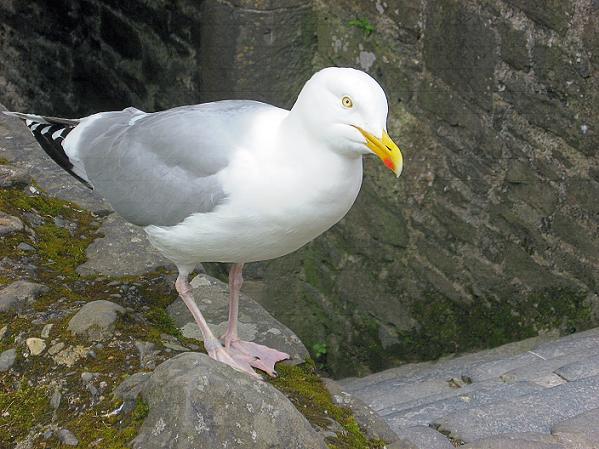
Thou shall not pass!
Though I bet, contrary to Gandalf, this guy would have been bribable. Found him perching beside a staircase in Conwy Castle. Read more »
Can be found in Conwy, Wales. It’s painted in a pretty red so you won’t miss it, tucked in there between one of the town wall towers and another, bigger house.

The ‘one up – one down’ house measures 3.05 by 1.8 metres (10 x 6 feet). The ground floor room was heated by a coal fire; the coal stored under a bench. The top room is reached by a ladder through a trap door and provides just enough space for a bed. There are no bathroom, toilet or kitchen, but that was not so uncommon in the 16th century when the house was built. Read more »
Inchcolm Abbey was presenting itself in best Scottish weather: stormy, wet, dark and brooding. But it suited the visit to an island where once a king got shipwrecked.
The waves in the Firth of Forth were more impressive than the ones a few days later on my visit to Staffa and Iona, which made taking photos from the ferry a bit of a challenge. After deboarding I got me a rain cloak in the Historic Scotland shop on the island, because balancing the camera and an umbrella in a futile attempt to block horizontal rain didn't work. Just well I consider weather like that to be fun nevertheless.

Inchcolm, known as Aemonia to the Romans, is an island in the Firth of Forth. The Romans had a fort and probably a naval base in nearby Cramond (Alaterva) during the time of Antoninus Pius around 142 AD, but it is covered by houses and a church today. Some finds point at a reuse of the place during the campaigns of Septimius Severus in 211 AD. Inchcolm may have been used by the Romans (my guess would be a watchtower on the island) but no traces have been found so far. Thanks to its strategical position, it still played a role as part of the WW2 defenses. Read more »
I also revisted the Bannockburn Heritage Centre in Stirling (built in the late 1960ies) and the Bruce Memorial in a park that may have been the original battlesite, though the subject is still discussed. The sky was a mix of sunshine and dramatic clouds which made for some interesting shots of the famous statue. The rest of the pics is from Stirling Castle.

The famous battle of Bannockburn took place on 24 June 1314. I'm not going into details in this post - I should leave that to Kathryn (aka Alianore), our knowledgeable Edward II blogger. The short version is: the Scots* won that one and sent King Edward II of England packing in a hurry, though that's about as correct as 'Arminius kicked the Romans out of Germany for good at the battle of Teutoburg Forest'. The Romans came back, and so did King Edward's son, another Edward, numbered III. Read more »
I'm being very lazy with this post, because Carla Nayland has written such excellent essays about the Dark Age activity on the site of Birdoswald (the Roman Banna), one of the Hadrian's Wall forts, where excavations have brought to light traces of two large timber halls that made use of the Roman granary foundations.
I'm only going to add the illustrations. :)

The second timber hall has been excavated in 1987 and marked with timber posts in the ancient post holes so that visitors can get an image of size of the hall and its situation in relation to the granaries.
A somewhat earlier timber hall had been constructed over the south granary, but it was no longer use when the northern hall was built. This makes sense because a timber building had an average life span of 30 years and would then be rebuilt on a new place instead of undergoing repairs.

The style reminds of a Saxon long house, and according to the description and a drawing on site it looks like some sort of Meduseld. There are also some finds of Anglo-Saxon jewelry.
It would not be the first case where a local ruler saw the advantage of the Roman remains and the strategical situation of the place. The Norman keep in Cardiff is another example. What I'd like to know is whether the wall and trench fortifications at Birdoswald were still in maintained during the Dark Ages. Those times weren't exactly peaceful, after all.
I've collected virtual Roman military daggers, pugii (the singular is pugio), for some time now whenever a museum allowed taking pictures. Here are some pretty ones found in Germany, dating from Augustean and Tiberian times.
For some reason, daggers are more frequently found than swords of the short gladius or the longer spatha type (though some gladius fragments have been found in Hedemünden). Maybe those have been recycled more often.

The iron pugio was found in Hedemünden main camp (camp 1), and cleaned and conserved by the company of H. Biebler in Mühlhausen / Thuringia. What you find isn't such a shiny item, but some caked mix of metal, rust and dirt. It takes lot of experience to see there's something cool hiding in such a lump. Read more »
Duart Castle, the ancient MacLean stronghold on Mull, is situated where the Sound of Mull meets with the Firth of Lorn and Loch Linnhe. It sits atop a crag, in view of Dunstaffnage and Dunollie castles, and is part of a chain of eight castles that protected Mull and the mainland. Today, you can reach it by ferry from Oban and a short bus trip.
Back in 1367, you'd have needed to be on the right side of Lachlan Lubanach 5th chief of clan MacLean to get passage on one of his war galleys. Lachlan married Mary Macdonald, the daughter of the Lord of the Isles who gave her Duart as dowry. It was a love match, it is said, and old Macdonald not too happy about it. Relations between the two clans remained uneasy in the future.

At that time, Duart Castle was a rectangular wall enclosing a courtyard (which, I suppose, held some timber buildings), and it was Lachlan Lubanach who built the stone keep outside the curtain wall but connected with it. It's an unusual structure to have the keep outside the wall, but it is protected by its situation on the crag and the peninsular structure of the site. On the landward side, the curtain wall was 9 metres high, and the castle was additionally protected by a deep ditch cut into the solid rock. Read more »