My Travel and History Blog, Focussing mostly on Roman and Mediaeval Times
30 Mar 2018
Winter Night on Hardangervidda - From Oslo to Bergen by Train
I took the afternoon train from Oslo to Bergen, well aware that the last part of the journey would take place in darkness. But as it turned out, there was sleat later changing into rain once we passed the Hardangervidda, so I didn't miss much since the scenery would have been veiled by rain and fog anway.
The first part of the ride offered a mostly overcast sky and the long period of twilight typical for late March in the north. I managed to get some photos out of the moving train - a journey into winter indeed. Snow was piling up high on the Hardanger Plateau.

Lake Krøderen
Like the Dovre Railway, the Bergenbanan (Bergen Railway) was built in bits and pieces. The part from Bergen to Voss dates to 1883. There also was a railway from Oslo to Drammen since 1866. The whole single track line connecting those parts was finished in 1909. It covers a distance of almost 500 kilometes (310 miles), with some 180 tunnels and 300 bridges; the ride takes about seven hours. Read more »
I took the afternoon train from Oslo to Bergen, well aware that the last part of the journey would take place in darkness. But as it turned out, there was sleat later changing into rain once we passed the Hardangervidda, so I didn't miss much since the scenery would have been veiled by rain and fog anway.
The first part of the ride offered a mostly overcast sky and the long period of twilight typical for late March in the north. I managed to get some photos out of the moving train - a journey into winter indeed. Snow was piling up high on the Hardanger Plateau.
Like the Dovre Railway, the Bergenbanan (Bergen Railway) was built in bits and pieces. The part from Bergen to Voss dates to 1883. There also was a railway from Oslo to Drammen since 1866. The whole single track line connecting those parts was finished in 1909. It covers a distance of almost 500 kilometes (310 miles), with some 180 tunnels and 300 bridges; the ride takes about seven hours. Read more »
11 Mar 2018
A Trace of Spring in Dovrefjell - From Trondheim to Oslo by Train
I took the train from Trondheim to Oslo mid-April 2011 after the Hurtigruten voyage and managed to take some photos out of the moving train. The usual caveat for pictures taken out of a train or bus applies: there might be some reflections from the windows and slight blurs.

Kongsvoll Mountains.
I traveled the Dovre Railway in the 'wrong' direction. When it was built, the first stage covered the way from Oslo to Eidsvoll and was the first railway in Norway (1854). The line was then built in bits and parts. The stretch between Søren and Trondheim dates to 1864, followed the connections between Eidsvoll - Hamar - Lillehammer etc., while the last part from Dombås to Søren - the original Dovre Railway which today gives the name to the entire route - was finished in 1921. Read more »
I took the train from Trondheim to Oslo mid-April 2011 after the Hurtigruten voyage and managed to take some photos out of the moving train. The usual caveat for pictures taken out of a train or bus applies: there might be some reflections from the windows and slight blurs.
I traveled the Dovre Railway in the 'wrong' direction. When it was built, the first stage covered the way from Oslo to Eidsvoll and was the first railway in Norway (1854). The line was then built in bits and parts. The stretch between Søren and Trondheim dates to 1864, followed the connections between Eidsvoll - Hamar - Lillehammer etc., while the last part from Dombås to Søren - the original Dovre Railway which today gives the name to the entire route - was finished in 1921. Read more »
3 Mar 2018
The Architecture of Scarborough Castle
After the tour through the earlier and later history of Scarborough Castle, let's have a closer look at some of the architectural features.

The barbican seen from the viewing platform;
the double D-shaped outer gate is to the left, the first bridge to the right
Since the castle is situated on a headland with steep cliffs (about 90 metres / 300 feet high) on three sides, there was only the landward side which needed additional protection. A double ditch was cut and curtain walls put up; the remains of the present ones date mostly from the 12th and early 13th centuries. The entrance was defended by a gatehouse with a double D-shaped tower on the land side, as well as two drawbridges (which today have been rebuilt in stone) and a walled-in walkway. There likely had been a portcullis, too. Read more »
After the tour through the earlier and later history of Scarborough Castle, let's have a closer look at some of the architectural features.
the double D-shaped outer gate is to the left, the first bridge to the right
Since the castle is situated on a headland with steep cliffs (about 90 metres / 300 feet high) on three sides, there was only the landward side which needed additional protection. A double ditch was cut and curtain walls put up; the remains of the present ones date mostly from the 12th and early 13th centuries. The entrance was defended by a gatehouse with a double D-shaped tower on the land side, as well as two drawbridges (which today have been rebuilt in stone) and a walled-in walkway. There likely had been a portcullis, too. Read more »
11 Feb 2018
Scarborough Castle, Part 2 - From Civil War Fortress to Tourist Attraction
Ths is the second part about the history of Scarborough Castle. After James I (James IV in Scotland) ascended the throne in 1603, there was no longer any danger of an invasion from the north, therefore King James parcelled out a number of northern English castles to private owners. Scarborough was bought by a prominent local family, the Thompsons. Since it was no longer used as fortress, the defenses were no longer kept up.

Scarborough Castle, view from the barbican to the keep in the mist
But the castle must still have been in a decent shape, because it played a role again in the Civil War (1642-1651). At the time, a local gentleman named Sir Hugh Cholmley commanded the castle (1). He had been commissioned by the Parlamentarians to raise a regiment, but eventually switched sides and defended Scarborough Castle for King Charles I after he had visited the king in York. Read more »
Ths is the second part about the history of Scarborough Castle. After James I (James IV in Scotland) ascended the throne in 1603, there was no longer any danger of an invasion from the north, therefore King James parcelled out a number of northern English castles to private owners. Scarborough was bought by a prominent local family, the Thompsons. Since it was no longer used as fortress, the defenses were no longer kept up.
But the castle must still have been in a decent shape, because it played a role again in the Civil War (1642-1651). At the time, a local gentleman named Sir Hugh Cholmley commanded the castle (1). He had been commissioned by the Parlamentarians to raise a regiment, but eventually switched sides and defended Scarborough Castle for King Charles I after he had visited the king in York. Read more »
29 Jan 2018
Scarborough Castle, Part 1 - From Roman Signal Station to Tudor Stronghold
After all those obscure German castles and geneaologies of German noble families I've been blogging about those last months - if I blogged at all - I'll be back to some British history and British castles. I still got a bunch of those in my photo archives from my travels to the UK. So here is Scarborough Castle for you - photographed on one of the few days of 'British weather' I've experienced during my travels: fog, drizzle, and an icy wind.

Scarborough Castle; the keep seen from the outer gate
The history of human settlement on the rock promontory overlooking the North Sea goes further back than the Roman signal station, but the late Bronze Age and Iron Age people left few architectural traces behind. An excavation done in the 1920 produced evidence for a hill fort which dates to 900-500 BC. Some pottery finds are even older (2100-1600 BC). There is an anchorage place beneath the promontory which may have attracted interest in the site at such an early time; and the promontory is protected by steep cliffs on three sides which makes it a suitable place for a hill fort. Read more »
After all those obscure German castles and geneaologies of German noble families I've been blogging about those last months - if I blogged at all - I'll be back to some British history and British castles. I still got a bunch of those in my photo archives from my travels to the UK. So here is Scarborough Castle for you - photographed on one of the few days of 'British weather' I've experienced during my travels: fog, drizzle, and an icy wind.
The history of human settlement on the rock promontory overlooking the North Sea goes further back than the Roman signal station, but the late Bronze Age and Iron Age people left few architectural traces behind. An excavation done in the 1920 produced evidence for a hill fort which dates to 900-500 BC. Some pottery finds are even older (2100-1600 BC). There is an anchorage place beneath the promontory which may have attracted interest in the site at such an early time; and the promontory is protected by steep cliffs on three sides which makes it a suitable place for a hill fort. Read more »
21 Jan 2018
A Fake Death and a Secret Mistress - The Stauffenburg near Seesen / Harz
Today I'll show you another rather obscure castle in my surroundings: the Stauffenburg near Seesen in the Harz mountain range (1). The castle may have been built by a 'Gerberdus of Stouphenburch', a member or vassal - the sources are not clear about that - of the family of the Counts of Katlenburg who served as imperial reeves. Unfortunately, I must rely on online sources and thus got two contradictory dates for the first mention of the Stauffenberg family: 1050 or 1154. The 1154 date seems more likely since it is connected with a feudal transaction involving Duke Heinrich of Saxony, a rather well documented time. But it is likely that a castle was built much earlier, maybe around 1050. The castle protected the ore mines in the surroundings and the road to Nordhausen.

Stauffenburg, remains of the keep seen from the bailey
The nearby village is called Gittelde. It was in possession of the Billung family in 950, but may go back to an Iron Age Germanic settlement. The Billung family were important vassals of the Ottonian emperors; Margrave Hermann von Billung was administrator (procurator regis) in Germany for Otto I the Great when the latter was staying in Italy in 961-966 (2). The Counts of Katlenburg were likely vassals of the Billung family, or even related by marriage. They died out in the male line in 1130. Read more »
Today I'll show you another rather obscure castle in my surroundings: the Stauffenburg near Seesen in the Harz mountain range (1). The castle may have been built by a 'Gerberdus of Stouphenburch', a member or vassal - the sources are not clear about that - of the family of the Counts of Katlenburg who served as imperial reeves. Unfortunately, I must rely on online sources and thus got two contradictory dates for the first mention of the Stauffenberg family: 1050 or 1154. The 1154 date seems more likely since it is connected with a feudal transaction involving Duke Heinrich of Saxony, a rather well documented time. But it is likely that a castle was built much earlier, maybe around 1050. The castle protected the ore mines in the surroundings and the road to Nordhausen.
The nearby village is called Gittelde. It was in possession of the Billung family in 950, but may go back to an Iron Age Germanic settlement. The Billung family were important vassals of the Ottonian emperors; Margrave Hermann von Billung was administrator (procurator regis) in Germany for Otto I the Great when the latter was staying in Italy in 961-966 (2). The Counts of Katlenburg were likely vassals of the Billung family, or even related by marriage. They died out in the male line in 1130. Read more »
29 Oct 2017
American Trees and an Enchanted Rock - Some Hiking in the Harz
It's quite some time I last posted photos from the Harz mountain range, one of our favourite hiking areas. This time we took one of the walks in the Arboretum near Bad Grund. A rather North-American walk. *grin* It will also give you some pretty autumn pics.

Totem poles
The arboretum, recently renamed Welt Wald (World Forest) was founded in 1975, so the trees are still comparably young. A storm had brought down some 20 hectares of spruce monoculture in November 1972, and the Lower Saxon Forestry Commission decided to use the space for a botanical garden to research how non-native trees would cope with the climate and to offer a recreational area for visitors to this part of the Harz. Read more »
It's quite some time I last posted photos from the Harz mountain range, one of our favourite hiking areas. This time we took one of the walks in the Arboretum near Bad Grund. A rather North-American walk. *grin* It will also give you some pretty autumn pics.
The arboretum, recently renamed Welt Wald (World Forest) was founded in 1975, so the trees are still comparably young. A storm had brought down some 20 hectares of spruce monoculture in November 1972, and the Lower Saxon Forestry Commission decided to use the space for a botanical garden to research how non-native trees would cope with the climate and to offer a recreational area for visitors to this part of the Harz. Read more »
3 Oct 2017
A Virtual Tour through Medieval Erfurt
I had been to Erfurt, the capital of the county of Thuringia, back at the time of analog cameras, and only for a few hours. But it takes more than a few hours to explore all the interesting historical sites, so I always wanted to go back, especially since Erfurt plays such an important role in German Mediaeval history.

Cathedral (left) and St.Severus Church (right)
We'll start with the most iconic view of Erfurt, the two churches and the stairs on the cathedral hill: St.Mary's Cathedral and St. Severus Church. The cathedral is the kernel of the town. The first church on the site was built by St.Boniface in 742. Erfurt belonged to the diocese of Mainz and later the diocese of Paderborn during most of its history, but today the cathedral is the centre of the diocese of Erfurt, which administers mostly the Thuringian Eichsfeld - the rest of the county is predominantly Protestant. Read more »
I had been to Erfurt, the capital of the county of Thuringia, back at the time of analog cameras, and only for a few hours. But it takes more than a few hours to explore all the interesting historical sites, so I always wanted to go back, especially since Erfurt plays such an important role in German Mediaeval history.
We'll start with the most iconic view of Erfurt, the two churches and the stairs on the cathedral hill: St.Mary's Cathedral and St. Severus Church. The cathedral is the kernel of the town. The first church on the site was built by St.Boniface in 742. Erfurt belonged to the diocese of Mainz and later the diocese of Paderborn during most of its history, but today the cathedral is the centre of the diocese of Erfurt, which administers mostly the Thuringian Eichsfeld - the rest of the county is predominantly Protestant. Read more »
17 Sept 2017
Some More Castles in Thuringia - An Overview
I spent a week visiting the towns of Erfurt, Jena, and Weimar. I also went hiking to some castles in the surroundings. Here are some first impressions (posts about Jena and Weimar, and more detailed portraits of the castles will follow).

Castle Gleichen near Erfurt
Some ten miles west of Erfurt, three hills of almost identical conic shape rise in the Thuringinan Basin, and each of them has a castle on top: Burg Gleichen, Mühlburg and Wachsenburg. The castles itself are pretty different, though. Read more »
I spent a week visiting the towns of Erfurt, Jena, and Weimar. I also went hiking to some castles in the surroundings. Here are some first impressions (posts about Jena and Weimar, and more detailed portraits of the castles will follow).
Some ten miles west of Erfurt, three hills of almost identical conic shape rise in the Thuringinan Basin, and each of them has a castle on top: Burg Gleichen, Mühlburg and Wachsenburg. The castles itself are pretty different, though. Read more »
15 Aug 2017
Neolithic Orkney - Life in Skara Brae
Skara Brae might look like a cozy little village at the end of the world, but it was in fact part of a net of settlements and stone settings in the area, from the Ring of Brodgar, the Stones of Stenness and the burial mound of Maes Howe to the settlement of Barnhouse and the really intriguing structures found at the Ness of Brodgar. Finds on the site also show contacts to places on the Mainland and in Ireland.

Skara Brae
5,000 years ago, Skara Brae didn't sit as closely to the coast as today. No one wants the ocean in his living room on a regular basis, after all. The sea level was lower and the settlement was therefore situated some hundred metres inland, on a gentle slope of bedrock covered by sand dunes and grass. Today, precautions have to be taken to prevent the sea from claiming the place. Read more »
Skara Brae might look like a cozy little village at the end of the world, but it was in fact part of a net of settlements and stone settings in the area, from the Ring of Brodgar, the Stones of Stenness and the burial mound of Maes Howe to the settlement of Barnhouse and the really intriguing structures found at the Ness of Brodgar. Finds on the site also show contacts to places on the Mainland and in Ireland.
5,000 years ago, Skara Brae didn't sit as closely to the coast as today. No one wants the ocean in his living room on a regular basis, after all. The sea level was lower and the settlement was therefore situated some hundred metres inland, on a gentle slope of bedrock covered by sand dunes and grass. Today, precautions have to be taken to prevent the sea from claiming the place. Read more »
18 Jul 2017
Neolithic Orkney - Skara Brae
Storms often destroy coastal land, but sometimes they also bring to light interesting finds that have long been covered by sand and earth. The Viking Treasure from the German island of Hiddensee is one of those. Another one from Orkney is much larger: an entire Neolithic village.

Skara Brae, a Neolithic settlement on Mainland Orkney
It was the winter of 1850 when a great storm hit Orkney. Its ferocous waves tore the grass layer off a mound known at Skerrabra in the Bay o'Skaill in the west Mainland. The opening in the mound revealed some stone buildings. The laird William Watt who lived in nearby Skaill House took an interest in the place and started digging around, together with James Farrer who had discovered Maes Howe. Their notes are unfortunately sketchy, but it can be assumed that they discovered what is today known as houses 1, 3, 4 and 5. Read more »
Storms often destroy coastal land, but sometimes they also bring to light interesting finds that have long been covered by sand and earth. The Viking Treasure from the German island of Hiddensee is one of those. Another one from Orkney is much larger: an entire Neolithic village.
It was the winter of 1850 when a great storm hit Orkney. Its ferocous waves tore the grass layer off a mound known at Skerrabra in the Bay o'Skaill in the west Mainland. The opening in the mound revealed some stone buildings. The laird William Watt who lived in nearby Skaill House took an interest in the place and started digging around, together with James Farrer who had discovered Maes Howe. Their notes are unfortunately sketchy, but it can be assumed that they discovered what is today known as houses 1, 3, 4 and 5. Read more »
9 Jul 2017
From Castle to Convention Centre - Castle Scharfenstein in the Eichsfeld
We can thank Pope Benedict XVI for most of the repairs of castle Scharfenstein near Leinefelde-Worbis (1), and the surprisingly comfortable road leading to it.
The castle sits on a promontory of a musselkalk plateau near the twin town of Leinefelde-Worbis in the Eichsfeld, a Catholic enclave in the overall Protestant county of Thuringia and a small part of southern Lower Saxony (2). And that is why the pope came here in 2011.

Castle Scharfenstein, view to the inner bailey with the great hall
Like so many castles in the former GDR, the Scharfenstein had first been used as state holiday site for families and later fell into decline; it was pretty much abandoned in the 1980ies. After the reunion, no one wanted to take the financial burden until the community of Leinefelde-Worbis bought the ruins in 2002. The visit of Pope Benedict gave a real boost to the renovation work, since it was planned for him to hold a public mass there. The event was later moved to nearby Etzelsbach Chapel, but the road, the newly renovated great hall and the rooms in the former stables and other outhouses had already been done. Read more »
We can thank Pope Benedict XVI for most of the repairs of castle Scharfenstein near Leinefelde-Worbis (1), and the surprisingly comfortable road leading to it.
The castle sits on a promontory of a musselkalk plateau near the twin town of Leinefelde-Worbis in the Eichsfeld, a Catholic enclave in the overall Protestant county of Thuringia and a small part of southern Lower Saxony (2). And that is why the pope came here in 2011.
Like so many castles in the former GDR, the Scharfenstein had first been used as state holiday site for families and later fell into decline; it was pretty much abandoned in the 1980ies. After the reunion, no one wanted to take the financial burden until the community of Leinefelde-Worbis bought the ruins in 2002. The visit of Pope Benedict gave a real boost to the renovation work, since it was planned for him to hold a public mass there. The event was later moved to nearby Etzelsbach Chapel, but the road, the newly renovated great hall and the rooms in the former stables and other outhouses had already been done. Read more »
18 Jun 2017
Border Castle and Forester's Lodge - The Altenstein at the Werra
There are several castles named Altenstein or Altenburg in Germany. The one I'm writing about here are a few ruins hidden in a forest near Bad Sooden-Allendorf, on a promontory 350 metres above a rivulet confluencing into the Werra, with no tourists around. But it was one of those border castles between Hessia and Thuringia which has played a role in history, albeit a small one.

The ruins of Castle Altenstein near Bad Sooden-Allendorf
Today, the castle belongs to Thuringia, but during history, it was part of the landgraviate of Hessia most of the time. Read more »
There are several castles named Altenstein or Altenburg in Germany. The one I'm writing about here are a few ruins hidden in a forest near Bad Sooden-Allendorf, on a promontory 350 metres above a rivulet confluencing into the Werra, with no tourists around. But it was one of those border castles between Hessia and Thuringia which has played a role in history, albeit a small one.
Today, the castle belongs to Thuringia, but during history, it was part of the landgraviate of Hessia most of the time. Read more »
1 May 2017
Roman and Medieval Vestiges in Tongeren
On my way back, I spent a day in Tongeren, a smaller town that often gets missed by tourists focussing on the Big Three, though it is well worth a visit. It is a nice place with some impressive Roman walls, a must see Roman museum, and a fine Gothic basilica. The sun decided to come back as well, so it was fun to walk around. (No boat tour this time, there are not so many canals.)

The 2nd century Roman wall
Tongeren started out as a Roman municipium called Atuatuca Tungrorum, a town situated on the crossing of several military roads. It lies futher east than the cities of Ghent, Bruges and Antwerp, at the foothills of the Ardenne mountains. But the documented history of the area goes back to this chap who defeated several of Caesar's legions in a place called Atuatuca in 54 BC. Read more »
On my way back, I spent a day in Tongeren, a smaller town that often gets missed by tourists focussing on the Big Three, though it is well worth a visit. It is a nice place with some impressive Roman walls, a must see Roman museum, and a fine Gothic basilica. The sun decided to come back as well, so it was fun to walk around. (No boat tour this time, there are not so many canals.)
Tongeren started out as a Roman municipium called Atuatuca Tungrorum, a town situated on the crossing of several military roads. It lies futher east than the cities of Ghent, Bruges and Antwerp, at the foothills of the Ardenne mountains. But the documented history of the area goes back to this chap who defeated several of Caesar's legions in a place called Atuatuca in 54 BC. Read more »
23 Apr 2017
A Virtual Tour through Medieval Bruges
The weather turned into a mix of sunshine and clouds during the days I spent in Bruges, but despite the dramatic appearance of some of those clouds, it never rained.

A tour on the canals is very popular
Bruges has even more canals than Ghent, so one of the first thing I did was to take a tour on the water, which was almost as crowded as the streets. A bicycle taxi proved the fastest way to get to my hotel, winding its way through narrow lanes and tourist clusters. (Ghent has recently closed its old town for most cars which makes walking the narrow lanes easier.) And this is Bruges in April; in summer you'll better get a Nimbus 3000 to move around. *grin * Read more »
The weather turned into a mix of sunshine and clouds during the days I spent in Bruges, but despite the dramatic appearance of some of those clouds, it never rained.
Bruges has even more canals than Ghent, so one of the first thing I did was to take a tour on the water, which was almost as crowded as the streets. A bicycle taxi proved the fastest way to get to my hotel, winding its way through narrow lanes and tourist clusters. (Ghent has recently closed its old town for most cars which makes walking the narrow lanes easier.) And this is Bruges in April; in summer you'll better get a Nimbus 3000 to move around. *grin * Read more »
17 Apr 2017
Dominated by the Cathedral - Antwerp's Old Town
Antwerp is a bigger city than Ghent or the charming Bruges, with one of the largest ports in Europe and a famous shopping mile, but the historical centre is no larger than in the other towns.

Interior of the central railway station in Antwerp
I visited the city on a day trip from Ghent - the train connections are very good - so the first thing I saw of Antwerp was the railway station, an imposing hall in the Art Nouveau style built between 1895-1905 and renovated in the 1980ies, after the consequences of bomb damage during WW2 and constant vibrations from the fast speed trains had made the building instable. Read more »
Antwerp is a bigger city than Ghent or the charming Bruges, with one of the largest ports in Europe and a famous shopping mile, but the historical centre is no larger than in the other towns.
I visited the city on a day trip from Ghent - the train connections are very good - so the first thing I saw of Antwerp was the railway station, an imposing hall in the Art Nouveau style built between 1895-1905 and renovated in the 1980ies, after the consequences of bomb damage during WW2 and constant vibrations from the fast speed trains had made the building instable. Read more »
14 Apr 2017
A Virtual Tour through Medieval Ghent
Let us take a little tour of Ghent in Flanders, one of the largest towns in Europe in the 13th century, famous for its trade in fine cloth, member of the Hanseatic League, and a town with a lot of its old buildings intact. In short, the perfect place for me to visit.

Gravensteen castle, just a few steps from my hotel
It was warm and sunny when I arrived in Ghent. And right outside the very nice hotel situated in a old town house, I found this fascinating castle, called Gravensteen (Count's Castle).
No question where to go first. :-) Read more »
Let us take a little tour of Ghent in Flanders, one of the largest towns in Europe in the 13th century, famous for its trade in fine cloth, member of the Hanseatic League, and a town with a lot of its old buildings intact. In short, the perfect place for me to visit.
It was warm and sunny when I arrived in Ghent. And right outside the very nice hotel situated in a old town house, I found this fascinating castle, called Gravensteen (Count's Castle).
No question where to go first. :-) Read more »
21 Mar 2017
Between the Landgraves of Hessia and the Archbishops of Mainz: Castle Grebenstein
Castle Grebenstein, situated 15 miles north of Kassel, is another of those less well known castle ruins that dot the German landscape. Instead of the keep which is usually the main remaining - and often restored - feature, in case of Grebenstein the great hall, or palas is the best preserved building. And a pretty impressive one at that.

Grebenstein Castle, the palas building
The building is 37 metres long and 12 metres wide, with a cellar and three storeys, still about 13 metres high. One can see remains of the kitchen on cellar level, the solar, some fireplaces and scuncheons with seats (there is enough space for cozy seats in those three metres thick walls), and toilet oriels. It must once have been a pretty palas for a border castle that was mostly run by a chatellain (Burgmann). Though some additions were made when members of the family of the landgraves of Hessia actually lived in the castle at times in the 14th century. Read more »
Castle Grebenstein, situated 15 miles north of Kassel, is another of those less well known castle ruins that dot the German landscape. Instead of the keep which is usually the main remaining - and often restored - feature, in case of Grebenstein the great hall, or palas is the best preserved building. And a pretty impressive one at that.
The building is 37 metres long and 12 metres wide, with a cellar and three storeys, still about 13 metres high. One can see remains of the kitchen on cellar level, the solar, some fireplaces and scuncheons with seats (there is enough space for cozy seats in those three metres thick walls), and toilet oriels. It must once have been a pretty palas for a border castle that was mostly run by a chatellain (Burgmann). Though some additions were made when members of the family of the landgraves of Hessia actually lived in the castle at times in the 14th century. Read more »
19 Feb 2017
Memories of Summer
Right now, the weather is dreary and grey, with rain and wind - no longer winter, but not yet spring. So I looked for some nice summer photos to cheer myself and my readers up.

View from Hanstein Castle
The German Central Uplands (Mittelgebirge) are a beautiful place to live, as the above vista shows. We got plenty of such views, a mix of mountains and valleys, forests and fields. Read more »
Right now, the weather is dreary and grey, with rain and wind - no longer winter, but not yet spring. So I looked for some nice summer photos to cheer myself and my readers up.
The German Central Uplands (Mittelgebirge) are a beautiful place to live, as the above vista shows. We got plenty of such views, a mix of mountains and valleys, forests and fields. Read more »
5 Feb 2017
Winged Winter Visitor
There are winter days when the balcony and the garden below look like this.

Winter view from my balcony
It usually only lasts a short time, but this year we got a colder winter. Albeit there is not much snow in my area - the mountain areas got a lot more of the white fun. Read more »
There are winter days when the balcony and the garden below look like this.
It usually only lasts a short time, but this year we got a colder winter. Albeit there is not much snow in my area - the mountain areas got a lot more of the white fun. Read more »
15 Jan 2017
Revisiting the Weidelsburg
I've mentioned that we revisited Weidelsburg Castle in my 2016 summer travel post. I wanted to take photos of the place after the restoration work going on in 2008 was finished (1). Here is a bunch of them.

Weidelsburg, the east keep (left) and west palas (right)
I've posted about the history of the Weidelsburg here and the architecture here, so this post will be mostly photos, esp. of the parts that had been scaffolded in or were inaccessible in 2008. Read more »
I've mentioned that we revisited Weidelsburg Castle in my 2016 summer travel post. I wanted to take photos of the place after the restoration work going on in 2008 was finished (1). Here is a bunch of them.
I've posted about the history of the Weidelsburg here and the architecture here, so this post will be mostly photos, esp. of the parts that had been scaffolded in or were inaccessible in 2008. Read more »
1 Jan 2017
New Year Walk at the Kiessee Lake
Here are some winter photos for you. :-)

Kiessee Lake with ducks and swans
The Kiessee Lake - a flooded gravel pit which had been in use until 1955 - is a recreational park not far from my flat, so I do a bit of walking there frequently. Read more »
Here are some winter photos for you. :-)
The Kiessee Lake - a flooded gravel pit which had been in use until 1955 - is a recreational park not far from my flat, so I do a bit of walking there frequently. Read more »
22 Dec 2016
Christmas Figures
I wish everyone a merry and peaceful Christmas.

My Christmas forest
I've been asked for more photos of my pretty Christmas decorations. I picked my wood turned splinter tree forest this year, since it has grown a bit. I try to collect another tree or two every year. Read more »
I've been asked for more photos of my pretty Christmas decorations. I picked my wood turned splinter tree forest this year, since it has grown a bit. I try to collect another tree or two every year. Read more »
18 Dec 2016
Dowager Queens, Skirmishes, and a Bonnie Prince - The History of Doune Castle, Part 2
Doune Castle had been the favorite residence of the Duke of Albany since 1401 at latest - he wrote letters dating from Doune Castle regularly since 1401 - as well as his son Murdoch and Murdoch's wife Isabella. The place was already a fitting abode for a duke, but it was not yet complete in the 1420ies.
After the execution of the Albany Stewarts, the importance of Doune Castle declined. It became a hunting lodge while the main seat of the Stewart kings was the nearby Stirling Castle. That is the likely reason why the castle was never completed - some windows in the southern curtain wall point at intended buildings along that wall.

Window openings in the southern curtain wall
After King James I was murdered in Feburary 1437, Isabella Stewart regained most of her titles and estates, though Doune Castle remained a royal possession and the title of the Duke of Albany was later given to a son of King James II as second creation. Read more »
Doune Castle had been the favorite residence of the Duke of Albany since 1401 at latest - he wrote letters dating from Doune Castle regularly since 1401 - as well as his son Murdoch and Murdoch's wife Isabella. The place was already a fitting abode for a duke, but it was not yet complete in the 1420ies.
After the execution of the Albany Stewarts, the importance of Doune Castle declined. It became a hunting lodge while the main seat of the Stewart kings was the nearby Stirling Castle. That is the likely reason why the castle was never completed - some windows in the southern curtain wall point at intended buildings along that wall.
After King James I was murdered in Feburary 1437, Isabella Stewart regained most of her titles and estates, though Doune Castle remained a royal possession and the title of the Duke of Albany was later given to a son of King James II as second creation. Read more »
11 Dec 2016
Kings and Stewarts - The History of Doune Castle, Part 1
We've had a look at the architecture of Doune Castle back in October. This post is going to deal with its history.
The name Doune derives from the Gaelic word dún, fort, but archaeological traces for a fortified structure on the promontory at the conflucence of the Ardoch into the Teith date no further than the 13th century and are now overlaid by the Duke of Albany's castle from the late 14th century. There was a Roman camp on the flat ground north of the castle, though, dating to the time of Agricola (about AD 83-55).

Doune Castle, Gatehouse Tower seen from the outside
To get an image of the time when the Stewarts of Albany rose to political power, we'll have to sort some geneaology again. King Robert I the Bruce had succession problems. His younger brother and heir Edward had died in 1318. His daughter Marjorie (with his first wife Isabella of Mar) had died the year before, but she left behind a son with her husband, Walter Stewart, the High Steward of Scotland, a boy named Robert for his grandfather. Sure, the boy was still in his crib, but at least he was male and closely related to the king, so Robert the Bruce had the parliament enact an entail that named baby Robert as his successor. Read more »
We've had a look at the architecture of Doune Castle back in October. This post is going to deal with its history.
The name Doune derives from the Gaelic word dún, fort, but archaeological traces for a fortified structure on the promontory at the conflucence of the Ardoch into the Teith date no further than the 13th century and are now overlaid by the Duke of Albany's castle from the late 14th century. There was a Roman camp on the flat ground north of the castle, though, dating to the time of Agricola (about AD 83-55).
To get an image of the time when the Stewarts of Albany rose to political power, we'll have to sort some geneaology again. King Robert I the Bruce had succession problems. His younger brother and heir Edward had died in 1318. His daughter Marjorie (with his first wife Isabella of Mar) had died the year before, but she left behind a son with her husband, Walter Stewart, the High Steward of Scotland, a boy named Robert for his grandfather. Sure, the boy was still in his crib, but at least he was male and closely related to the king, so Robert the Bruce had the parliament enact an entail that named baby Robert as his successor. Read more »
6 Nov 2016
Autumn in the Hoher Meissner
Just some lovely autumn photos from a hiking tour on the Hoher Meissner.

The Meissner Nature Reserve in autumn
I have been to the Harz as well, but those photos still need to be sorted out. October was a very dreary month this year anyway, there were only two sunny days for pretty photos during our hiking tours. Read more »
Just some lovely autumn photos from a hiking tour on the Hoher Meissner.
I have been to the Harz as well, but those photos still need to be sorted out. October was a very dreary month this year anyway, there were only two sunny days for pretty photos during our hiking tours. Read more »
24 Oct 2016
14th Century Stonghold and Film Set - A Virtual Tour of Doune Castle
Ivanhoe has been there, Monty Python's knights in search of a grail, and Jamie Fraser and Claire Randall, the star crossed lovers from Outlander. Castle Doune, near Stirling in Scotland, has developed a certain sort of fame as film location (1).
In Outlander, the castle stands in for Castle Leoch, seat of Collum MacKenzie, chief of the clan, and his brother Dougal who is a supporter of Prince Charles Edward Stuart, better known as Bonnie Prince Charlie. It fits then, that in real history the castle was held for the prince by a McGregor of Glengyle in 1745.
If you are interested to see where Claire spent the first weeks after she went through a magic time-travel portal stone, follow me on a virtual tour of the castle:
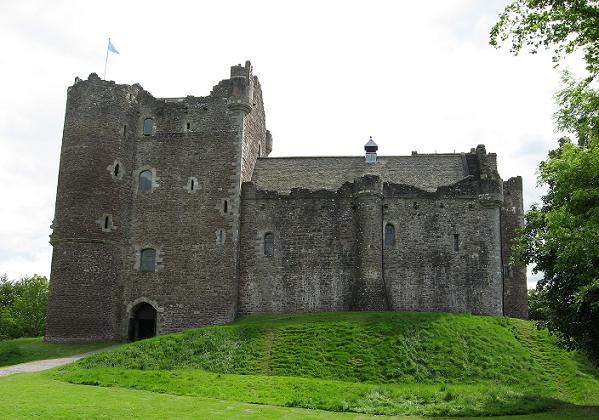
Doune Castle, north front
Contrary to most castles in Scotland that have been altered over the times, Doune is the product of a single building period and has survived relatively unchanged until today. Read more »
Ivanhoe has been there, Monty Python's knights in search of a grail, and Jamie Fraser and Claire Randall, the star crossed lovers from Outlander. Castle Doune, near Stirling in Scotland, has developed a certain sort of fame as film location (1).
In Outlander, the castle stands in for Castle Leoch, seat of Collum MacKenzie, chief of the clan, and his brother Dougal who is a supporter of Prince Charles Edward Stuart, better known as Bonnie Prince Charlie. It fits then, that in real history the castle was held for the prince by a McGregor of Glengyle in 1745.
If you are interested to see where Claire spent the first weeks after she went through a magic time-travel portal stone, follow me on a virtual tour of the castle:

Contrary to most castles in Scotland that have been altered over the times, Doune is the product of a single building period and has survived relatively unchanged until today. Read more »
21 Oct 2016
The Volcano that Burped - The Blue Dome near Eschwege
The Blue Dome (Blaue Kuppe) near Eschwege in northern Hessia is an interesting geological feature. It is a 10-12 million year old volcano that never really erupted but got stuck in the surrounding sandstone instead. The area was used as quarry from the 17th to th 20th century which shaped most of the bizarre rock formations. Today it is a Nature Reserve.

Blue Dome, view into the south bassin
We have to go back in time a bit. The uppermost rock layer in the area is sandstone which got deposed there during the Triassic period (250-200 million years ago). It's the same strata that can be found in other places along the Werra / Weser river - the Blue Dome is only a few miles from the Werra (1). Read more »
The Blue Dome (Blaue Kuppe) near Eschwege in northern Hessia is an interesting geological feature. It is a 10-12 million year old volcano that never really erupted but got stuck in the surrounding sandstone instead. The area was used as quarry from the 17th to th 20th century which shaped most of the bizarre rock formations. Today it is a Nature Reserve.
We have to go back in time a bit. The uppermost rock layer in the area is sandstone which got deposed there during the Triassic period (250-200 million years ago). It's the same strata that can be found in other places along the Werra / Weser river - the Blue Dome is only a few miles from the Werra (1). Read more »